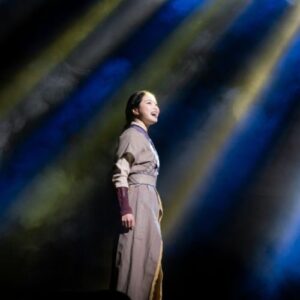
 Swag Age in Concert was performed at the Gillian Lynne Theatre, London.
Star rating: four stars ★ ★ ★ ★ ✩
Oppression of the masses by those in power is a tale as old as time. It also forms the basis of Swag Age, a Korean musical making its London debut as a one-off performance.
Billed as a concert, Swag Age is more of a fully-staged musical – just without much of a set, a couple of wooden platforms adorning an otherwise bare stage. Some standing remnants of the Gillian Lynne Theatre’s current production, My Neighbour Totoro, extend out into the audience, but the natural woods and structures feel appropriate for this fantasy tale set within Korea’s Joseon Dynasty.
The premise for this tale is that the old king has been assassinated. As his young successor ascends to the throne, his prime minister, Hongguk (Lim Hyun Soo), has decreed that the peasant classes may not use the country’s traditional poetic form of sijo, for fear it may be used to sow further dissent and rebellion. A young woman, Kim Soo Ha’s Jin, continues to teach the form to villagers in secret, while a mysterious masked troupe known as the Golbin Gang perform in public to ensure that the spirit of rebellion remains alive.
Much of that has to be pieced together over the musical’s running time, as Swag Age places us firmly into the action without much concern for exposition. Just as tales of Robin Hood assume some knowledge of the Nottingham outlaw and his merry men, and as Hamilton relies upon at least cursory familiarity with the American Revolution, one gets the impression that Swag Age is leaning on cultural context to fill in a lot of those blanks.
But no matter, because as the musical gets going, the characters’ place in the saga becomes clear. That’s helped by a charismatic performance from Yang Hee Jun as Dan, dissolute young man from a Northern village who is not much liked when he arrives to pay his respects to the grave of an uncle who was a despised tyrant. Some of the language in the English language surtitles is surprisingly direct in the villagers’ dislike, most often referring to Dan as a bastard (to which his reply, “How can I be a bastard? I’m an orphan!” is surprisingly entertaining) and, once, as a “wanker”.
But Dan brings with him a lack of respect for anybody – including the ruling Yangban aristocracy, which means that he ends up falling in with the Golbin gang, whose number includes Jin.
Lee Jeong Yeon’s music draws on Korean heritage with an infusion of modern hip-hop and K-pop beats. That’s also reflected in a choreographic style that includes some street dance and breakdancing alongside more traditional dance. Swag Age is no full-out, ZooNation-style hip-hop musical, or even a Hamilton reappraisal of history with modern beats – but the fusion feels natural and, at times, fun.
This is especially true when Hongguk announces the revival of the previously banned Joseon Sijo Contest as a means to try and flush out the Golbin Gang, just as the Sheriff of Nottingham may use an archery contest to flush out Robin Hood. The MC for the contest is gleefully anachronistic, in the sort of anarchic manner of the Shrek movies or Disney’s The Emperor’s New Groove.
But mostly, the story plays out as one would expect. The book by Park Chan Min (who co-writes the lyrics with Lee Jeong Yeon) sees Dan become less self-centred and obnoxious as he finds a cause to believe in. Both Yang Hee Jun and Kim Soo Ha deliver impressively powerful and emotional balladic solos.
When those are combined with the spirited ensemble performances, it is easy to see why Swag Age has been a hit in its native Korea. If it is to see more success outside its home country, some of those contextual clues might need a bit more expositional explanation. But its tale of the strength of people rising up against oppression – and of the critical place that the arts have in bringing people together – is universal.
Scott Matthewman
SHARE THIS POST:


Comments are closed.