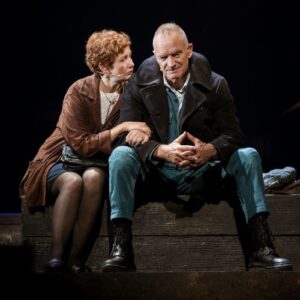
Jackie Morrison and Sting in The Last Ship at Theatre Royal Drury Lane, London. Pictures: Nienke de Groot
The Last Ship continues at Theatre Royal Drury Lane, London until 3 October 2026.
Star rating: two stars ★ ★ ✩ ✩ ✩
Labour relations have formed the backbone of many modern musicals to various degrees, from Made in Dagenham’s Essex car workers and Billy Elliot’s miners to the Northampton shoemakers in Kinky Boots and the plight of unemployed steel workers in The Full Monty. Granted, for some of those musicals the plight of the working class is a secondary story to the main plotline, but there is an omnipresent sense of the common man and their oppression by The Man.
Into this subgenre wades The Lost Ship, with music and lyrics by Sting and a setting inspired by his own childhood in the shipbuilding town of Wallsend. Set in the mid-1980s, the industrial storyline involves the creation of a huge ship, and the prospect that once it is completed no more government contracts will be forthcoming. With the future of the dockyard in doubt, the local union find themselves at loggerheads with both the Thatcherite trade minister and local man Freddy Newlands (Matt Beveridge), whose family owned the shipyard before its nationalisation and seeks to own it again.
Alongside the issue of how the local workers should react to this news, there is a tale of Declan Bennett’s Gideon, a Marine who returns to the town following his father’s death to discover that he has a 16-year-old daughter with ex-girlfriend, and now pub landlady, Meg (Frances McNamee). Sting plays shipyard foreman Jackie, who is dealing with his own mortality with the prospect of “test results” constantly brought up by wife Peggy (Jackie Morrison).
Oh, and there’s a quasi-supernatural, reggae-loving ferryman who crops up in multiple scenes, during most of which he plays no real part. On press night the role was played by Jamaican-American reggae musician Shaggy, for the remainder of the show’s run the role will be taken by Lejaun Sheppard.
That’s an awful lot of disparate plot strands, and pretty much all the reasons for which The Last Ship fails are down to its incapability to reconcile them all effectively. Many have tried, as can be witnessed by the show’s credits: the current book is credited to Barney Norris, from a book by Lorne Campbell which itself was based on the original book by John Logan and Brian Yorkey. If each iteration is intended to improve upon the previous, one can only shudder to think what state the book was in before.

Frances McNamee and Declan Bennett in The Last Ship
Here, the antagonists are paper-thin in Leo Warner’s production. Cassiopeia Berkeley-Agyepong’s trade minister is so sneerily and simplistically dismissive of the shipworkers that she feels more of a cartoon threat than anything approaching reality. Any attempt to make her position weightier and more serious would have helped to elevate the sense of peril we are supposed to feel for the Wallsend community. Instead, we get a politician so weak and caricatured that she makes Liz Truss look like a titan of politics.
Beveridge’s Freddy fares little better. There’s a setup at the beginning that he may be one corner of a love triangle, vying with Gideon for Meg’s attention, but that prospect is barely returned to until late in Act II, with not enough attention for us to care. His idea to try and save the shipyard might make for a challenging moral quandary, lending weight to a conflict between him and Joe Caffrey’s shop steward. Instead, there are a couple of scenes of them shouting at each other, neither really listening and certainly not getting the audience on side.
Thankfully, Sting’s songs elevate the story immensely. Over the last decades, the songwriter’s lyrics have got progressively denser than his earlier pop songs with The Police, and that desire for storytelling through song translates well to the crafting of many new songs. The singer is not afraid to reuse some of his own back catalogue – most notably, 1994’s ‘When We Dance’ changes tense to become the nostalgic ballad ‘When We Danced’ – but this is no jukebox romp through Sting’s works (for that, ZooNation’s incredible, and vastly superior, dance show Message in a Bottle remains the pinnacle).
The orchestra, which includes some onstage musicians complementing those in the Drury Lane’s pit, combines folk instruments familiar to the north east of England with a variety of musical styles and tempos, from soft-rock ballads to tango, waltz and even something approaching a polka. Gradually, one begins to notice a similarity of verse-chorus structure to many of the songs, though. Sting has a template and, while its reuse helps us identify his hand in the music, it also begins to grate once you notice how each singer’s line delivery slows in the phrases heading into a chorus.
With a large cast supplemented by a sizeable ensemble, it is perhaps surprising that Act I has barely any group choreography to speak of. Choreographer Rebecca Howell does get the chance to put the company through their paces in Act II, but by then we also have to deal with how the book is going to maintain interest in the shipbuilders.
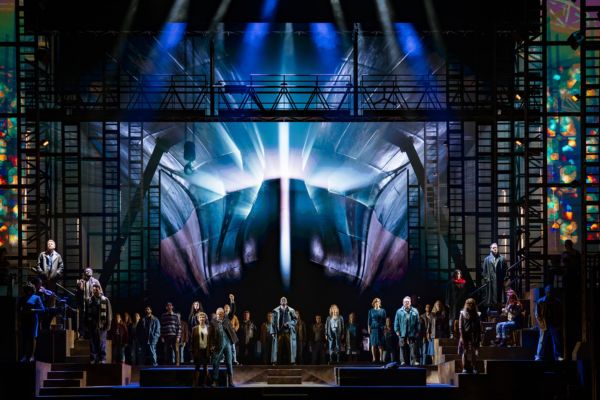
The ensemble of The Last Ship
Here, they decide to take over the shipyard and, rather than striking, instead work to finish the ship – which, despite being months behind schedule, they are apparently going to be able to make seaworthy in a single night. It’s all so oddly perfunctory – barricades around the shipyard gates go up and down in the space of a song, and the mystery of how the workers are going to get into the yard itself is solved by having the guards open the gates and walk off.
More interesting is the potential rekindling of the romance between Bennett and McNamee, although even then the book can hardly resist recycling old tropes. A more interesting subplot involves around the couple’s teenage daughter, Ellen (Hannah Richardson) who has inherited her mother’s strong will and her father’s desire to leave Wallsend, but even then its ability to be more interesting than anything else on stage is clearing a fairly low bar.
The nadir of the book has to be an Act II death which is so pompously overblown that it risks inadvertently becoming the funniest scene currently in the West End. Had any of these characters really earned a sense of connection with the audience, it might be more affecting, but here all the humans feel dwarfed on the Theatre Royal’s large stage.
What does feel suitably large is the ship itself. A full-height CGI backdrop shows the massive keel of the constructed ship towering over the people and houses of Wallsend. It’s rendered so beautifully with lighting changes turning the metal hull into a painting of ever-changing hues, reinforcing the curved shape so realistically that one can easily forget that it’s not a physical prop.
But when a piece of virtual set is the best thing about a show, you know there’s something wrong. The Last Ship wants to be a tribute to the working classes of Wallsend and places like it, left behind as British industry changed in the 1980s. Instead, it reduces them to little people, stuck in front of a screen that is far more interesting than the musical beneath it.
Scott Matthewman
SHARE THIS POST:


Comments are closed.