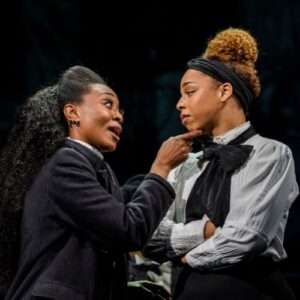
Beverley Knight and Naomi Katiyo in Sylvia at the Royal Albert Hall, London. Picture: Tristram Kenton
Sylvia: A Musical Revolution continues at the Royal Albert Hall, London until 15 November 2026.
Star rating: four stars ★ ★ ★ ★ ✩
As Act I of Sylvia came to a rousing close, with the dedicated members of the Women’s Social and Political Union (WSPU) performing the intensely moving numbers ‘March Women March’ / ‘Be the Change’ – a response to the Conciliation Bill of 1910 being blocked in Parliament – I scribbled in my notebook: ‘like a rally’.
Full disclosure: it wasn’t until after the show that I discovered just how fitting that description was. During the fight for women’s suffrage, the Royal Albert Hall hosted more than 20 suffragette rallies and some of the movement’s most significant speeches. It was also the venue from which those dedicated to the cause were banned between 1913 and 1918. Watching Sylvia bring its own powerful rally to the Hall therefore felt particularly poignant.
The way director/choreographer Kate Prince’s staging commands the attention of such a vast venue is testament to how far this contemporary, edgy and relevant musical has come.
With a book by Prince and Priya Parmar, lyrics by Prince and music by Josh Cohen and DJ Walde, Sylvia was originally staged as a work in progress at the Old Vic in 2018 before returning to the theatre as a full production in 2023. Now, the musical’s 2026 UK tour comes to a close in London at the Royal Albert Hall – a fitting finale for a production that has grown considerably in scale.
The piece follows the battle for women’s suffrage through the experiences of Emmeline Pankhurst and her daughters Sylvia, Christabel and Adela, from the formation of the WSPU to the passing of the Representation of the People (Equal Franchise) Act in 1928, which extended the right to vote to all women over the age of 21.
There is, however, a slight narrative imbalance, as Act II shifts quite quickly towards Sylvia’s story – not only her refusal to follow Emmeline and Christabel’s ideology and methods, but also her determination to improve the welfare and employment conditions of working people alongside the campaign for women’s suffrage. It is compelling to witness Sylvia forge her own path, but the transition comes at the expense of some of the characters we have come to know earlier in the piece, who increasingly become little more than ciphers. Emmeline, in particular, is presented in an increasingly unsympathetic light.
There is also a case for some further trimming and refinement of the libretto and score to sharpen the pace and flow of the storytelling. At times, Sylvia feels as though it is trying to cover an enormous amount of ground – not only the individual stories and changing relationships of the Pankhurst family, but also the wider social and political upheaval taking place around them. There is fascinating material in all of it, but the sheer breadth of the story occasionally comes at the expense of focus. That said, the refinements already made are clearly having a positive impact.
The score’s combination of soul, funk and hip-hop inevitably invites comparisons with Hamilton, and there are certainly stylistic and thematic crossovers. However, Sylvia has a distinctive musical identity of its own.
When all the creative elements combine with the jaw-dropping energy and expertise of this exceptional cast, Sylvia becomes a very special theatrical experience, and one that feels capable of inspiring a new generation of theatregoers.
The black and white palette of Ben Stones’ minimalist set and costumes serves both character and narrative, while feeding into the varied musical signatures and styles of the score. Add Natasha Chivers and Hector Murray’s striking lighting design and Andrzej Goulding’s video and animation – often like works of art in their own right – and the production reaches another visual level.
Surprisingly, the Royal Albert Hall’s acoustics did not always seem to do the production any favours, especially in the early stages. With dialogue and lyrics delivered at such a speed, some words were difficult to catch, although the sound did seem to settle as the performance progressed, allowing the orchestra, led by musical director Sean Green, to let rip.
One of the clever things about the musical’s book and casting is that, while some of the male characters are deliberately somewhat cartoonish, they are by no means all stereotypes. Tachia Newall is particularly effective as Keir Hardie, while Ivano Turco brings charm to his performance as Sir Almroth Wright.
It is, of course, the women at the heart of the movement who leave the most lasting impression, both as a vibrant ensemble – stunning in their execution of Prince’s sharp, dynamic choreography – and individually.
Kelly Agbowu is a formidable presence as Mrs Flora ‘The General’ Drummond, Kirstie Skivington brings warmth and determination to Adela Pankhurst and Ellena Vincent makes her mark as Christabel. Collette Guitart also has wonderful presence as Clementine Churchill, coupled with a striking vocal performance.
It feels like a privilege to see Beverley Knight reprise her Olivier Award-winning role as Emmeline Pankhurst. Of course, her vocals are goosebump-inducing, but she deserves continued recognition as a fine stage actress and a commanding leader of a company. It is quite something that Naomi Katiyo, as Sylvia, holds her own so convincingly alongside her, particularly given the force of Knight’s presence. When Sylvia breaks away from her family later in the story and is given the space to tell her own story, Katiyo’s performance goes up another notch.
The scale of the Royal Albert Hall has many advantages, but it also means that a large proportion of the audience members are seated some distance from the stage, which can create an emotional disconnect. I found myself wishing for the opportunity to be closer to the action and experience more directly the intensity of the dramatic work unfolding on stage.
And yet, there is no denying the impact of such an inspiring story on those present. Once this electrifying cast delivered their final numbers, urging us to ‘Stand Up’, the ovation that followed felt inevitable. In a venue so steeped in the history of the suffrage movement, it was a fittingly powerful way to bring Sylvia’s tour to a close.
Lisa Martland
SHARE THIS POST:


Comments are closed.