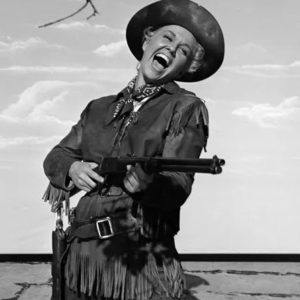
 American actress and singing star Doris Day has died aged 97 (3 April 1922 to 13 May 2019). She enjoyed a long career of more than 50 as a performer and has outlived all her leading men. She had a great career but one that didn’t always run smoothly, mainly because of the leading men in her private life, her husbands, who were less than ideal partners. Michael Darvell looks back at the life of a great movie icon…
So, how do we remember Doris Day? She had such a long career during which she possessed the knack of reinventing herself, so that we need to remember her from the many different aspects of her life and career. It could be that this was the secret to her longevity – despite all the setbacks that life threw at her, she never gave up, but simply came back and got on with the next job in hand.
At first there was Doris Day the potential dancer, then the popular band singer of top ten hits, then the radio host, the movie actress, the musical comedy film star, the dramatic actress, the rom-com star, the television personality and finally the carer who created the Doris Day Animal Foundation, and who devoted the last years of her life to animal welfare.
Doris Day was born Doris Mary Ann Kappelhoff in Cincinnati, Ohio, on 3 April 1922, the daughter of William Kappelhoff, a music teacher, and his wife Alma, but the marriage did not last long. When her parents separated Doris lived with her mother. She was the youngest of the family’s three children. Her brother Richard had died before Doris was born and Paul was a few years older than her.
As a teenager Doris was interested in dancing and she formed a dance act with her friend Jerry Doherty. However, in a bad car accident Doris broke her leg and her potential dancing career was over. Instead she turned to singing along with the bands playing on the radio. She was influenced by the way Ella Fitzgerald sang, so her mother arranged singing lessons for her daughter who eventually got bookings on a radio show and at a local restaurant.
Doris was finally discovered by band leader Barney Rapp who suggested she change her name to Day. She also worked with other bands including Jimmy James, Bob Crosby and finally Les Brown and His Band of Renown with whom she toured at age 17. Her first hit record was ‘Sentimental Journey’ in 1945 and following that she had another six chart hits after the Second World War as her popularity increased. She also appeared on Bob Hope’s radio show and when composer Jule Styne heard Doris he and his lyricist partner Sammy Cahn secured her a part in the Warner Bros film Romance on the High Seas with Jack Carson. In the UK the film was called It’s Magic after the movie’s hit number. After this her film career then took off in a big way.
 Doris made another two films with Jack Carson, My Dream Is Yours and It’s a Great Feeling, then did Young Man With a Horn with Kirk Douglas, Tea for Two with Gordon MacRae, The West Point Story (aka Fine and Dandy) with James Cagney, Lullaby of Broadway with Gene Nelson, On Moonlight Bay and By the Light of the Silvery Moon, both with MacRae again, I’ll See You in My Dreams with Danny Thomas, April in Paris with Ray Bolger, culminating in her biggest success, Calamity Jane in which Doris had the title role opposite Howard Keel as Wild Bill Hickok. Written for the screen the film had a clutch of great songs by Sammy Fain and Paul Francis Webster including ‘The Deadwood Stage’, ‘Just Blew in from the Windy City’, ‘I Can Do Without You’, ‘My Heart Is Higher Than a Hawk’, ‘The Black Hills of Dakota’ and, of course, ‘Secret Love’ which won an Academy Award.
Although Doris made more musical films – Lucky Me with Phil Silvers, Young at Heart with Frank Sinatra and The Pajama Game with John Raitt, she wasn’t above showing her dramatic talents in Storm Warning and The Winning Team, both with Ronald Reagan, Love Me or Leave Me, opposite James Cagney in a musical drama about singer Ruth Etting, in Julie with Louis Jourdan, and in Hitchcock’s remake of The Man Who Knew Too Much with James Stewart and the song ‘Que Será Será’ which was another Oscar winner for Doris.
With the musicals out of the way Doris embarked on a stream of comedies, beginning in 1958 with Teacher’s Pet opposite Clark Gable, then The Tunnel of Love with Richard Widmark, It Happened to Jane with Jack Lemmon and Please Don’t Eat the Daisies with David Niven. Then came the first of a very popular run of rom-coms with Rock Hudson, namely Pillow Talk, Lover Come Back and Send Me No Flowers. This series of comedies also included That Touch of Mink with Cary Grant, The Thrill of It All and Move Over Darling with James Garner, and Do Not Disturb and The Glass-Bottomed Boat with Rod Taylor.
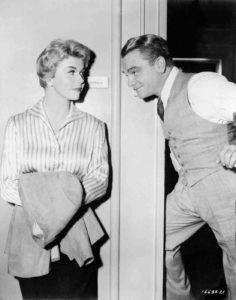 In between these films Doris appeared in Midnight Lace, a thriller with Rex Harrison, and Billy Rose’s Jumbo, her last musical film with Jimmy Durante and Stephen Boyd. A few more movies followed until 1968 when Doris made her last cinema film, With Six You Get Eggroll, the title of which was probably the funniest thing about the production. By then her genre of film making, playing the eternal virgin, was out of fashion, so that when she was offered the part of Mrs Robinson in The Graduate, she turned it down. It just wasn’t her style at all.
Throughout her acting career Doris carried on recording songs and made over 20 albums and several hit singles. She sang and recorded the title songs from many of her comedy films, some of which were chart hits. From her first success with a recording of ‘Sentimental Journey’ in 1945 through her many other recordings, she remained popular over the years. As late as 2011 she released the My Heart album, her first new album since The Love Album in 1994, which was a compilation of tracks previously unreleased that her son Terry Melcher had produced before his death in 2004.
Doris was married four times. As a teenager she married jazz musician Al Jorden in 1941 but, following his abuse of her, they were divorced less than two years later after their son Terry was born. Doris then married another musician, George Weidler, in 1946 but they divorced three years later. Husband number three was Martin Melcher who produced many of Doris’ films and also adopted her son. They were married for 17 years but when he died in 1968, she discovered that he had lost all her money through bad investments and she was left virtually penniless until she recovered some funds through the courts.
Without her knowledge Melcher had contracted Doris to host a television show which she did for 128 episodes even though she didn’t want to. Her fourth husband was Barry Comden, a restaurant maître d’, from 1976 to 1982, but according to Comden Doris was more interested in her animals than her marriage. After quitting show business, she set up the Doris Day Animal Foundation in Carmel, California, where she cared for all kinds of animals right up to her death.
Doris Day had several very successful careers – as a band singer, as a radio show host, as a movie star in musicals, comedy and drama, as a popular recording artist, as a television host and producer, and finally as the creator of a charity that puts animals first. Apart from the 40 odd films and umpteen music recordings, her charity is another legacy to survive from the all-American girl who became a great US ambassador not only for Hollywood but also for animal welfare throughout the world.
Michael Darvell
SHARE THIS POST:


Comments are closed.