 The European premiere of Unexpected Joy, opening this week at the Southwark Playhouse, tells the story of three generations of female singers and their week together to try and clear some long-held family feuds.
Joy is a baby boomer pop star, who lived the hippie life and is now preparing for a concert to honour her late husband. Her conservative daughter comes to visit with her granddaughter and Joy is reluctant to tell her that she is planning to marry again but this time to a woman.
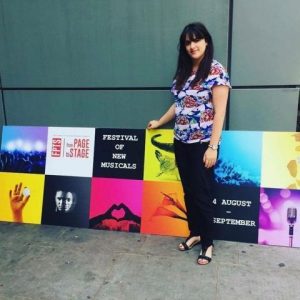
During the show’s run, From Page to Stage, founded by the show’s producer, Katy Lipson, will also showcase seven new musicals.
From Page to Stage is an international festival giving new writers the opportunity to showcase their work at various stages of development. The programme is now its sixth year.
Here, KATY LIPSON is in conversation with Musical Theatre Review’s Tal Fox.
How does it feel to be involved in the European premiere of Unexpected Joy?
It’s extremely exciting whenever you do any new piece of musical theatre but even more so for this piece because I’ve been a huge fan of writers Bill Russell and Janet Hood growing up, as a teenager and as a musical theatre fan, so to be working them as artists and on their next piece together is quite rewarding.
I was involved with the production Off-Broadway but this is a whole new reincarnation of it with the British production. It’s very unique to be able to do that, to look at a piece and to do it in two different places.
In what ways have you changed it for the UK performances?
Everything really, the whole set design, the actors. These things are all about the company so by having four different actors, it changes so much about it. We’ve gone for very different castings for some of roles so it opens up a whole new idea for it.
The space of Southwark Playhouse is so different to the York Theatre, Off-Broadway, so we can create an intimacy and make it immersive in the sense that the audience is nearer the company and the action. I think all these things are quite exciting for a British audience as well because these characters will mean something slightly different to them depending on where the production is on.
What sparked your interest in this show?
I wanted to form a strong collaboration with New York and actually start looking at a way to bring shows from there to London and vice versa. I was looking and speaking to the director Amy Anders Corcoran and producer Jim Kierstead about what they were working on which is when they brought this to my attention.
I immediately loved how small it was because the telling of a story is very different way when you’ve only got four characters and I loved the fact that it was four women. I loved the songs, having been such a fan of Janet’s, and I loved what the show was about, the story, the message. I liked the characters and how they were drawn out. I just thought it was a really enjoyable piece of theatre that people could really get behind and emotionally connect with as well.
 Is there a particular moment that stood out for you in the show?
Well, without giving too much away, there’s a lot of family dramas and a lot of things come out, but you have empathy for the granddaughter, the daughter and the grandma, you can understand all of them and where they’re coming from. It’s quite heartfelt, it’s quite eye-opening, it can be taken at the level of being quite light-hearted and it’s really got a strong message. It’s all about prejudice and acceptance, the way of the world and free love.
The roles are reversed, you’ve got this hippie living grandma and you’ve got this conservative daughter, and it’s almost playing around with the roles when the daughter is actually shouting at the mother, it’s interesting, I’ve never quite seen that before in musicals. I like that it doesn’t take itself overly seriously but it has great heart and these wonderful women on stage.
It feels like a play but there are about 16 songs in it and the songs are all framed around a concert style, so although the character is giving a concert in memory of someone, the songs have hidden narratives within them as well as being exposition or a song you can just lose yourself in and enjoy and that’s quite unique too.
It’s a good device for storytelling when it’s framed like that and that’s what Janet Hood is so brilliant at, she writes wonderful songs. It’s an album of songs regardless of being Unexpected Joy – The Musical. The songs could all be on their own without any sort of reason, it could be a pop album. As a producer I know very quickly if I want to do something, and everything I’ve worked on is something that I would love to watch, so I tend to make that decision very quickly. But then I look at all the things that are difficult about it and why am I doing that production, what are my limitations and how am I going to overcome them. When trying to do a big show in a 100-seat venue it’s always the same issue.
Was it important to you to find a show with a strong female lead cast?
Yeah, I’m a big supporter of that and I always have vast numbers of female creatives working on my shows. I’ve done another couple of shows with female casts, one was Lizzie the rock musical with four women, and the other was Vanities, which had three ladies at Trafalgar Studios. I’m drawn to chamber work, I’m drawn to work that is not instinctive for the proscenium arch, work that is telling different sorts of stories and it’s lovely to hear female voices on stage, especially contemporary voices. When you get sent a lot of work, it stands out.
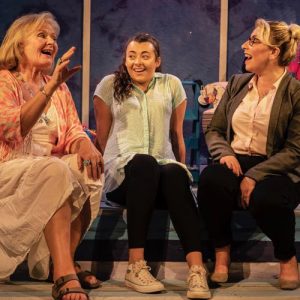
Janet Fullerlove, Kelly Sweeney and Jodie Jacobs in Unexpected Joy at the Southwark Playhouse. Picture: Pamela Raith Photography
When is the show set and is this particularly important to the plot?
It’s set in the modern day but it’s looking back at the series of music from Joy’s collection so it also emulates a more 70s style as well because that is when they were famous singers and songwriters, so there’s an homage to that. I think in order to understand where Joy came from, the way she was, how wild she was as a young woman when she had her child and the person she became. I think it all makes sense that she was a hippie because it explains a lot about her. In hindsight, with a few changes, it could be set at another time, absolutely. It deals with gay marriage and free love and people’s judgements on that, it does feel quite timely.
I think it is a good time because of where we’re at as a society. I do think pieces can feel very topical and they can respond to people because of that, I think that has something to do with a lot of commercial success of musicals. I do think that this works in the genre, in terms of it being set now and she was in her 20s during the late 60s to 70s.
What more can you tell us about the story?
What you can’t really get a sense of when you just read the blurb or a poster is how the music and the show interacts. What’s quite thrilling is you can watch it as if you’re watching Joy’s gig and she’s celebrating all the music that she wrote with this man, but as the show progresses you’re learning so much about her relationship with her daughter, her granddaughter, her new lover.
It’s a show that you don’t expect necessarily to make you instinctively feel so much, so much emotional connection, maybe even anger. Some of the things that the daughter says could anger a lot of people because she’s not very accepting of her mother’s new love and she’s judgemental. It’s actually quite dramatic, although it’s framed around a very chilled atmosphere – you can sit back and enjoy the concert but it’s got a lot more to it.
I think people will fall in love with these characters, I think there’s a potential for people to want to see more of them. It’s almost like we’ve created the beginning of a sitcom on television and we want to see more. I always say that Joy reminds me of Frankie from Grace and Frankie, it’s something you want to see more of.
That’s the premise of the plot, what you see on the back of the flyer, but these characters are vibrant, warm and sensitive and they’ve got so much to say in a 90-minute, one-act musical with 16 songs. It’s about 45 minutes of music and 45 minutes of script, there’s a lot inside and I love that. I love when you can become part of someone’s world and that’s what you can’t get until you’re in the room seeing it.
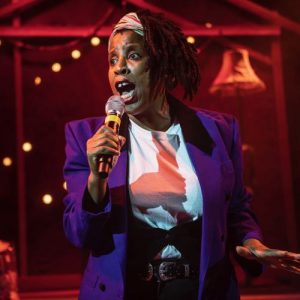
Melanie Marshall in Unexpected Joy. Picture: Pamela Raith Photography
What were rehearsals like?
For the first week of rehearsals, I leave my cast to it because they don’t want the pressure of having the producer there. Amy was here redirecting, well not redirecting, looking at it fresh with Gareth who is our MD. He’s a wonderful MD, I’ve worked with him on Hair, Spring Awakening and Aspects of Love and they were creating magic in the room.
The women are amazing, they have really connected with each other and the piece. I heard fantastic feedback from Amy and Gareth Bretherton every day. I was there for the casting and I chose the designer, the lighting, the sound, just getting all those things sorted in terms of production and leaving them to make magic in the room really because that’s their job. I put those wonderful people together and knew they would do something great. I just popped in as and when they needed me to answer questions about the boring things like budgets and schedules.
They explored these characters and at one point we had a huge chat about these characters for about two hours and it was amazing hearing from these women about what they loved about their roles, what they found weak about their characters. Hearing how actors respond to material is quite brilliant because if you see something in someone and then you see a cast responding, it just validates every reason why you chose that piece and why it’s important to be heard.
Where do you see the industry headed in the battle between new writing and revivals?
I think we all have to realise that revivals only go so long, a revival can only revive a little bit of people’s curiosity and new audiences don’t necessarily keep going, that’s the thing about them, they don’t have that staying power of taking off again.
It’s all about the new, in terms of the limitations of the potential to develop musicals in the UK, we know we’re suffering of a backlog of not supporting it. Without a constant strong subsidised sector backing the genres, it’s difficult. We don’t have the spaces, we don’t have the additional funding, we don’t have enough of it for audiences to understand it as normal. They’ll only understand it’s normal to see a new musical when it’s done often, when we have the Royal Court, the National and the Hampstead. We just don’t have that so it’s harder to build up a bigger audience.
I think it’s going to be tough over the next ten years to establish those new voices in this country that fit outside the box a little bit. In the US it’s a much bigger market, much bigger infrastructure, more of the buildings and the brands, not to mention the better training ground for having more talent pools of writers that get commissioned so that the writers can hone in on their craft and get better.
What I want to do is try create a world for shows outside of the proscenium arch and the West End that could maybe be commercial because the difficulty is, if it’s not the Fringe and it’s not on tour, it’s the West End and actually so many shows wouldn’t work in the West End and wouldn’t find their heart there.
That’s the issue, a lack of space, a lack of subsidy, a lack of audience awareness but it is changing, it is a lot better than 12 years ago. But I think in the next 10 years we might just get a little bit more exciting, but it takes a lot of commitment and risk to do that, and I don’t know how many people are passionate enough about that. You either see the obstacles approached in the same way because many producers are multi-genre, which is amazing, but when you just do musicals, you notice it much more.
 But you’re hoping to work on this through From Page To Stage?
From Page to Stage was set up six years ago to do that, but also as I knew I was passionate I thought: what’s the easiest way for me to meet new artists, read their work, see their work, get to know them and either produce or commission that work? In between Unexpected Joy we run some new musicals on the Monday and Tuesday. We have three readings, three new musicals and a showcase of another four, so seven new shows will be showcased on top of Unexpected Joy through these four weeks we’re at Southwark Playhouse.
In what ways have you seen it evolve since you started it?
It definitely has for many reasons. One, I became more experienced as a producer, so my expectations of what I was looking for changed – how I ran it, where I fundraised, the location of it. Ultimately, I have now supported maybe 100 shows. At the beginning it was funded by the Arts Council as well, I was trying to give a voice to something that wasn’t traditional or necessarily commercial. I would never ask for ownership to take the show, I would be allowing those artists the chance to play around with their piece with a fully-paid cast and crew too. That allows me to position myself in a marketplace where I would get good work and continue to find good writers and investors and it introduced me to the industry.
As someone very passionate, it’s important to establish what your ground is and who you are and what you’re about. One of the questions everyone asks is: “Have you found a Hamilton yet?” “Is anything you’ve discovered on the West End?” Let’s be realistic, name a British musical that isn’t Matilda or Billy Elliot in the last ten years and Everybody’s Talking About Jamie now, that’s gone from page to stage that quickly and become something, that didn’t have a subsidised company behind it.
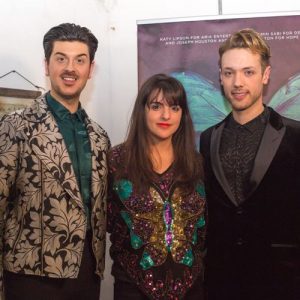
Championing new musicals at the Hope Mill Theatre in Manchester: Joseph Houston, Katy Lipson and Will Whelton. Picture: Nikki Cotter
So it’s not that I’ve been looking for the next Hamilton but it taught me a lot, it taught me a lot about the industry, about the quality of writers, about the audience and about the support for it. Last year it was The Other Palace – being at that theatre and Andrew Lloyd Webber speaking so highly of new musicals got a tremendous amount of press and it was incredible.
This year, we’ve downscaled a little bit because I’m doing so many other things, I can’t commit to four weeks and 28 shows, which is what I did last year. We moved to Southwark Playhouse knowing I was doing Unexpected Joy and it felt like the perfect time to do both there. It’s lovely because at the same time I’m running The Return of the Soldier at the Hope Mill Theatre in Manchester. It’s one of the first readings I produced for From Page to Stage in 2014 so it’s gone on this wonderful journey now back to the stage and it just shows how everything comes full circle.
What would someone need to know if they wanted to get involved in the future?
When we do open our doors, if you’re a writer and you’re connected with the Writers’ Guild and Mercury Musicals or MTN, you should hear about this festival and it will be heavily advertised to theatrical outlets. You could go onto the website and read all about it and submit your application, send a scene, send three songs and send a little bit about you, and then you wait for our team to read it. If we were interested in seeing more, we would write to you, and if not, we’ll say: “Unfortunately we’re not pursuing this as a reading, this time.”
Obviously, it’s competitive, we can only have five to six shows out of 150, but you may as well send it in. There’s not many open submission policies around in the UK for musicals. I would say, if you are interested in this business then make sure you’re on these newsletters to hear about these opportunities.
* Unexpected Joy continues until 29 September 2018
* From Page to Stage runs from 11-25 September 2018
SHARE THIS POST:


Comments are closed.