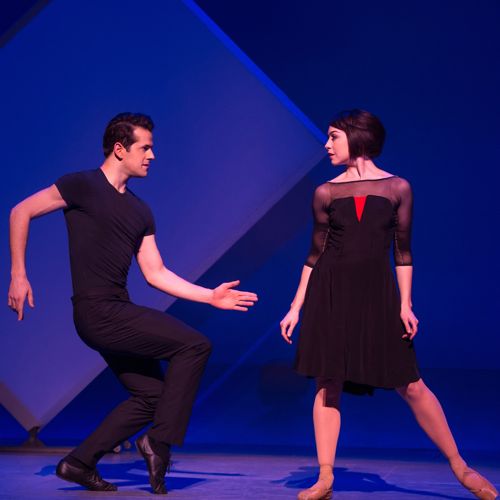
Robert Fairchild and Leanne Cope in An American in Paris at the Palace Theatre, New York. Picture: Matthew Murphy
An American in Paris continues at the Palace Theatre, New York.
Star rating: 5 stars ★ ★ ★ ★ ★
After its brief world premiere engagement this past winter in the city of its title, An American in Paris has arrived on Broadway, uncorking an intoxicating brew of glorious dance and gorgeous music.
Don’t expect too much of the unfettered Technicolored gaiety that marked the 1951 Oscar-winning, Gene Kelly-Vincente Minnelli movie musical on which the show is based. Director-choreographer Christopher Wheeldon, a pillar of contemporary ballet, has reworked the property pretty much from top to bottom, and he makes it an exhilarating adventure to share.
To be sure, there’s still a grand serving of George and Ira Gershwin tunes to savour. However, some songs featured in the movie have been jettisoned – such as the lilting ‘By Strauss’ and the almost-signature ballad ‘Our Love is Here to Stay’ – and others from the Gershwin catalogue added in their place. The newcomers include pantheon standards such as ‘The Man I Love’ and ‘But Not for Me’, as well as such lesser heard tunes as ‘Fidgety Feet’ and ‘For You, For Me, For Evermore’.
For the songs that remain, Wheeldon has created imaginative new settings or production numbers, including the climactic ballet performed to Gershwin’s ‘An American in Paris’, the symphonic tone poem that inspired the movie. It now has a more abstract balletic style (a style that dominates the show’s dancing), and it unreels in breathtaking synch with the music, as it depicts love found and lost.
Moreover, playwright Craig Lucas has darkened and extended, if not exactly deepened, the slim plot lines of Alan Jay Lerner’s screenplay. The timing of the story has been moved back from circa 1950 to 1945 and the immediate end of the Second World War. There’s significant mention of Nazis, collaboration and resistance, things totally absent from the film.
Romantic entanglements, however, remain the nexus of the tale. Jerry Mulligan, an American soldier, stays on in Paris after discharge, aspiring to become a painter. He’s taken under the wing of a dilettante American heiress with amatory ambitions, but Jerry has fallen in love at first sight with a Parisian shop girl named Lise, who, unknown to him, is being courted by his French pal, Henri.
Lucas adds to the romantic quadrangle by having Max, Jerry’s American buddy in Paris and an aspiring composer always ready with a cynical quip, also fall in love with Lise. Furthermore, in Lucas’ redo, Lise is a Jew, who was kept safely in hiding by Henri’s family during the Nazi occupation of Paris. She’s also a ballet dancer, providing a rationale for a lot of the show’s dancing. There’s a dramaturgical cleverness to Lucas’ work, although his script is unfortunately punctuated with such truisms as “Money can’t buy love” and “True love is more important than art”.
Still, what’s most important in this Broadway bonanza is Wheeldon’s singular vision as a creator of musical theatre and the exceptional cast and creative team he has led in realising that vision. Among his main creative collaborators are designer Bob Crowley and music adapter, arranger and supervisor Rob Fisher. Crowley’s brilliantly original sets and mood-setting costumes – along with the projections of 59 Productions and the lighting of Natasha Katz – evoke with genuine emotion the sense of a majestic city coming to life again after the ravages of war. Under Fisher’s aegis, Gershwin’s music, played by a 19-piece orchestra, crackles with genius, vivacity and freshly discovered motifs. From start to finish, it seems to elevate the impressive talents of the cast, both principals and ensemble.
In the title role, Robert Fairchild, a principal dancer of the New York City Ballet, reveals himself to be a triple-threat of high order. He vocalises with Broadway panache, his dancing has gargantuan power, and his acting is convincing, whether he’s playfully pursuing Lise with such songs as ‘Liza’ and ‘I’ve Got Beginner’s Luck’ or seriously fending off the advances of his wealthy patron.
Leanne Cope’s Lise is also wondrous. Coming from the Royal Ballet, Cope is the essence of gamine, dances like a sylph and sings quite prettily. Her wistful rendering of ‘The Man I Love’ is haunting.
Terrific work also comes from Brandon Uranowitz as Adam and Max von Essen as Henri. When the two join together for ‘I’ll Build a Stairway to Paradise’, accompanied by feather-bedecked showgirls and gents in white tie and tails, it’s a lift-you-out-of-your-seat gaudy showstopper. And certainly after all that great ballet they’ve already seen and with the ‘American in Paris’ dance sequence still to come, a Broadway audience can always use a big tap number.
As it was in the movie, the role of Milo, Jerry’s free-spending patron and wannabe paramour, is probably the most problematic element in the script, but Lisa Paice meets the challenge with a nice sense of chic and solid singing. Not in the movie, but adding laughs to the stage proceedings, is Henri’s pretentious mother played with a well-tempered comedic sense by Veanne Cox.
Summing up, Christopher Wheeldon’s version may not be your grandmother’s An American in Paris, but it’s sure to make her – plus all of your relatives – ecstatically happy.
Ron Cohen
SHARE THIS POST:


Comments are closed.