Picture: Rich Southgate
The Pianist continues at the Park Theatre, London until 28 November 2026.
Star rating: five stars ★ ★ ★ ★ ★
Many first encounters with Władysław Szpilman will have been through his acclaimed 1946 memoir The Pianist or the 2002 Oscar-winning film adaptation starring Adrien Brody. Hailed as the “Polish Gershwin”, Szpilman was a Jewish pianist, classical composer and Holocaust survivor. His story of the breakdown of society during the German occupation of Poland and his narrow escape from the horrific fate of so many Jews in the Warsaw Ghetto is nothing short of remarkable.
What is so beautiful about this new stage adaptation of his story, however, is the way it centres that other remarkable part of Szpilman’s life: his music. Adaptor and director Thom Southerland has shaped this production around Szpilman’s compositions. Various lyricists – including the composer’s own son Andreas – have been drafted in and the resultant piece feels far more like a cohesive book musical than you might expect.
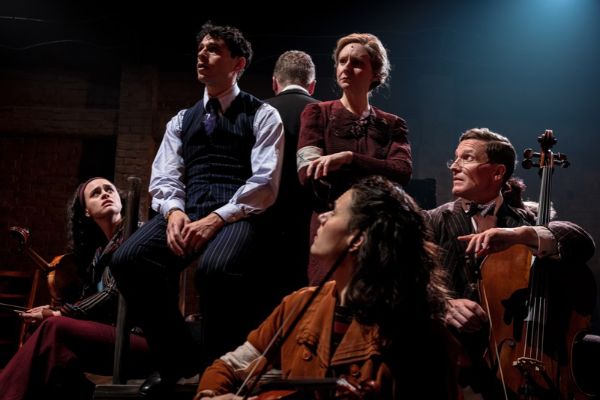
With a 12-strong cast of actor-musicians, the show sounds incredible. Though amplification is used for reinforcement, it is not overbearing. Instead, the organic sound of the all-acoustic mini-orchestra is allowed to shine through. Kudos to musical supervisor Simon Lee for the incredible arrangements.
Daniel Krikler takes on the lead role with a commendable command of the room. His take on Szpilman is brilliantly balanced: respectful, but not to the point of ironing out the wrinkles that make a character feel human. His is a recognisable portrayal of a creative genius. Not an impossible alien, but a relatable man with doubts, insecurities and foibles. A superb performance.
Elsewhere, Rosalind Ford, TJ Holmes, Nitai Levi, Elżbieta Kalicka and Melania Maggiore are a wonderfully tight five-piece band as the Spilzman family. Their joking and bickering is a delightful inclusion in what could otherwise be a pretty heavy show. Ford also treats us to the song most likely to break out of this show and find its way into common repertoire: ‘Someday We Will Love Again’ in a gorgeous and joyous moment of hope.
With a much smaller budget and cast than a feature film, some sequences lean more towards ‘tell’ rather than ’show’. However, in the intimate space of the Park Theatre, this only builds connection with the audience. Andrzej Goudling’s set features clever use of a large wooden gate which transforms into everything from a ghetto wall to a train carriage to a burning apartment building with the help of tasteful projections.
At the centre of proceedings is a wheeled island, atop which sits an immaculately polished Yamaha baby grand piano: an impossible to ignore reminder of the civilised world beyond the ugly fascism and putrid conditions faced by Polish Jews. Indeed, Krikler regards it with awe and angst, unable to face the reminder of what has been taken away from him and his people.
In those darkest days of the Holocaust, reminders of the past and reminders of happiness are painful. When piano accompaniment is called for, these duties are handled by Malcolm Forbes-Peckham in classy coattails. His performance of Szpilman’s strikingly modern and beautiful piece ‘The Life of the Machines’ is a highlight of the entire show. As bombing began, Szpilman was in the middle of playing Chopin’s ‘Nocturne in C# Minor’. At the hopeful and tear-jerking ending, this piece is reprised and played in full. Only by the end of the story, when the allies have liberated Warsaw, is Krikler reunited with his instrument to finally fully embody the man he is playing.
As tragic as it is that this story should still be urgent and timely when the horrible events depicted are still in living memory, sadly, that is the situation in which we find ourselves. This is a vital story, and a tearful standing ovation suggested it remains a powerful account of one of humanity’s darkest periods. An additional blessing is that those hearing it for the first time, will do so while also discovering Szpilman’s gorgeous musical compositions. The Pianist is an astounding work that will stick with its audience long after their journey home.
Ian Bowkett
SHARE THIS POST:


Comments are closed.