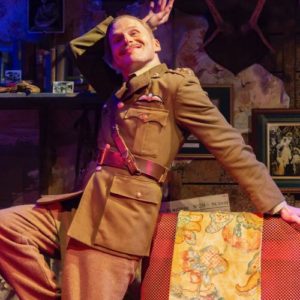
Charles Aitken in Billy Bishop Goes to War at Southwark Playhouse, London. Picture: Nick Rutter
Billy Bishop Goes to War continues at the Southwark Playhouse, London until 6 April 2019.
Star rating: four stars ★ ★ ★ ★ ✩
The great thing about an intimate venue like Southwark Playhouse is that you can’t help but get whisked away into the time, place and story that’s laid out before you. For this show, walking by the set to get to your seat is like walking through a portal that takes you back in time.
Billy Bishop Goes to War opened in Canada in 1978 and has since become one of the most popular plays to be produced across Canadian theatres. In its first life, the show had one actor and one piano player but for this reincarnation, director Jimmy Walters decided to reimagine the show by having the piano player also take on the role of older Billy looking back at his life. Now the two actors share something like 17 roles between them.
Veering from the traditional First World War stories where we’re looking up from the trenches, this show provides a fresh angle so audiences get a new view from the sky. We follow the true story of a celebrated Canadian war hero who became the number one pilot of his generation.
Anyone who has ever studied the First World War at school will remember that people believed that this would be a ‘Great War’ and ‘The war to end all wars’, and as the show begins, there’s a definite sense of that.
Both Billys sing about going off to war and how it “looked like lots of fun.” But from the moment they leave Canadian soil the harsh realities become evident. Once they reach British soil, it’s clear that they are from the colonies rather than part of this British unit.
Charles Aitken as younger Billy (and several others) has an incredible energy and charm that make it impossible to take your eyes off of him. He bounds into the audience on several occasions and sometimes even engages with individual members. It’s also great to check in with Oliver Beamish as older Billy, but he gets to engage more as several other characters too – butler Cedric being a particular favourite.
While there is plenty of humour along the way, one thing that really sticks out is how quickly the enemy becomes dehumanised as the war goes on. While in Act I we get a cocky yet endearing kid, Act II is more of a reflection on how war has affected everyone involved in a much-needed moment of contemplation.
It’s an incredible story, although how true it really is has come into question over many years. But if you’re willing to leave the scepticism to one side, it’s a rather remarkable history. By the time you get to the end it’s clear that no one intends on glorifying war. It’s a fascinating story told with the right level of charm, humour and poignancy.
Tal Fox
SHARE THIS POST:


Comments are closed.