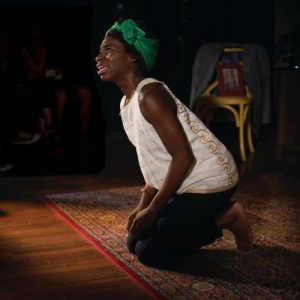
 Black is the Color of My Voice continues at the Cromdale Theatre, Pleasance at the Edinburgh International Conference Centre, until 14 August 2021.
Star rating: five stars ★ ★ ★ ★ ★
The spirit – and sound – of Nina Simone is ever present in Apphia Campbell’s timely one-woman show, which recounts the tale of a black singer whose story closely mirrors that of the legendary, if troubled, ‘High Priestess of Soul’. Written and performed by Campbell, it’s a powerful exploration of a black woman’s struggle… to find herself, her sound, her purpose and her power, during a particularly tumultuous time in the civil rights movement.
The concept of the hour-long monologue is that Mena Bordeaux is holed up in a hotel room on a three-day detox, rummaging through a suitcase of memories to distract her from the telephone, booze and cigarettes. As she addresses a cherished portrait of her dead father – a man she clearly loved and revered – she revisits turning points in her life, from childhood to present day, seeking some kind of redemption and self-realisation.
Mirroring Ms Simone – who was born Eunice Waymon in 1933 – the character starts life as Eugenia: a precocious young pianist who’s bewitched more by Bach than Basie. Her god-given talents soon see her booked to give her first classical recital, and it’s here that she also encounters her first taste of racism, as her Methodist parents – quietly resigned to the reality of racial inequality – are sent to the back of the hall. In a defiant gesture that would be repeated throughout her life, the furious Eugenia refuses to play until her parents retake their seats at the front.
What follows, then, is an almost beat-by-beat retelling of Simone’s life, viewed through the lens of Bordeaux – either for legal reasons, or in order for Campbell to escape the shackles of a genuine biography. In a series of vignettes, we hear of her ill-fated attempts to enter the classical world and become the first black female concert pianist, her secret life playing ‘the Devil’s music’ in nightclubs (under her new Bordeaux sobriquet), the violent husbands, the rise to fame and finally her political awakening.
The play is peppered with carefully chosen snippets of Simone’s music, intelligently curated – and beautifully sung – by Campbell. She gives a commanding, tour-de-force performance that is impossible to turn away from. Her ability to capture the many sides of this complex character is compelling – a trajectory from the bright-eyed, impish young protégé via the lovesick teen and then battered wife to the angry, political powerhouse.
Fans of Simone will be pleased by the musical selection – ‘I Loves You, Porgy’, ‘I Put a Spell on You’, ‘Mississippi Goddam’, ‘I Got Life’ – if not their truncated forms. The hour flies by, leaving you wanting more of Campbell and her gorgeous voice.
The show’s been around for a number of years, now, having first surfaced in Edinburgh in 2014. At an hour or so long, it’s festival-ready stuff, and as a not-quite-biography, it avoids the pitfalls of impersonation and needing to cover every key point in Simone’s colourful life. But such is the extraordinary nature of her life story, there would be plenty of material here for a full-blown – dare I say, jukebox – show. It got me thinking of Audra McDonald’s sensational turn as Billie Holiday in Lady Day at Emerson’s Bar & Grill – I could just imagine Black is the Color of My Voice with the full numbers, a live band, a cocktail club venue…
Indeed, the only bad word I have against this production is the mundane location! What you want for Campbell’s bed-and-a-chair production is a smokey, dimly lit jazz club and a follow spot. Not a conference hall with its school-stage lighting and monstrously DayGlo TOILETS signs.
Still, as a big fan of Simone, I was thrilled to be able to finally catch this show live. Campbell is absolutely captivating, and, liberated from the nuts and bolts of real life, her play can focus on the redemptive, transformative power of music, as well as its potency as a political tool.
Craig Glenday
- Also playing at the Festival is Apphia Campbell’s award-winning WOKE
SHARE THIS POST:


Comments are closed.