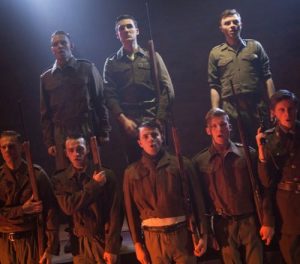
The Leeds Pals in Brass at the Union Theatre, London. Picture: Mark Senior
Brass continues at the Union Theatre, London until 24 November 2018.
Star rating: five stars ★ ★ ★ ★ ★
Benjamin Till’s ambitious musical charting the fortunes of a Leeds brass band that enlists for the Great War enjoys an intimate retelling at London’s Union Theatre.
Commissioned by the National Youth Music Theatre to commemorate the war’s centenary, this epic show – winner of the 2014 UK Theatre Award for Best Musical – has surely presented director Sasha Regan with some serious challenges in terms of its scale. Not only do the interweaving storylines cover a lot of ground, but also what was originally presented with 60 young actor-musicians now has to work with just 16 and a piano.
Brass recounts the tragic story of a Leeds Pals regiment and a brass band of brothers that jointly enlist, leaving their women behind to man the Barnbow munitions factory and pick up their instruments in preparation for a fanfare return. It’s a return that, of course, doesn’t happen, as the boys fall to a hail of bullets and shrapnel on the first day of the Somme.
The book, music and lyrics are all provided by Benjamin Till, who has created one of the finest ever pieces of British musical theatre. (Till credits Nathan Taylor and Sir Arnold Wesker as co-lyricists.) I fell in love with the score after catching the NYMT staging at Hackney Empire in 2016, packed as it is with morale-boosting jingles, heart-breaking elegies and stirring chorales. Till knows how to write a memorable tune, and there is no shortage of toe-tappers.
In Regan’s production, gone are the orchestra-sized forces of the Hackney Empire’s NMYT band, replaced almost entirely by the brass-fingered (and period-dressed) Henry Brennan, who does an incredible – and almost non-stop – job at the piano. The old upright could do with a tuning (or is this a nod to authenticity?!), but Brennan controls it masterfully and does a faultless job as musical director, underpinning four of the cast who do actually play a handful of assorted brass instruments.
The plot follows the stories of various individuals so there is no central character as such. Instead, each cast member is effectively a featured performer, and there’s not a weak link. Joe Douglass, Adam George-Smith, Alistair Hoyle, Maison Kelley, Sam Kipling, Matthew Peter-Carter, Jack Reitman and Lawrence Smith form the Pals, with Michael Martin as their suitably stiff-upper-lipped Major.
Of the boys, Kelley (Wilfred), Kipling (band-conductor Alf), Reitman (Harry) and Smith (Morrie) give particularly powerful performances, helped by their nicely fleshed-out characters. (Interestingly, Reitman has been with the Brass story since its debut.)
I also enjoyed Peter-Carter’s intense Lieutenant Bickerdyke, torn between his allegiance to his countrymen and his duty to his seniors. Bravo Smith for the beautiful trumpet/cornet playing.
Back home, the Barnow Lassies are represented by an equally strong and characterful company of Lucy Aiston, Tamsin Dowsett, Hannah Francis-Baker, Emma Harrold, Rosa Lennox, Kelsie-Rae Marshall and Samantha Richards.
The ever-reliable Dowsett delivers a deliciously matronly and stentorian Miss Grimsby (and wow, she has some powerful vocals!), with Aiston (Tats) and Marshall (Emmie) also standing out among the girls for their feisty and emotional performances.
While there are some beautiful solo numbers, it’s with the group work that Brass really shows it polish. Company numbers are plentiful and bountiful, and the ensemble work is outstanding, both in Till’s writing – he out-Mis-es Schönberg with the spine-tingling chorale ‘No Man’s Land’ – and in the tightness of the vocal work by the company.
‘Barnbow Lassies’, ‘Forming a Band’,‘Billy Whistle’ and ‘You’ll Always Have a Friend’ are all a joy: catchy and memorable, and evocative of the Great War setting.
The simple set – just a few crates and tables – by Toby Burbidge and effective lighting by Matthew Swithinbank creates a clean and flexible tableau, and Regan and associate director Lee Greenaway fill this space with movement, allowing the show to flow seamlessly.
Could it be trimmed? Perhaps. Musically, there’s such an over-supply of great material, it could survive a cut or two. It is a little on the long side: it covers a multitude of Great War tropes, including teenage volunteers, desertion, class warfare, the dangers of working in munitions, single mothers, homosexuality – although not so superficially as to reduce everything to cliché. Predictable, yes, but then the Somme provides the stage with the ultimate in dramatic irony.
As a keen supporter of new British writing – and a long-time brass band member myself – I find an awful lot to like in Till’s Brass. I look forward to a second hit of the show in the author’s own directed version at his alma mater, Mountview, next week. Mostly, I’m excited that this wonderful show is getting an airing. It deserves to have a life long after the centenary commemorations, and beyond merely student productions. Up the Pals!
Craig Glenday
SHARE THIS POST:


Comments are closed.