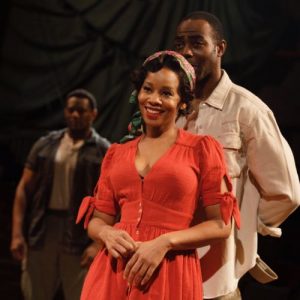
David Aron Damane, Anika Noni Rose and Clifton Duncan in Carmen Jones at Classic Stage Company, New York. Picture: Joan Marcus
Carmen Jones continues at Classic Stage Company, New York until 29 July 2018.
Star rating: five stars ★ ★ ★ ★ ★
Georges Bizet, Oscar Hammerstein II and John Doyle prove to be amazing collaborators. True, Bizet and Hammerstein have long left this earth, but the John Doyle-directed revival of Carmen Jones, which has just opened Off-Broadway at Classic Stage Company, comes across as so right and assured that you can’t help feeling that Doyle received both input and affirmation from his departed colleagues.
French composer Bizet, of course, composed the opera Carmen, which premiered at the Paris Opéra-Comique in 1875. (I suppose a nod should also be given to Henri Meilhac and Ludovic Halévy who wrote the libretto, based on the novella by Prosper Mérimée.)
Then, decades later, Hammerstein transformed Bizet’s opera into a Broadway musical, Carmen Jones, populating the story with African-Americans during the Second World War. It opened in 1943 and ran for 503 performances, a long run for the time. The production received brief remountings in 1945 and 1946, but the Classic Stage offering marks the first major New York revival since then. (A London production at the Old Vic in 1992 won an Olivier Award as Best New Musical and London’s Southbank Centre featured the show as a summer offering in 2007. And, oh yes, there was a well-received received Otto Preminger-directed film version in1954.)
Hewing to Doyle’s dedication to minimalism – or “essentialism” as he likes to call it – his cast numbers 10, but glorious singers all. The six-piece orchestra, led by music director Shelton Becton at the piano, is ensconced in an elevated space to the side of the small theatre. And whatever is needed to fulfill Doyle’s vision is provided imaginatively by his creative team, including set designer Scott Pask, Ann Hould-Ward for costumes and Adam Honoré for lighting.
Things begin on a bare stage, with the audience seated on all four sides, and it’s up to the cast to bring on or adjust the spare pieces of locale-setting scenery.
To begin with, they set up some crates and packing boxes to sit on. Hammerstein changes Bizet’s cigarette factory, where Carmen and the other ladies work, to a parachute factory, and the military men guarding the place are US airmen. Later, the ladies, take off the sheer scarves they’ve been wearing and wrap them around the lighting pieces dropped from the ceiling to create the smoky atmosphere of Billy Pastor’s café, where the workers hang out with shady types.
Still later, a large piece of white shimmering cloth is hung in place to form the ceiling of a Chicago country club, and finally, the stage is bare again for the fateful climax outside of the stadium where a big boxing match is taking place.
What dominates the stage is an intensely intimate distillation of the opera’s story of a potentially great love affair gone bad between a free-spirited woman, true beyond anything else to her own passions, and the good-hearted simple guy whose love when spurned ignites into rage. The denouement, as well-known as it is, is overwhelming. You feel as if you’re experiencing it for the first time.
At the same time, Bizet’s music, some of the most familiar in the opera canon, takes on fresh dramatic colourings in the pared-down orchestrations by Joseph Joubert and heightened by the colloquial turns of speech employed in Hammerstein’s lyrics.
Some might say his lyrics are too fancifully black or stereotypical but they are character-defining and infused with genuine emotion. And the terrific cast makes the words totally organic, bringing truth to just about every moment of the show.
Anika Noni Rose infuses Carmen with both fire and a hard-edged felicity, letting us see a woman who knows what she has to do to survive but will still let her desires on occasion rule. She is aware of her attraction to men, but never lets it slip into the pose of a typical temptress.
In Hammerstein’s resetting of Bizet’s ‘Habanera’, Carmen sings: “Love’s a baby dat grows up wild/an’ he don’ do what you want him to,” and you can sense that unpredictable persona jangling the fibre of Rose’s Carmen.
As Joe, the airman who falls under Carmen’s spell, Clifton Duncan is at the start winning, charmingly unassuming, but as his emotions begin to swirl he becomes a tempest of heart-rending anguish and obsession.
Equally playing on our heartstrings is the portrayal of Cindy Lou, Joe’s neglected hometown girlfriend, by Lindsay Roberts.
David Aron Damane steps quietly out of the ensemble to become a commanding Husky Miller, the champion prizefighter who takes over Carmen’s attentions, while Justin Keyes and Lawrence E. Street score with comedic moments as Husky’s fawning minions.
Soara-Joye Ross takes the stage impressively as Frankie, one of Carmen’s co-workers, leading the big café number ‘Beat Out Dat Rhythm on a Drum’ as a joyful seductress, even finding the lap of an audience member to perch on for a brief moment. It’s that number in which the work of Bill T. Jones, the show’s noted choreographer, comes vividly alive, filling the stage with his distinctive movement.
Completing the cast in exemplary fashion are Tramell Tillman as a no-nonsense sergeant and Andrea Jones-Sojola and Erica Dorfler as other workers in the parachute factory.
How these 10 voices would sound in the vaulted spaces of a grand opera house, of course, remains to be seen – or rather, heard. But in the tight dimensions of this venue (and probably some thanks as well to Dan Moses Schreier’s sound design), they sound just great. This Carmen Jones gives you all the thrilling musicality of a night at the opera galvanised with gut-grabbing theatre.
Ron Cohen
SHARE THIS POST:


Comments are closed.