Picture: Mark Senior
Elegies for Angels, Punks and Raging Queens continues at the Union Theatre, London – until 8 June 2019.
Star rating: four stars ★ ★ ★ ★ ✩
It is easy to forget, in these days of effective drug treatments, that life for HIV-positive people was so very different 30 years ago. There was no drug regime that could halt someone’s decline once they were diagnosed, and along with the physical symptoms that the onset of AIDS brought with it came the prejudice and abuse.
But those who the virus took had full lives, no matter how much society tried to sweep them under the carpet. One project designed to remember that was the NAMES Project AIDS Memorial Quilt. The art project was a means of remembering those lost to a disease whose social stigma was such that they often received no other remembrance. Each 3’ by 6’ panel, representing one person lost to the disease, is now the largest community art project in the world, it currently stands at over 49,000 panels and continues to grow.
Originally devised in the late 1980s, Bill Russell and Janet Hood’s Elegies for Angels, Punks and Raging Queens takes the quilt as its inspiration. A series of poems by Russell are delivered by the departed souls memorialised in the quilt, interspersed with songs representing the feelings of friends and family who are left behind.
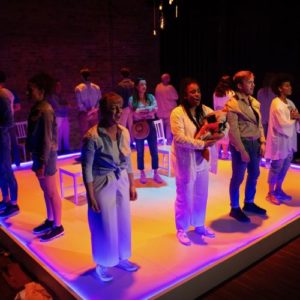
In the Union Theatre’s revival – its first full-length run in the UK since the original 1992 King’s Head theatre production, which transferred to the West End the following year – Justin Williams’ set design pays homage to the Quilt by presenting the stage floor as a subtle 6×6 grid, upon which handmade panels are placed as each character comes forward to tell their story. Director Bryan Hodgson keeps the entire cast on stage throughout, sitting around three edges of the central stage: each panel surrounded by others waiting to tell their story.
Of the stories themselves, first impressions make one a little wary, a couple of the 16-strong cast being so over-the-top in their performative campness that one worries that the whole evening may turn into a succession of stereotypes. Thankfully, such fears are short lived: once the cast has warmed up we are treated to vignettes from a succession of characters that all feel genuine.
While each of the actors’ monologues that Russell constructs is replete with imagery, Hodgson often supplements the words with silent mummery from other cast members. Sometimes, such as with scenes of clubbing and people finding themselves alone at the heart of the crowd, this approach reaps dividends: at other times, it can’t help but detract from the imagery inherent in the prose.
Also distracting are occasional updates to the script with modern references, from Netflix to Tiger Woods. This may have been done with the best of intentions — an attempt to emphasise the relevance of the whole project some 30 years after its creation — but the effect is counter-productive. The stories being told are rooted in their time and deserve to be celebrated and commemorated as such.
For every small moment that takes one out of the moment, though, there are many more to draw one in. The musical numbers, accompanied by musical director Henry Brennan and Pippa Mason on cello, range from the solemn (‘Heroes all Around’) to the comedic: a Fosse-infused Vaudevillian number, ‘I Don’t Do That Anymore’, is a highlight of Act I, while the ebullience of ‘Spend It While You Can’ fulfils a similar task in Act II.
But while there is much comedy in musical numbers and monologues, there are other emotions present too. As the shows begins to draw to a close, Alisa Davidson — who has been mute onstage throughout, an audience to each ghost’s storytelling as she prepares to add another panel to the quilt – opens her mouth to sing the solo performance of the show. ‘My Brother Lived in San Francisco’ is a soaringly romantic act of remembrance that deservedly brings the house down.
And as the show draws to a close, we are reminded that the lines between the departed and the living, between those living with and those dying from, between actors and audience, are artificial. As the cast moves along the audience for the final performance of ‘Learning to Let Go’, it would require a cold heart indeed to remain unmoved.
And it is in such moments where Elegies… feels modern and contemporary without the need for dialogue tweaks. The result is a show which memorialises all the fabulous people lost to AIDS: with the best party they could wish for.
Scott Matthewman
SHARE THIS POST:


Comments are closed.