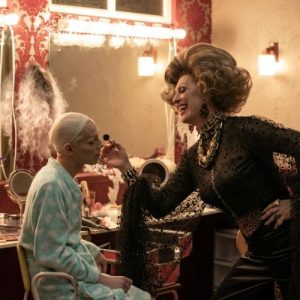
 Prime Video has just released Everybody’s Talking About Jamie, the film adaptation of Sheffield Theatres’ much-lauded musical about a teenage drag queen. The stage show has been a beloved West End fixture and is currently enjoying success with a UK tour.
If all had gone to plan, we’d all have experienced the movie last year on the cinema screen. But with things being how they are, instead, it’s getting a global release into people’s homes, joining the roster of new musicals that can be streamed or seen in slowly-reopening cinemas. That number has ballooned of late, due partly to the release of some projects delayed over the last 18 months.
We have filmed stage productions of Broadway hits Hamilton and Come From Away, film adaptations including The Prom, In The Heights, and (soon) Dear Evan Hansen, and original musicals from Netflix’s Jingle Jangle to Vivo and Prime Video’s other latest entry to the genre, Cinderella.
Yeah, perhaps we should quietly forget about that last one. It’s better than Cats, but then so is a trip to the vet.
Indeed, getting a musical right on the screen is perhaps one of the most difficult accomplishments in the cinematic canon. This is why it’s such a pleasure to see that Everybody’s Talking About Jamie has achieved the transfer so well. I’d go so far as to say that, from my first viewing, it’s become one of my favourite musical adaptations ever.
That’s no mean feat for a movie that’s directed by a newcomer to the medium, this being director Jonathan Butterell’s first film. But Butterell knows his material inside out: he directed the stage musical and, being Sheffield-born, knows how to make the Steel City shine on screen. In his hands, as the musical escapes the confines of the stage, the screen fills with exquisite specificity.
Jamie also succeeds in something so many film adaptations miss; it knows not to overdo the sense of scale. Jamie New’s dreams may be big, but the places where he has them are small. And so Christopher Ross’ cinematography helps transform a standard classroom into The Jamie Show, giving it gloss without going for the largesse that spoiled Ryan Murphy’s adaptation of The Prom.
There’s a level of faithfulness in the staging of some key scenes, too. Scenes that take place in the New family’s kitchen or in the bedroom of Jamie’s best friend Pritti are shot in spaces that are realistically sized, and therefore much smaller than their stage counterparts.
 Having the hopes, dreams and fears of the movie’s central characters sung about in such otherwise mundane spaces, with little to no movement of characters or camera, really allows for those inner character moments to explode on the screen. A shout out here to Sarah Lancashire as Jamie’s mother Margaret; not enough people saw her flex her musical skills in Betty Blue Eyes, so it’s a joy to see her bring those formidable talents to a wider audience here.
And it’s this grounding in reality that allows the show’s more fanciful moments to shine. Moments such as ‘Work of Art’ use all the camera trickery and quick costume changes that a live theatre production could never do. Because such techniques are kept in reserve for most of the film, they can really capture the audience’s imagination when they are deployed.
I truly think that what makes Everybody’s Talking About Jamie work on screen is how closely it keeps to the stage play’s structure. For In the Heights, composer Lin-Manuel Miranda and book writer Quiara Alegría Hudes made substantial changes to the screenplay, adding several new subplots, excising characters, dropping some songs and moving others around.
For Jamie, the changes are much more minimal, the film keeping the play’s core structure largely intact. The biggest difference is a new number for Jamie’s drag mentor Hugo/Loco Chanelle, sung by Richard E Grant and Holly Johnson. ‘This Was Me’ provides a context for the political side of drag, the sharp edges of an art form which the mainstream success of RuPaul’s Drag Race sometimes threatens to chamfer away.
The old spectres of Section 28, homophobic violence at the hands of the police and the AIDS epidemic deepen Jamie’s understanding of why drag and gender nonconformity have been at the heart of gay subculture for decades. It’s a way of expanding the political side of the culture at the heart of the musical that is way more successful than any accomplished by the In The Heights rewrites.
In all, anybody who’s seen and loved the stage show of Everybody’s Talking About Jamie will see the film and come away with a deepened understanding of all the characters, all within an immediately recognisable framework that feels tightly aligned with the source material. Meanwhile, millions of viewers of the film will have not yet seen the live musical – and when they do, they won’t feel short-changed at all.
There aren’t many adaptations that manage such a feat, and Butterell and his company should feel rightfully proud of what they’ve managed to accomplish. Hopefully, future attempts to adapt stage musicals can replicate Jamie’s success.
Scott Matthewman
SHARE THIS POST:


Comments are closed.