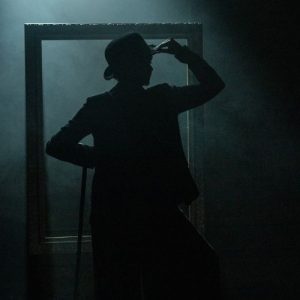
Picture: Paul Nicholas Dyke
Falling Stars is streamed via stream.theatre until 29 November 2020. There will be live performances staged at the Union Theatre, London on 8 and 9 January 2021.
Star rating: five stars ★ ★ ★ ★ ★
I can’t get enough of this show. I might say that the more I watch it the more I see in it but also the more I listen to it the more I hear…
It’s conceived and written by the marvellous Peter Polycarpou (‘Pol’ I now know) and he stars alongside the equally marvellous Sally Ann Triplett with ever-present musical direction and arrangements by Mark Dickman.
This show is musically so intimate that the three of them are intertwined throughout despite careful social distancing. There are some subtle gestures in the early part of the show that point up that it was filmed in lockdown and will date the work to this time even when the events of the year are long gone.
The intimacy is belied by a team of people in the final credits who are crucial to this production including Michael Strassen who provides excellent direction and staging, costumes and set by Jean Grey and atmospheric lighting by Andrew Exeter.
They were one day into rehearsing this show for the Union Theatre when the second UK lockdown started, so they jumped in and instead filmed it in three days for streaming instead. The live show has now been rescheduled at the Union for January 2021.
Polycarpou describes the show as ‘songs from a distant gallery of forgotten melodies’. They are taken from a gem of an old book that he bargained for (with £20 and an actual song) in an antiques dealer in East Finchley, north London.
Whether this is true or not, it makes for great theatre if you like that sort of thing. The show then is Pol and Sal singing songs from the book (which is in itself beautiful) and talking about the writers and performers and the context the songs were originally written and performed in: films, shows, revues, people’s homes and the equivalent of the charts of the day from about 1916 to 1929.
The show’s script makes reference both to the Great War and to the subsequent Spanish influenza epidemic that killed at least 30 million people. The songs of the era and the decade that followed have an ‘innocent sensuality and long-gone naivety’ in Polycarpou’s words, as people both privately mourned and publicly celebrated life.
Charlie Chaplin taught himself the piano, cello and violin but not to read or write music, so he hummed his songs in his films to arranger Meredith Willson who took them from there.
Several of these appear in the show including the title song, ‘Falling Stars’. Another song the performers linger on is ‘Je t’aime à travers les âges’ with music by James V Monaco and French lyrics by Jean Charles and Albert Willemetz with the English version by Arthur Freed rendering it as ‘You know you belong to somebody else so why don’t you leave me alone’. They have fun with this, sometimes singing both sets of very different lyrics simultaneously.
Another highpoint is the riotous ‘Last Night On the Back Porch’ by Carl Schraubstader and Lew Brown where they bang around the furniture on the set (not much, it’s a small theatre) and finally collapse in separate heaps, and Polycarpou takes to the piano himself once for a beautiful rendition of Chaplin’s ‘Smile’.
Near the end of the show they burst into ‘Yes! We Have No Bananas’ which was apparently written with a distant greengrocer relative of Polycarpou in mind and he gives it a full Greek rendition with appropriate gestures for the vegetables.
In a show filmed primarily in close-up it is a privilege to get to see so much detail of the performances. As well as everything else it is a tour de force of singing and acting technique, particularly Polycarpou for English, American, French and Greek vocal production, as well as great entertainment. There’s even something of a dance number and some fabulous self-conscious glances to camera.
Intriguingly, the introduction to ‘Roses of Picardy’ inspired me to look it up. In the show they credit it to Frank (actually Fred E – I found) Weatherly and Haydn Wood, a composer likened to Elgar in his day. The story of this song as told here is that it was written by a British soldier in 1916 who fell in love with a French widow while she was protecting him at her house.
In his memoirs of 1926 Weatherly vaguely says it might actually have happened to ‘a very dear friend’ of his. Certainly, soldiers sang the song as they were going and coming from France and Flanders but according to Haydnwood.com (a website created and maintained by Wood’s great niece Marjorie Cullerne and Gilles Gouset, a French cinema writer and teacher from Picardy) Weatherly was 68 in 1916 and therefore not serving as a soldier in France.
He was a barrister and wrote about 3,000 lyrics for songs on train journeys, about half of which were set to music and published, and with this song, he certainly captured something of the spirit of the age (as he also did with his lyrics to ‘Danny Boy’).
What touches me about all this is how quickly truth becomes legend and how stories intertwine themselves with truth in history, memory and in theatre as time passes.
The songs in this show were in active living memory (as the ‘old songs’) certainly at the beginning of my life but now they are drifting away into the past. I am glad they are being captured so magically here.
Clare Walters
Footnote: I also stayed up late on Wednesday night to watch Sal and Pol appear live on Seth Rudetsky and James Wesley’s Stars In The House, their daily live-streamed series to support the US-based Actors Fund and its services. They devoted pretty much the whole hour of the show to Falling Stars and the show also contained some footage of Polycarpou in the original productions of Les Mis and Miss Saigon and Triplett at the Eurovision Song Contest (twice!) and in Anything Goes at the National Theatre. It’s a bit of a musical theatre gem in its own right and can be watched HERE!
SHARE THIS POST:


Comments are closed.