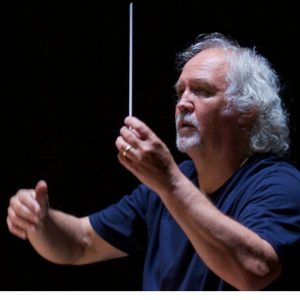
 Fidelio was performed at Usher Hall, Edinburgh as part of the Edinburgh International Festival.
Star rating: five stars ★ ★ ★ ★ ★
It is curious that Beethoven wrote only one opera, given his influence on other musical forms. The first version, premiered in 1805 in Vienna, was the fruit of two years of his life, and was revised more than once until, finally, a successful version was performed in 1814. It has been termed a ‘rescue opera’, a genre popular in post-revolutionary France and again, in the first decade of the 19th century, as Napoleon spread his grasp over an ever-widening sphere – he had occupied Vienna only weeks before the premiere. Dare it be said that there is a current political resonance.
The plot is said to be based on a true story and Joseph Sonnleithner’s libretto was used for the 1805 version. In essence, Florestan has been imprisoned by Pizarro, an archetypal governor with a grudge. Leonore, the courageous wife who cleverly concocts a daring plan to rescue Florestan before he expires, disguises herself as a male prison guard and manages to wangle her way into finding her husband – just in time before Pizzaro tries to murder him. The couple are reunited. Hope triumphs over evil.
This concert performance in Edinburgh’s Usher Hall had an intriguing framing device, created by David Poutney: Willard White, no less, who sat at a desk equipped with an iPad and a microphone and introduced the evening as being part of a truth and reconciliation process. This narrative device punctuated the performance, keeping the audience on track and underlined the magnitude of the evil that had been committed.
The concert was simply a magnificent experience, Donald Runnicles giving a masterclass in inspiration and coordination of the whole ensemble: the Philharmonia Orchestra (in fine form, strings energetic to brooding, an epic horn section soaring above all with majestic hope, and rippling woodwinds evoking the much needed air when the prisoners were given a brief break), the Philharmonia Voices (clarity, dynamics, nuance and projection, also contributing with fine soloists), and, of course, a team of top class soloists.
Right from the opening number with Marzelline (Kim-Lillian Strebel) and Jaquino (Gideon Poppe), it was clear that this was going to be a vocal-fest. They sang with precision, colour and focus. Then we had the Canon Quartet, ‘Mir ist so wunderbar,’ adding Rocco and Fidelio, Günther Groissböck and Emma Bell. You get an inkling that Marzelline’s love, as expressed in the quartet, is not going to go as she hoped. You also get to hear the wonderful quality of Bell and Groissböck, rich and sublime voices that filled the Usher Hall. Markus Brück’s Pizarro projected vengeance-fuelled hatred onto the object of his loathing, Florestan.
We see Florestan, his slumped shadow, at the beginning of Act II, as portrayed by Clay Hilley whose crescendo out of the darkness of the dungeon was a spine-chilling call to remind us that he was still in life. You got a sense of the almost superhuman capacity that was going to be required to succeed in securing his salvation from Hilley’s outstanding performance. It was magical. But the night belonged to Bell with her majestic performance of ‘Abscheulicher! Wo eilst du hin?’ and ‘Komm, Hoffnung, lass den letzten Stern’. The audience’s enthusiastic applause was well-deserved.
It’s a happy end for all, except Pizarro, of course – everyone else moves into the sunshine, White leaves his iPad and desk and majestically pronounces the end of tyranny in his role as Fernando, the minister.
Abi Adam
SHARE THIS POST:


Comments are closed.