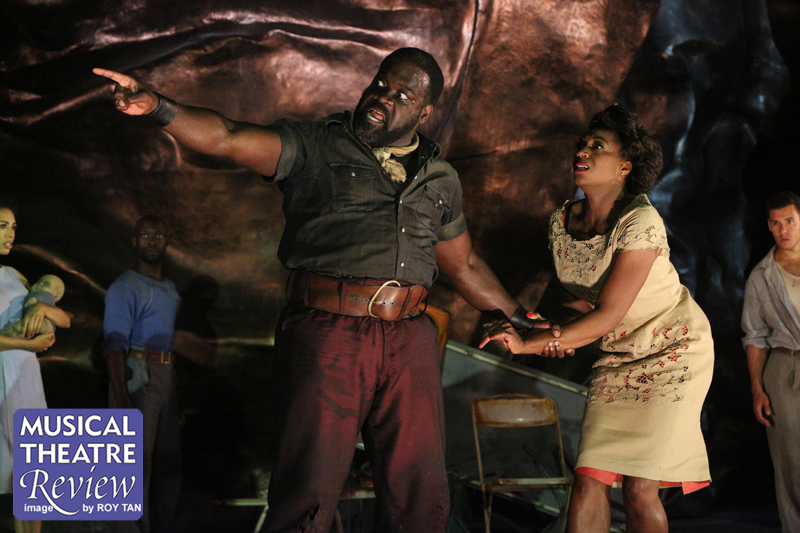
Phillip Boykin and Nicola Hughes in The Gershwins’ Porgy and Bess at the Regent’s Park Open Air Theatre, London. Picture: Roy Tan
The Gershwins’ Porgy and Bess continues at the Regent’s Park Open Air Theatre until 23 August.
Since 1935, when George Gershwin (composer), his brother Ira (lyrics) and DuBose Heyward (lyrics/libretto) presented their musical masterpiece Porgy and Bess to Broadway, there has been a heated debate about whether the show should be described as an opera or musical or a hybrid of both. The most recent Tony Award-winning adaptation, seen in New York in 2012, even sparked controversy for subduing the operatic elements of the piece in order to attract a more mainstream audience.
Now London audiences have the opportunity to make up their minds about that very interpretation – book adapted by Suzan-Lori Parks and musical score revised by Diedre L Murray – but chances are they could be disappointed.
Perhaps part of the problem is the libretto, with the dependence on the use of spoken dialogue, rather than operatic recitative, which slows up the dramatic flow and leaves characters undeveloped.
But there are flaws in the direction too. Timothy Sheader, often so fine at conveying the themes and emotions at the heart of a piece, seems uninspired here and the result is a production that lacks focus and dramatic intensity.
There is hope in the opening, as the sensuous Nicola Hughes stumbles into view as Bess, half undressed and high on ‘happy dust’, living up to her reputation as a “liquor-guzzling slut”. Hughes allows us to see how desperate Bess is to lead a decent life and her relationships with the women who become her ‘sisters’ – Sharon D Clarke as Mariah and Golda Rosheuvel’s Serena – are powerful.
Clarke is a force to be reckoned with as she demonstrates her contempt for the manipulative ways of drug dealer Sporting Life, while Rosheuvel’s heartbreaking desperation and pain is ever-present during ‘My Man’s Gone Now’ – the evening’s musical high.
The three actors who have travelled across the pond – Rufus Bonds Jr as Porgy and Phillip Boykin and Cedric Neal reprising their roles as Crown and Sporting Life – all impress to some extent, but they seem stifled by a staging that prevents the drama or Gershwin’s groundbreaking score to soar. The villainous, intimidating Boykin, in particular, is capable of striking fear into the heart of the audience as well as those on stage, but the lack of a strong narrative context means that these moments are fleeting.
Another fly in the ointment is Katrina Lindsay’s battered bronze set that dominates the stage. Despite there being a certain beauty about the structure (lighting by Rick Fisher) evoking something of the way the residents of Catfish Row make the best of their lives despite constantly being beaten down, it does little to complement Sheader’s vision.
While some commentators have felt Porgy and Bess reinforces stereotypes of African/American life, there is no question that Gershwin’s incredible score – influenced by folk, gospel, jazz and classical music – was ahead of its time. Musical director David Shrubsole, who heads an orchestra of 15 musicians (the biggest Regent’s Park has assembled), does his best to ensure the score sounds as beautiful as it should, but he is limited by the amplification required by the al fresco acoustic.
Part of Sheader’s approach is to have the company use a mismatch of tables and chairs to create settings and scenarios, and occasionally this works – for example when Porgy turns his chair around to indicate his sympathy to Bess’ plight. However, when Bonds’ Porgy strides across a pathway of tables to follow his Beth to New York, I just wish I cared more about him getting there.
Lisa Martland
SHARE THIS POST:


Comments are closed.