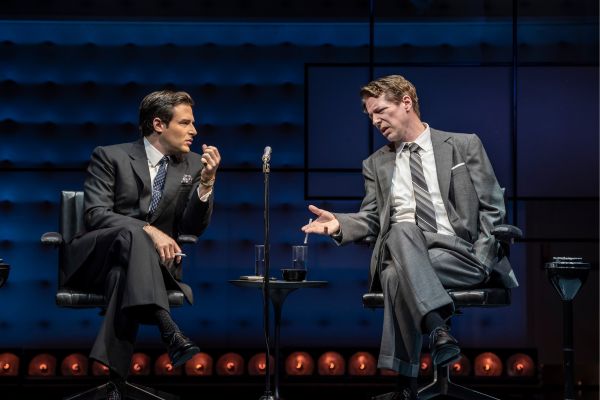
Ben Rappaport and Sean Hayes in Good Night, Oscar at the Barbican Theatre, London. Picture: Johan Persson
Good Night, Oscar continues at the Barbican Theatre, London until 21 September 2025.
Star rating: four stars ★ ★ ★ ★ ✩
In the programme notes for Good Night, Oscar director Lisa Peterson confesses that she hadn’t known anything about the American actor, composer, concert pianist, author and raconteur Oscar Levant until she was sent the play by her longtime friend Doug Wright.
I would have been a little ahead of Peterson in that I grew up loving movie musicals, not least the likes of An American in Paris and The Band Wagon, both of which featured Levant. However, I was less aware of his presence as a popular, witty, candid and unpredictable radio and TV personality during the 1950s and 60s when he would openly discuss his mental health issues and drug addiction on talk shows (when those kinds of subject were very much taboo).
Wright’s play is inspired by a true event when Levant was allowed a four-hour pass from incarceration at Mount Sinai Hospital so he could appear on a television quiz show. Here, the location has been changed to the The Tonight Show, the West Coast debut episode for which Levant has been booked as a guest (“I was starting to depress the other patients,” says Levant).
This makes complete sense for the narrative arc of the piece, but also because Levant was a regular guest on the show and a huge favourite of host Jack Paar. After Levant became too ill to appear on the programme anymore, Paar would sign off with: “Good night, Oscar Levant, wherever you are.”
The audience witnesses the events of that night, from the intimacy of Paar’s office backstage, via Levant’s dressing room to the vast Tonight Show sound stage and its padded walls where the star ultimately begins to unravel. Rachel Hauck’s beautifully observed set, brilliantly lit by Carolina Ortiz Herrera and Ben Stanton, widens in its focus as Levant begins to feel more and more vulnerable.
Up until the point that Levant reluctantly agrees to play the piano on the show, though we can see he is in turmoil, laughs are at a premium with one-liners arriving thick and fast. And yet these gags are fuelled by a self-loathing, a despair at the path his life has taken, away from a career as a ‘proper musician’ and towards ‘sidekick’ roles in movies and being known as a great interpreter of other people’s music rather than his own, especially that of his friend George Gershwin (represented by the ghostly presence of David Burnett).
The culmination of all these struggles comes in the shape of Levant’s performance of ‘Rhapsody in Blue’. Up until this point actor and accomplished pianist Sean Hayes (who won a Tony Award when the play ran on Broadway) has already given a bravura performance, embodying every aspect of Levant’s persona, whether it be his quick-thinking sardonic wit, the tics and rocking back and forth of an addict, the terror of hearing voices or music that haunt him.
Yet to watch Hayes become Levant at the piano is incredibly moving (credit to sound designer André Pluess). The ovation that follows unleashes a wave of emotion that continues until the final bows.
Occasionally Wright’s text tries to pack in a little too much exposition, but when his words combine with Peterson’s sharp, intelligent direction and Hayes’ phenomenal portrayal, it can be breathtaking.
Hayes has some fine support as well with Ben Rappaport reprising the role of Paar. On top of the infectious chemistry he has with his co-star, the actor is impressive in conveying the struggle the host must have felt balancing freedom of speech on air with studio executives like the stressed and straitlaced Bob Sarnoff (Richard Katz) breathing down his neck. It’s a debate that continues to this day, the recent cancellation of The Late Show With Stephen Colbert being one such example.
Rosalie Craig is also a welcome presence as June Levant, demonstrating a certain compassion fatigue after years of trying to cope with her husband’s self-destruction and addiction and yet at the same time desperately wanting him to be home, wearing his favourite shabby dressing gown, surrounded by everyone he loves.
Amongst the things that Levant feared was the thought he wouldn’t be remembered for anything unique to his own talents – or be remembered at all. This play has helped to rectify that situation, but I would also encourage you to investigate further, there are books, great interviews on YouTube and original compositions, both popular and classical – including the exquisite ‘Blame It On My Youth’.
If I expected love when first we kissed
Blame it on my youth
If only just for you I did exist
Blame it on my youth
I believed in everything
Like a child at three
You meant more than everything
All the world to me
Lisa Martland
SHARE THIS POST:


Comments are closed.