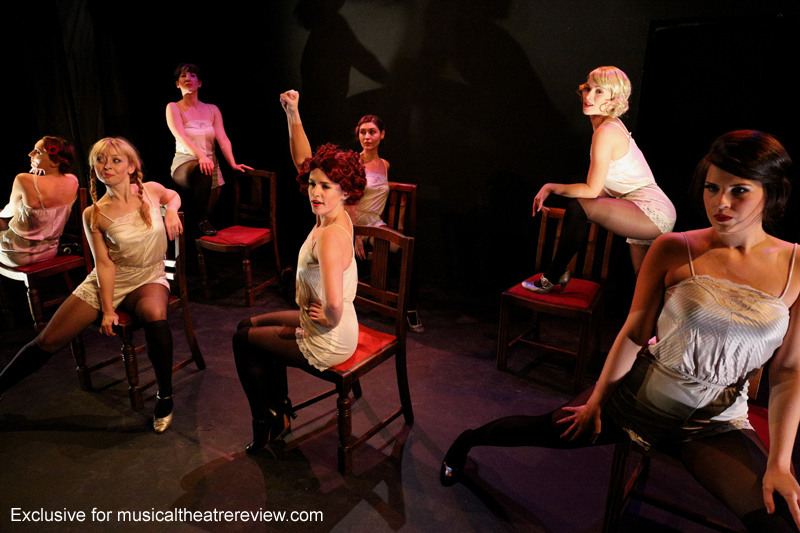
A scene from Halbwelt Kultur at the Jermyn Street Theatre, London. Picture: Roy Tan
Halbwelt Kultur continues at the Jermyn Street Theatre, London until 15 December.
Halbwelt Kultur explores the world of political upheaval and exuberant cultural experimentation during the Weimar Republic, and highlights in particular the work of six extraordinary female artists – international film star and cabaret singer Marlene Dietrich, lesbian entertainer Claire Waldoff, actress and singer Blandine Ebinger, scandalously androgynous and sometimes nude dancer and performance artist Anita Berber, socialist revolutionary Rosa Luxemburg and avant-garde performer Valeska Gert.
Each of these women were later to be labelled as degenerates by the Nazi regime and either exiled, imprisoned or murdered.
The show opens to a good start with the ladies warming up around the nightclub tables and moving into the lively and intriguing song ‘Chuck Out the Men’, followed by the fun and saucy ‘Take It Off, Petronella’.
There are also some memorable vignettes between the group numbers, especially from Alma Fournier-Carballo in her strong depiction of Rosa Luxemburg, making good use of Bertolt Brecht’s stark lyrics in ‘Supply and Demand’. I also liked the choreographic narrative build-up of Anita Berber’s drug addiction and bisexuality in ‘Morphium’.
Alyssa Noble’s choreography, if a little too busy at times, makes good use of the Jerymn Street Theatre space, and the show is ably accompanied by a four-piece band under the leadership of musical director Peter Mitchell.
The evening is entertaining and informative, and covers a unique period of cultural history. Where I felt the production could develop was in creating a greater sense of danger, emanating both from the performers themselves, and also from the world the artists inhabited. The women portrayed were vilified for a reason – they were culturally threatening and seditious, undermining the fabric of extreme right wing policy and propaganda. We were told of their increasing persecution, but we needed to feel the fear of the growing threat more strongly.
The performances of the ladies are technically well-executed, but err rather on the side of cutesy naughtiness, particularly in the group numbers, lacking the sensuous earthiness of the artists they represent. This approach is fun and amusing to a point, but the sense of shock is lost, especially as the topics of homosexuality and counter-culture are now viewed through modern eyes.
The talent of the cast is not in question, but the work tends to be rather too prettily balletic, somewhat frenetic and over-decorated with flirtatious movement, thereby losing authenticity and sharper humour. The power of the artists of Das Kabarett lay in their stillness and ability to draw the audience to them. Likewise, while some of the performers have fine singing voices, some of the material requires darker and sometimes harsher tones.
Nevertheless, this is an enjoyable show drawing attention to some fascinating and culturally important women of Europe’s history not often presented in English-speaking countries, and I applaud composer, director and producer Patrick Kennedy’s resolve to stage work of this kind. It is certainly a welcome antidote to the glut of Christmas sentimentality about to be on offer.
Fiona-Jane Weston
CAST: Sarah Bradnum, Samantha Louise Clark, Julia Cugini, Alma Fournier-Carballo, Stephanie Hampton, Alyssa Noble, Gabriella Schmidt
Readers may also be interested in:
KT Sullivan & Karen Kohler/Barb Jungr – London Festival of Cabaret
SHARE THIS POST:




Comments are closed.