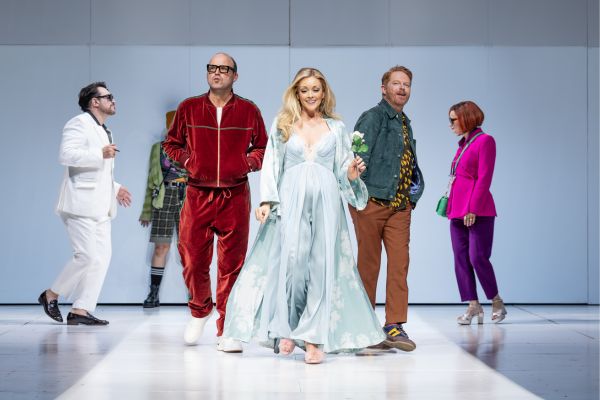
The cast of Here We Are at the National Theatre. Picture: Marc Brenner
Here We Are continues at the National Theatre (Lyttelton) until 28 June 2025.
Star rating: five stars ★ ★ ★ ★ ★
Stephen Sondheim’s final staged work – a musicalisation of two movies by Spanish-Mexican auteur Luis Buñuel – has opened at the 890-seat Lyttelton in the National Theatre, hot on the heels of its US debut Off-Broadway in 2023. It gives UK audiences their last chance to experience the premiere of a new work by the legendary composer-lyricist, who died in 2021, during the writing of the show.
On paper, it sounds a tad intimidating, if not unbearably pretentious: Sondheim collaborating with Venus in Fur playwright David Ives in a mash-up of surrealist Buñuel material. Although Sondheim and his many proponents long ago shattered the myth that his musicals are unapproachable or cold, there was the risk that Sondheim plundering Buñuel might just be an ostentation too far.
This couldn’t be farther from the truth, I’m relieved to say. Indeed, the UK premiere production – an almost identical restaging of the US debut, again with director Joe Mantello at the helm, manages to mine the material even more thoroughly for laugh-out-loud moments than the original run at The Shed in New York. And while you might have to just go with the flow in terms of the ever more eccentric plot – and a paucity of new musical material in Act II – it’s a surprisingly fun, enjoyable night at the theatre.
The premise is that a group of wealthy US socialites striving to dine together somehow keep failing, for a variety of increasingly demented reasons – the plot of Buñuel’s 1972 movie The Discreet Charm of the Bourgeoisie. Billionaire businessman Leo Brink (Rory Kinnear) and his wife Marianne (Jane Krakowski) receive unexpected visitors to their 90th-floor penthouse in the shape of plastic surgeon Paul Zimmer (Jesse Tyler Ferguson) and his movie-agent wife Claudia Bursik-Zimmer (Martha Plimpton), who are expecting brunch. The Brinks are not only out of food, but short-staffed, as explained in short order by their clearly overworked housekeeper (Tracie Bennett, who covers a multitude of low-status roles, as does fellow domestic Denis O’Hare – the only two reprising roles from the US production).
Brink instead offers to take the Zimmers – plus Marianne’s sister Fritz (Chumisa Dornford-May) and friend Raffael Santello Di Santicci (Paulo Szot), the ambassador of (the fictional) South American banana republic Moranda – out for brunch. Thus begins a series of visits to restaurants where nothing is quite what it seems
Along the way, the hapless diners pick up a soldier (Richard Fleeshman), his colonel (Cameron Johnson) and a priest (Harry Hadden-Paton), all of whom are looking for something. The priest is having a crisis of confidence and is seeking a new job, and the Homeland Security team are on the hunt for drug dealers, who we know are actually a cartel formed by Brink, Zimmer and Rafa. Oh, and Fritz, under the name of Apocalypse, is fomenting a global revolution with the help of someone on the end of her phone called Inferno.
That’s Act I. Act II re-creates Buñuel’s earlier work, The Exterminating Angel, in which a group of aristocrats becomes inexplicably trapped at dinner. So after an hour of being denied food, despite the best efforts of O’Hare and Bennett’s maître d’s and waiting staff (‘enablers’, even, as Ives joyfully presents it), the now six-strong group find themselves stuck in an ornately decked-out lounge in the Morandan embassy. As in the movie, this elite slice of society finds itself questioning their lives and values, while also devolving into animals. And encountering animals, namely a bear. All very Buñuel, and never explained.
Much of the buzz at the National during press night surrounded the rumour that Act II has no music, and admittedly, the second half of the show is rather spare – a conceit that Sondheim supposedly sanctioned, reflecting the characters’ descent to such a hellish degree that they’re denied not just food and water but also their musical voice.
As it transpires – like it did in the US production – there are a few musical moments in Act II and I was content to embrace the otherwise tuneless hour. It does feel like an abrupt handbrake turn, and the tone darkens. But enough happens, including that rather magical ursine encounter, to hold the attention, and it does reflect the goings-on in the Buñuel movie.
Overall, the almost-all-new cast does a wonderful job with the surreal material, and the result is a very enjoyable piece of modern theatre that, for my money, is a more satisfying and rewarding experience than watching the movies. Everyone on stage seems to be having fun, and have broken in the stiff new shoes, making the whole thing feel more relaxed and lighthearted than the original New York staging.
This is most notable in the role of the Soldier, who is brought hilariously to life by a very earnest Fleeshman. He also gets the show’s – perhaps only – cabaret-ready number (‘The Soldier’s Dream’), which I could hear being hummed a lot on the way out at the end (over the grumbling sound of those unhappy with Act II).
The only piece of casting I missed from New York was Bobby Cannavale as Leo. This is not to slight Kinnear, who is excellent in the role, but Cannavale was Brink for me – a New Jersey bad boy with a sandpaper larynx. And again, he can’t be criticised, but maybe I’m not so sure that the sweet and affable Tyler Ferguson is the right person to play a drug-dealing Beverly Hills plastic surgeon with a shoulder-padded bitch of a wife…
Conversely, though, Krakowski seems born to play Marianne – diaphanous, away with the fairies and ultimately the only one not phased by the increasingly surreal unfolding of events. Her Marianne is almost enjoying the ride, and with her idealism and naivety, she brightens up every scene.
O’Hare and Bennett also do outstanding work, even if the latter is outrageously wasted in Act II. The former’s ‘Waiter’s Song’ from ‘Cafe Everything’ is a highlight.
Musically, it’s instantly recognisable as Sondheim, and indeed it’s very Jonathan Tunick, who orchestrates with devilish glee, treating us to warm french horns, Steve Reich-like minimalism, and a peach of a part for one lucky/busy bassoonist (no doubling here!) – MD Nigel Lilley draws a huge sound from the 13-piece band and gives the performers plenty of room to luxuriate in Sondhiem’s lyrics, aided by a top-notch sound system that lets every word be heard.
You can hear all of Sondheim here. It’s loaded with motifs and easter eggs that the nerdiest of Sondheimites will be falling over themselves to catch. I’ve become a big fan of the New York cast recording, and know the songs well, and I do think Sondheim has turned out a remarkable score that bears (or maybe begs) plenty of repeat plays. The plot also features a series of what I am sure are deliberately placed tropes from Sondheim shows – water miraculously spouting forth (Anyone Can Whistle, even with accompanying salsa beats), the cast ganging up on the ‘narrator’ (Into the Woods), a girl with a name like music (like Maria from West Side Story?), the ladies who lunch (Company), the blob (Merrily We Roll Along), lambs and dreams (Gypsy) and so on. It’s like a mashup of every Sondheim show into one – a messy mashup, admittedly, but still an enjoyable one.
So, is it one for the Sondheim brigade? Undoubtedly. They will relish the chance to dissect it and absorb it and discuss its many oniony layers. But to mix my culinary metaphors, it is also a curate’s (or bishop’s?) egg that might leave the less initiated a bit bemused. But isn’t this always the way with Sondheim? Give it ten years.
Oh, what it might have been had he ever got round to finishing it. Still, don’t miss your last chance for a Sondheim premiere.
Craig Glenday
SHARE THIS POST:


Comments are closed.