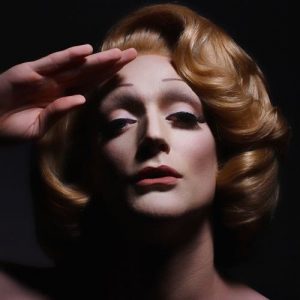
 PETER GROOM moved to London from Newcastle at the age of 17, and trained at the Guildford School of Acting on the three-year acting course. Since graduating, he has appeared in a number of roles in the UK and overseas – including Berlin and New York – and became artist in residence at Battersea Arts Centre. Over the past 18 months, his career has segued into drag and cabaret, and in his latest project is his self-penned musical portrait of the German-born actress Marlene Dietrich, in which he takes the lead role.
Dietrich – Natural Duty, which opens as part of the VAULT Festival in London’s Waterloo on 24 January, recounts the actress’ experience during the Second World War. In particular, it focuses on her contribution to the US war effort, having renounced her German citizenship at the outbreak of the conflict in Europe. In this one-(wo)man show, Groom reveals Dietrich’s determination to do her duty using an “irresistible mix of songs, sequins, sex and sympathy”.
In advance of the show’s opening, Musical Theatre Review’s Craig Glenday spoke to Peter about his experiences as a drag performer, and his fascination for Dietrich.
Where did the idea for Natural Duty come from?
I put this show together about Marlene Dietrich because I was doing drag at a lot of different places and I wanted to find a way to use drag theatrically. I thought it could be more than just a novelty for 10 minutes in a cabaret. I trained as an actor, so I wanted to try to use drag as a tool to tell a story.
Who do you normally perform as, and what’s your act?
It depends. Often I just call myself Peter, so I use my real name, but I’m in drag. I usually sing some song parodies, tell stories and jokes, do a bit of comedy.
When did you first perform in drag?
It was about a year and half ago. Maybe a little bit longer. Somebody asked me to host a party as Marlene Dietrich, and so I did. Then, from that, somebody saw some photos of me at that party, and asked me to host a night at Battersea Art Centre. Then, from that, I just kept getting gigs as her. You could say I owe my career to her in that sense.
What did you know about Dietrich before you started performing as her?
Well, I’d always sort of known about her, and been intrigued by her. As a kid, I’d seen images of her and was just drawn to this sort of… coldness in her. She seemed a very steely figure. A lot of other stars of this time were sweet, or cooing, but I was interested in this woman who was strong and fierce. I started to read about her, and I was amazed at what she did in her life – particularly during the war, and her political stance, and how much she sacrificed personally to follow what she thought was right.
Was she a performer for the USO?
Yes, eventually. She was very famous in the early 1930s, when Hitler came to power, and Hitler said: “Come back to Germany and be the queen of the Reich. You can have anything you want.” She said: “No” and she denounced her German citizenship. She became an American, and joined the army.
She entertained the boys but she also marched alongside them, and insisted on going to the front. She spent most of her time on the front lines, getting involved in battles, and really putting herself in a lot of danger. But she wanted to do it for those men, and to keep morale high. And to fight for what she thought was right against her homeland, which must have been, I mean, terribly contradicting.
 So she was actually doing more than just performing, then?
Yes. She wasn’t meant to – those were not her orders – but she wanted to be a soldier, and she wanted to fight. She wasn’t happy with just being a performer. A lot of Hollywood stars did entertain in the base camps, or back home in America. But she went to France; she went through North Africa; she went through Sicily, Italy, Germany, most of Europe, marching with the boys. There are great photos of her – all done up in the paratrooper or army uniforms – marching alongside these guys.
Where did her sense of duty come from, do you think? And is this something you deal with this in the show?
I do, yeah. I mean, the show is called Natural Duty because it’s about her sense of duty. I think it comes from her childhood. She was born in Berlin in 1901, the daughter of a Prussian soldier, so she had this strict post-Victorian Prussian/German upbringing. You learn that you have to serve everybody. You do your duty to everybody. You do the right thing and you work hard. Ironically, it’s that very German sense of duty that ends up driving her away from Germany.
It must have been difficult for her, fighting against her homeland…
Absolutely, and a lot of her family were serving in the army. There are stories of her at the front, fighting against cousins and nephews over the other side of the trench. She’s going on bomb rallies to raise money for bombs that are going to bomb Berlin, where her mother is still living. But, if she doesn’t do that, Hitler’s going to win. So it’s like, what does it cost you to follow your conscience? To fight for freedom?
What do you bring to the story as a drag performer?
Well, I think drag was hugely important to her. And I think she was making a political act by doing these “manly” things. In watching the show, you see her make all these political acts. And underneath it all, you’re watching a man as a woman in drag, which is also a political act. The very nature of the show – telling this story – is political.
Also, I think she understood the power of drag. She knew what turning against Hitler meant. And she did it so publicly, marching at the front as Marlene Dietrich. She marched as that Hollywood icon that she’d created. Even when she’s in the uniform, her make-up is done, her hair is done. She did it in drag. She did it as Dietrich the movie star, and she understood what that meant to those boys. She inspired them. “She is here as a symbol,” they would say. “We can keep going.”
So she’s playing with gender and drag, and she does this throughout her career – you know, the top hat and tails? – to navigate through life. So to tell that story through drag, I think is very natural.
The image of Dietrich on the poster is very striking – this is you, right? How did you get the eyebrows so neat?!
Yes, it is! I glue my eyebrows down. You smooth them down, and then you powder over them, and then foundation over them. She shaved hers off, but I’m not that brave!
We appear to be going through a gender revolution at the moment, so the show is very well timed…
Absolutely, and I think it’s wonderful that we have an icon that plays with gender in a way that’s fun and light and attractive. The idea that navigating gender can be a sensual experience, and can be empowering, and makes you feel good and attractive… That’s such a positive message, I think. And I just love drag, and I see a lot of drag, and I love a lot of different genres of drag. So to get to tell this story through drag is something that’s really exciting to me.
What will Dietrich’s story mean to modern audiences?
I think there’s a lot of parallels between the 1930s and what’s happening now, politically. And we’re asking the same questions now as we did then. We all want to be free, but what are we actually prepared to do to make a better world? What do we do to stand for what we believe in? Dietrich risked a lot, and her choices cost her a lot. She could never really go back to Germany. She lost her homeland because of what she did.
 What’s the format of the show?
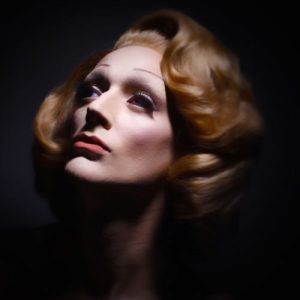
It’s a one-woman cabaret, so it’s about half songs and half stories. There’s some talking with the audience, and some interviews. But it stays very much in a cabaret style. It’s very “live” – I speak to the audience; we interact.
Do you play the musical saw, by any chance?
I don’t play the saw. I tried to learn, but it was incredibly hard. But she did it – there are some photographs of her playing the saw. I just stick to singing. I sing a lot of her back catalogue: ‘Falling in Love Again’, ‘Lili Marlene’, ‘Where Have All the Flowers Gone?’
There’s been a lot of success with Everybody’s Talking About Jamie – another show about drag. Have you seen this yet?
I haven’t seen it yet. But I really, really want to. The success of Jamie shows that people love to see drag. I think there’s something inherently empowering about it. To watch somebody own every part of themselves. I love seeing people walk down the street in drag. It makes you feel good because you think: “God, that person is brave!” You admire that courage, and I think we’d all want to be that brave. We admire that. I think when we watch a drag queen, we enjoy the play, and we enjoy the owning of contradiction.
* Dietrich – Natural Duty is created and performed by Peter Groom, co-written by Oliver Gully and directed by Bethany Pitts. The show runs from 24-28 January at the Vault Festival . Tickets are available at www.vaultfestival.com/whats-on/dietrich-natural-duty/
SHARE THIS POST:


Comments are closed.