
Adam Langstaff and Lauren Chinery in rehearsal for Miss Nightingale. Picture: Charlotte Murphy Photography
Matthew Bugg’s Second World War set musical Miss Nightingale’s run at London’s Hippodrome Casino, its West End debut, closes today (although we have heard there are plans for the show to travel overseas soon).
Set in an underground cabaret club in London during the Blitz and featuring 16 original songs, the show premiered in Salford in 2011 and has been playing the 180-seat Leicester Square space since March.
Produced by Sheffield-based musical theatre specialists Mr Bugg Presents and The Hippodrome Casino, the show which mixes music hall style songs with tender ballads in a tale of secrets and scandals set in has previously completed five sold-out UK tours and last year played a successful season at The Vaults in London.
Musical Theatre Review’s Tal Fox caught up with cast members and creatives just as the show opened and we wanted to repeat those interviews, here’s the show’s performers LAUREN CHINERY (as Maggie) and ADAM LANGSTAFF (as Tom).
What’s it like performing in a new musical?
AL: It’s great! Obviously there’s a place for jukebox musicals and the old classics but I’d like to think with our show we’re doing something different.
LC: It’s also really nice working with Matt who created it because he has his insights and views on what he wants to do with that but then there’s also new stuff that comes with new people.
AL: He’s up for collaborating.
LC: And being in a different space as well with the cabaret setting that’s really cool.
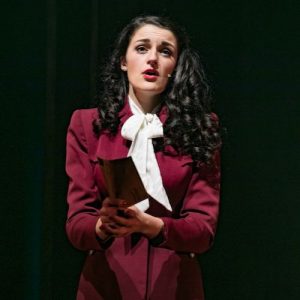
Lauren Chinery in Miss Nightingale at the London Hippodrome. Picture: Darren Bell
Is it intimidating to work with the man who created the show?
LC: It’s really great actually. The whole process has been really good fun. There’s a space for collaboration in there where different ideas are thrown in so it’s really good fun.
Tell us a bit about who you play…
LC: I’m playing Maggie Brown and Miss Nightingale is her on stage persona. She is a very fiery, feisty northern lass who is basically trying to find her way through a man’s world and find her place.
AL: I play Tom who is Maggie’s boyfriend and technically the baddie. He’s a black market dealer in London during the war.
The show has changed a little, is that helpful when coming back to it?
AL: The big changes come from doing it with different people but also this space particularly and doing the show immersively this time. We’ve not done that before so that is interesting and exciting.
What’s it like being the only woman in the cast, how does that play into the storyline?
LC: It’s set in 1942, a time when men made a lot of decisions on the woman’s behalf, that’s the way that it was and the women would just shut up and get on with it a lot of the time. Maggie very much doesn’t adhere to that rule at all, she’s very unapologetic, she will stand up for herself and stand up for her friends and the people that she loves.
AL: These men orbit around her trying to make decisions for her life.
LC: She steps in and goes: “hang on, I’m here.”
What do you think audiences will relate to most in the show?
AL: I think it’s got different levels that I hope can speak to different people. I think the overarching thing is about being an outsider and how individuals try to express themselves and sometimes they’re living in a society that doesn’t let them do that. Hopefully that speaks to a lot of people. They [the characters] put on a front to fit in but actually they have a secret life. There’s a lot of shadowy goings on.

Adam Langstaff in Miss Nightingale. Picture: Darren Bell
What have your experiences been with audiences so far?
AL: First and foremost I think people just have a great night of entertainment, but this story touches on quite a few universal things, so people get quite moved by it as well. We’re talking about a show set in 1942 that’s approaching things like closeted homosexuality and it’s something we’re still wrestling with in 2018. For Maggie’s story, we’re living through this time of swinging on a pendulum in terms of #MeToo and I think why shouldn’t Miss Nightingale be part of that and have something to say in the context of modern gender politics.
When we were on tour last time during some of the romance moments between the two male characters took people by surprise at times and I quite like that because we can be like, this is a thing – deal with it. Some people can’t deal with it, but it’s about putting a spotlight on it. I hope doing it in central London, we won’t get anyone walk out, but if we do then perhaps we still made an impact on people who need their eyes opening a little bit.
Does this affect the way you approach the role?
LC: She’s presented with opportunities in which she could potentially get ahead quicker than she has done by indulging in certain activities but she sticks to her guns. She doesn’t do anything that she doesn’t want to do and she would be the first person to get up and say: “No, I think this.”
AL: She’s got a strong sense of injustice.
LC: She has and she’s very in tune with other people’s feelings and situations. She’s very good at reading people and in her own slightly blunt way giving advice to people.
AL: The blokes are all hopeless so she shows them up time and time again in terms of her emotional maturity.

Lauren Chinery in Miss Nightingale. Picture: Darren Bell
Some of the themes are quite dark so do you feel a responsibility to portray them in a specific way?
LC: I think that it gives us a certain opportunity with which comes responsibility to put it out there. The gay relationship in the show is not a subplot, it’s there at the forefront. It’s what it’s about really and how that relationship affects what can happen and the way it can happen. With that as well, there’s the fact that George is Jewish, how that influences how things can work. It’s a wonderful way to say: “Look at this, look at how this works,” and to see how much you can invest in that.
A lot of research went into the play, were you expected to do any?
AL: It’s not so much that we were expected to but Matt and Toby are great at it. This show has been their baby for a while now and they found a lot of resources that they talked to us about. We can read things and watch things and listen to things and it’s just all fuel to the fire. A lot of it is about getting into the mindset of that era and how people felt at the time and what that meant to the decisions you made.
Have you learnt anything that particularly surprised you?
LC: Gracie Fields, a huge entertainer during that time was declared by Hitler personally as an enemy of the Third Reich which I thought was interesting.
AL: Propaganda and morale were such huge concerns for both sides of the war so she was made an enemy of the state.
LC: There’s some wonderful articles, diaries and accounts about things that people did and sometimes very well known people. You don’t realise the things that people have done and got on with because that’s just what needed to be done. It has been so interesting.
What’s it like being at the Hippodrome?
AL: It’s really interesting, it’s got so much history and it was great that we got to actually rehearse in the building because you don’t always get to do that.
LC: The Miss Nightingale side of my character is a cabaret performer so being in that space where it’s an actual cabaret type venue is great.
Is it easier or harder to play a role when it has been played before by other actors?
LC: I think it’s nice because I don’t feel I have to conform to anything that has been done before or live up to anything because I don’t know how the previous actors have played the role so it’s quite nice really.
When you return to a role what do you do to play it differently?
AL: I don’t think about previous incarnations much because I don’t think it’s very useful. Working with different people always means things are going to be different. That’s one of the joys of what we do. You can do the same show a thousand times but if you’re working with different people then the tiny details are going to shift and new moments are going to take on greater importance.
What do you think the key message of this show?
LC: A few times in the show we say live each day like it’s your last which I think is something that certainly in 1942 people were doing. Now it’s don’t be a pawn in someone else’s game. Live with integrity and live well.
AL: Be true to yourself.
SHARE THIS POST:




Comments are closed.