
Matthew Bugg in rehearsal for Miss Nightingale. Picture: Charlotte Murphy Photography
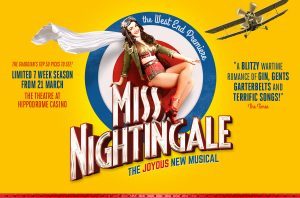
Matthew Bugg’s Second World War set musical Miss Nightingale’s run at London’s Hippodrome Casino, its West End debut, closes today.
Set in an underground cabaret club in London during the Blitz and featuring 16 original songs, the show premiered in Salford in 2011 and has been playing the 180-seat Leicester Square space since March.
Produced by Sheffield-based musical theatre specialists Mr Bugg Presents and The Hippodrome Casino, the show which mixes music hall style songs with tender ballads in a tale of secrets and scandals set in has previously completed five sold-out UK tours and last year played a successful season at The Vaults in London.
Musical Theatre Review’s Tal Fox caught up with cast members and creatives just as the show opened and we wanted to repeat those interviews, here’s the show’s writer and director MATTHEW BUGG and theatre maker and actor TOBIAS OLIVER…
How is seeing a show you thought up and wrote on stage?
MB: We first started doing it in 2011 and it did a big UK tour in 2013 and then again in 2014 and in 2015-2016, so it’s been on stage so many times. I think the big thing this time is bringing it to the West End, it’s a whole other ball game and also to this incredible venue, it’s just wonderful. We’re so close to the audience and it’s a really intimate world that we’re coming into. I’m so excited about just being in the centre of town and right in the heart of Theatreland.
Did you deliberately choose the Hippodrome?
MB: Actually they approached us about it which was extraordinary. They came to the show at The Vaults and loved it so much and they said that this is the show for them. What’s great about it is we’re in this incredibly privileged position as theatre producers where actually the venue approached us which is an unusual thing.
TO: What’s really interesting about the Hippodrome is in 2013, when we were doing our first tour, I was reading Julie Andrews’ autobiography and I got to the bit where she was talking about making her stage debut at the age of 12 at the Hippodrome Casino in 1947. We were in London at the time and I remember walking to Leicester Square and looking at the building and at that point the Casino hadn’t reopened.

Tobias Oliver in rehearsal for Miss Nightingale. Picture: Charlotte Murphy Photography
I was thinking wouldn’t it be amazing if one day we took Miss Nightingale there considering that’s where she made her stage debut, and now all these years later here we are, it is fantastic. We’re treading in the footsteps of absolute legends; Judy Garland, Shirley Bassey and anyone who’s anyone has performed here, you could just list them for hours.
Revivals seems to be a trend at the moment so what’s it like presenting new work in this environment?
MB: I think it’s a very interesting time, there’s a real appetite from audiences for new work and yet we’re often not delivering it as a music theatre environment. There’s a few new shows that are happening and people are doing new work that’s based on something else. There’s nothing wrong with that but it feels like we have to be a little bit braver and just start making shows that are specifically created for a musical. The thing that I think is amazing is that this is a show not based on an existing book, it’s not based on an existing title, it’s not based on an existing film, it’s got entirely original songs but it’s also an original type of story.
It’s not a story with a boy meets girl romance, it’s an in-depth story about people struggling to live a life with integrity, struggling to be the best version of themselves and I think that feels really current but it’s a time old part of the human condition.
It’s a great night out, it will make you laugh out loud, it is raucously funny, it’s also quite raunchy but it’s also very silly at times. It’s also heartbreakingly beautiful so it has multiple effects and I think that’s all you can really ask for from a theatre show. It moves you to tears and you have a great night out and you will laugh until you cry.
TO: We’re a Sheffield company, the show was made in Sheffield and our heroine is from Sheffield and comes to London. It’s interesting that the other original musical that’s wowing the West End at the moment is Everybody”s Talking About Jamie, another made in Sheffield musical about a working class Sheffield hero.
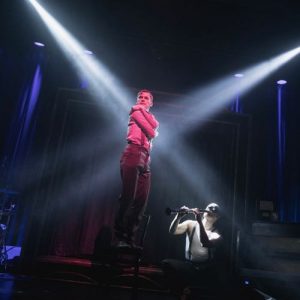
Matthew Floyd Jones and Matthew Bugg in Miss Nightingale at the London Hippodrome. Picture: Darren Bell
I don’t know what it is about Sheffield at the moment that’s making these kinds of shows. Something about Sheffield has always been a little bit left field so it’s really exciting and we feel like we’ve got our brothers and sisters in the West End. It’s nice that there’s another familiar home face in town.
How did you come up with this story?
MB: We run the company together and we’ve been doing the show for seven years but we are also together in real life, we’ve been together 24 years. The story is very much a combination of both of our family histories.
TO: Most of my family were Jewish refugees during the Second World War. My grandmother and great-grandmother were actors and my granny ran away at 18 to Berlin to perform in cabaret which caused huge shock and scandal within the family. My great grandparents sent a close family friend to go and check up on her and he reported back that she was living on her own, wearing a red dress and lipstick, so she was obviously a prostitute. She assured me she wasn’t and I’m sure she wasn’t.
She was working as an actor but in those days, in 1921, for a woman of that age to be living unchaperoned was unheard of. She told me these amazing stories about seeing Marlene Dietrich, buying songs from Bertolt Brecht and going to transvestite balls where people were dressed up as the opposite sex. When I was growing up in the 80s in the UK it was very black and white and very homophobic and a completely different time so that’s always inspired me.
MB: So it’s that influence mixed with my family who are all northern, working-class people. I come from a long line of these very feisty, very independent women who had been struggling, battling, to assert themselves in a world run by middle-class and upper-class men. I guess Maggie is very much a version of the women in my family, a collection of them put together. I guess that’s who I am, a small town boy, working-class lad actually trying to get their voice and their story heard in a place where it isn’t normally heard. The show is very much about bringing that Jewish experience from Toby’s family together with the northern, working-class experience of modern women.
The music is the mixture of the German cabaret music and then the English music hall with that northern humour, comic song tradition so you get this fascinating Marlene Dietrich meets Gracie Fields so it’s great.
There are some topics in there that would be considered ‘taboo’ in the 1940s so how are you addressing them?
TO: I think what’s very interesting is how we perceive gay relationships now, it’s so different to how it would have been perceived in 1942. The interesting thing about this show is that it’s all about how people choose to live their lives with integrity, but of course living your life with integrity in a time where being who you are is illegal is very different to living your life with integrity when the law permits you to be open. I have a lot of sympathy for people like Noel Coward or Benjamin Britten who were actually trail blazers in gay equality but have been forgotten as gay heroes because they didn’t live ‘out’ lives in a contemporary sense.
MB: But they lived ‘out’ lives within their circles and within their profession. They showed you could form these same sex long-lasting relationships.

Tobias Oliver in rehearsal for Miss Nightingale. Picture: Charlotte Murphy Photography
TO: It’s good because it’s something we really wanted to show. It’s really easy to be lulled into a sense of equal rights being a linear process but history shows us it’s cyclical. We started to see that with the rise of the far right within mainland Europe and some of those anti-immigration, anti-LGBT policy that people bring in, I mean pretty much the majority of what the Trump administration is doing in America. Those equal rights just can’t be taken away.
I think that’s what we saw in the 30s going into the 40s with the rise of Hitler and the Nazis. You went from an age of blossoming and making way for understanding and acceptance and an embracing of all the colours of the rainbow to a very hard line heteronormative lifestyle.
MB: I think the terrifying thing now is what we’re seeing in America is echoing exactly what was happening in the 1930s in Germany. I think you fight that by living your life with joy and you fight that by putting yourself out there, creating beauty and making people’s lives better.
Did all of this affect the writing process?
MB: We’ve been doing this for seven years now and every time we rewrite it and it’s going to change each time, with each specific venue and each specific company. For example, there’s a little tiny reference in the songs this time where we sing: “We’ll show those Trumped up buggers what we’re made of.” We just have little moments but make it really clear. The characters are trying to find integrity in who they are and it’s exactly the same as artists, we’re trying to keep our integrity. We’re not chasing a political agenda, what we’re doing is creating a show from our hearts and we’re keeping that and finessing it so that it has this absolute integrity.
You also have roles in the show, who are you playing?
TO: There’s six in the company and I play a number of parts, I play Clifford, who is the stage manager and he’s pretty much the only character who is completely straightforward, not playing any games. He’s not trying to take advantage of someone else and I think he’s deeply frustrated when he realises all the nonsense going on. All he wants is for these performers, who he really respects, is for them to do a great show and to give the audience the experience they deserve. I play a French waiter who is shocked by some of the activity that goes on in the Savoy and then a bit of a dodgy doorman at a private gentleman’s club. It’s fun!
MB: I also play a very small part, I’m only in one scene and I basically play a version of myself. I play a Northern working-class lad. I’ve come back from the war on leave to visit my sister. I come down to the West End at the Savoy hotel thinking: “Oh my word, this place is incredible!” and just watch my sister blossom, so it’s lovely.
 What’s the key message you want audiences to take from the show?
MB: I think the thing we have always found with people is this is the kind of show that can one minute make people just laugh to the point of tears and the next minute they’re heartbroken. I think this is just a show that moves people to tears because it’s so touching when these people are desperately trying to find their way. There’s also such joy and such silliness and such a sense of life and vitality about the show so you end up having the best night out and that’s the message.
TO: I think the message is about the importance of love and friendship, whether that’s sexual love or that familiar love. It’s about that and trying to understand people and actually loving the person for who they are and not getting confused by the judgement of society. Learning to live your life with integrity.
How have audiences responded to this?
TO: We’ve had people who have left when the two men kiss, we had someone boo, we had someone go, “Oh, no, no, no,” and put their head in their hands, we’ve had people demand refunds – they’ve never been given refunds.
MB: We’ve had people tutting when the boys kiss. We’ve had some abuse on social media when we shared some of the images.
TO: It’s just two people kissing and those two people just happen to be men. It does show that it’s still an issue.
MB: We also had one moment where we were in Halifax on tour and just before the boys were about to kiss for the first time, a woman’s voice from the auditorium shouted out: “Give him one from me, son!” It was one of the funniest moments I’ve ever experienced.
TO: It was quite an extraordinary response but one that for all the tuts and boos we’ve had, that one outweighs all of those. We’ve also had some beautiful messages from people who’ve seen the show. One particular was a mother and son who saw the show and she said that three weeks earlier her son had come out to her and it didn’t go very well and things had been really strained between them. She brought him to the show because she thought it would be interesting and then on the way home they started to talk about the show and then about him coming out. She said that they spoke for two hours and really cleared the air and it really helped break down the walls, which was such a beautiful thing to hear.
We do the show because we want people to have a great time but actually if you’re really lucky, they take that experience and they make something beautiful and realise the message of the show, which is about the importance of loving one another and living with integrity.
MB: We had another gorgeous letter from someone who came to the show in Guilford and she wrote to us to say that back in the 60s she was at art school in London and her best friend killed himself and she never understood why. When she came to see our show 50 years later she suddenly realised it was because he was gay.
TO: It was before homosexuality had been pardoned. He just couldn’t cope with that disconnection of knowing who he was and who he felt society wanted him to be. She said: “Thank you, I feel like you solved a puzzle for me that’s been at the back of my mind all these years.”
MB: So you get a letter like that and actually any bout of homophobia on the internet, I can take that. It makes you realise why it’s still important.
SHARE THIS POST:


Comments are closed.