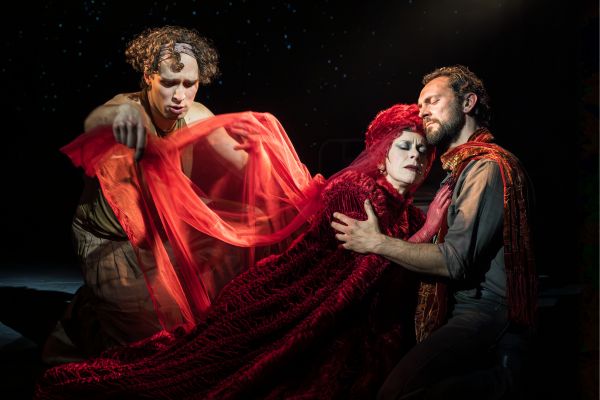
Fabian Soto Pacheco, Anna-Jane Casey and George Blagden in Kiss of the Spider Woman at Curve Leicester and Touring. Picture: Marc Brenner
Kiss of the Spider Woman was reviewed at Curve Leicester where it continues until 25 April 2026. The production then tours to Bristol Old Vic (29 April to 16 May) and the Mayflower Southampton (2-6 June).
Star rating: five stars ★ ★ ★ ★ ★
John Kander and Fred Ebb, the legendary songwriting team behind groundbreaking musicals like Cabaret (1966) and Chicago (1975), have long specialised in blending sharp social commentary with dazzling theatricality. Their 1993 musical Kiss of the Spider Woman – with a book by Terrence McNally – adapts Manuel Puig’s influential 1976 Argentine novel El beso de la mujer araña.
Puig, an openly gay writer forced into exile during Argentina’s turbulent political years, crafted a story that explores queerness, political repression and the power of imagination under authoritarianism. The novel also inspired a 1985 film starring William Hurt and Raúl Juliá, and a 1983 stage play.
The musical premiered in 1992 in Toronto under the direction of Harold Prince (the visionary behind The Phantom of the Opera and many Kander and Ebb hits), transferred to London’s West End later that year (running for 390 performances at the Shaftesbury Theatre), and opened on Broadway in 1993. There, it became a critical and commercial success, running for 904 performances and winning seven Tony Awards, including Best Musical, Best Original Score, Best Book, Best Actress in a Musical (for Chita Rivera as the Spider Woman/Aurora) and Best Featured Actor (Brent Carver as Molina). Rivera’s iconic, sultry portrayal of the title character remains a benchmark for the role’s blend of glamour and menace.
Now, more than three decades later, this first major UK revival since the 1992 West End production arrives at Leicester’s Curve Theatre. Directed by Paul Foster (known for his intelligent stagings of A Little Night Music at the Watermill and Kander and Ebb’s Curtains at the Wyndham’s Theatre and on tour), it feels remarkably fresh rather than archival – clearly a labour of love. Where the original Broadway version leaned into lavish spectacle under Prince’s direction, this intimate production emphasises psychological depth and raw immediacy, making the story’s themes of resistance through fantasy feel urgently contemporary amid ongoing global conversations about identity, authoritarianism and escapism.
Set in a grim prison cell under a Latin American dictatorship, the musical centres on two unlikely cellmates: Luis Molina, a gay window dresser imprisoned for his sexuality and accused of corrupting a minor (in this production implied as entrapment), and Valentin, a hardened Marxist political prisoner. Their evolving bond – marked by tension, tenderness and mutual transformation – unfolds as Molina recounts elaborate, Golden Age Hollywood-style film plots starring the glamorous Aurora. These escapist fantasies, embodied by the spectral Spider Woman, a figure of seductive death, interrupt the brutal reality of incarceration, highlighting imagination as a profound act of survival and defiance.
Foster directs with precision and sensitivity, never letting the audience lose sight of the prison’s claustrophobic harshness while allowing the fantasy sequences to erupt with seductive theatrical energy. The production captures the work’s central paradox beautifully: escapism is not mere frivolity but a vital tool for endurance and humanity in the face of oppression. In a more intimate studio setting at Curve, the emotional stakes feel heightened and personal compared to the grander original stagings, resulting in a revival that honours the musical’s legacy while sharpening its political and queer resonance for today’s audiences.
At the heart of the production are three standout performances that more than hold their own against the ghosts of Rivera, Carver and Anthony Crivello (who originally played Valentin).
Fabian Soto Pacheco delivers a triumphant Molina – warm, witty and layered with profound vulnerability. Pacheco charts the character’s arc from self-protective dreamer to tragic figure powerfully with emotional nuance and heartbreaking authenticity. His portrayal brings a fresh tenderness that feels deeply human and contemporary.
Opposite him, George Blagden invests Valentin with compelling ideological severity and guarded intensity. His gradual emotional unravelling is handled with intelligence and restraint, and the chemistry between the two men forms the production’s beating emotional core.
Anna-Jane Casey is magnificent as Aurora and the Spider Woman. A perfect embodiment of the character, even looking like a spider at times thanks to the fabulous video projections by Andrzej Goulding, she commands the fantasy sequences with thrilling glamour, danger and an untouchable star quality, injecting the exact theatrical electricity the dual role demands.
Visually, the production is striking in its contrasts. David Woodhead’s austere, claustrophobic prison set grounds the action in harsh realism, while Howard Hudson’s lighting fluidly shifts it into noirish or dreamlike territory. Gabriella Slade’s impressive costumes add opulent sheen to the fantasies and Joanna Goodwin’s choreography gives them a sweeping, cinematic flair. Under Dan Glover’s musical direction, Kander and Ebb’s rich, tango-infused score – moving seamlessly from lush Broadway glamour to menacing political undertones – sounds as potent and layered as ever. Goodwin as choreographer does a marvellous job despite reductions of big production numbers such as ‘Where You Are’.
This masterful, long-awaited revival deserves a West End transfer, where there’s a serious lack of intellectually and emotionally challenging musicals. It comes at just the right time, as its themes uncannily resonate in today’s climate of hysterical transphobia.
It also makes clear why Bill Condon’s movie version last year failed so dismally – by cutting some of best songs for the sake of realism when there’s enough of that in the score anyway. ‘Dressing Them Up’ at the beginning would have added lightness to Molina’s character in the film, as it does here, while the anthem ‘The Day After That’ moved the whole audience to tears, beautifully delivered by Pacheco – a climatic message of hope that we need now more than ever.
This is a bold, deeply moving revival, assuring its place in the pantheon as one of the most gut-wrenching and politically powerful pieces in modern musical theatre.
Patrick Honoré
SHARE THIS POST:


Comments are closed.