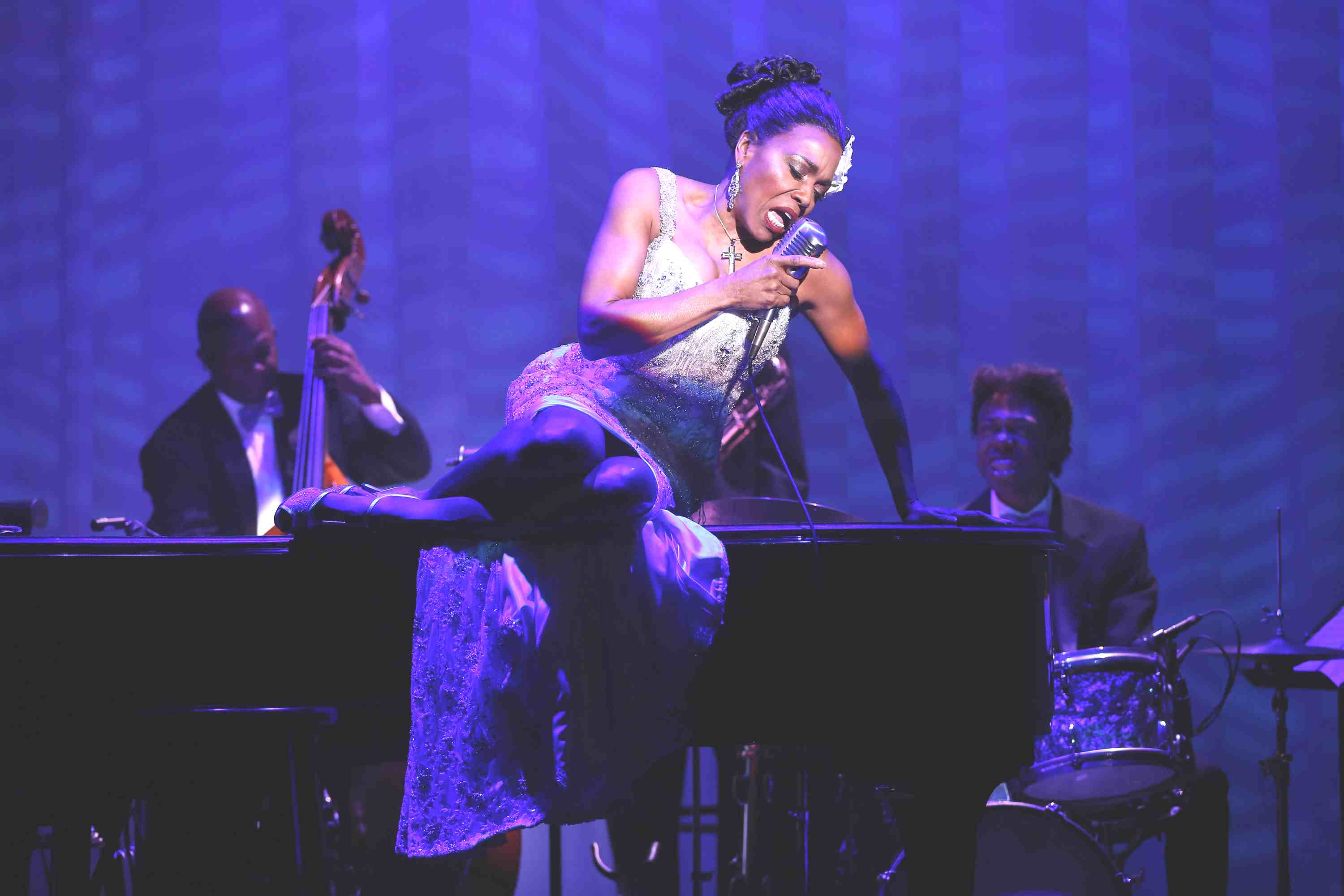
Dee Dee Bridgewater in Lady Day at the Little Shubert Theatre, New York. Picture: Carol Rosegg
Lady Day opened at the Little Shubert Theatre, New York, for an open-ended run.
Dee Dee Bridgewater, a major talent herself when it comes to interpreting the great jazz standards, is simply spectacular in channelling Billie Holiday in Lady Day. Bridgewater is, of course, no novice when it comes to celebrating the jazz legend. In 2011 her CD homage to Holiday won a Grammy Award as Best Jazz Vocal Album, and back in 1987 her performance in a production of Lady Day at the Donmar Warehouse gained her an Olivier Award nomination.
Her work in this current Off-Broadway offering, playing New York for the first time, is a vibrant and accomplished mesh of both singing and acting, infused with a compelling sense of immediacy.
The script by Stephen Stahl, who also directed, recounts one of the many eventful days in Holiday’s turbulent life. It is late August, 1954, in the gritty backstage rehearsal area of a London theatre, and as Act I begins a quartet of jazz musicians are waiting for Holiday to arrive for a rehearsal. The concert that evening – the finish to a European tour – is crucially important. Good reviews might help the singer win back her Cabaret Card, allowing her to work again in New York nightspots. It was taken away after an arrest on drug charges.
When Holiday finally arrives, she is filled with stress, one moment hostile to her musicians, and in the next showering them with exaggerated bonhomie. As she talks to the musicians and her beleaguered but ever-sympathetic road manager (well played by David Ayers), we are told various snippets about her life. And when she takes a break from singing, she is overcome by memories of her past, with Bridgewater enacting monologues of Holiday’s brutal childhood and recalling the humiliations of touring the segregated Southern states of the US as the vocalist with a white band. It’s not the most felicitous dramaturgy, but Bridgewater handles it with aplomb, even when portraying a rape.
In Act II, we witness the concert that evening. The setting has been transformed to an elegant concert stage, and Holiday is a sumptuous vision of glitter, white fur and her trademark white gardenias (Beowulf Boritt does the set design, Patricia A Hibbert the costumes). But the singer is also inebriated. She greets the audience with hostility, filling them in with more incidents from her life, fighting the poverty, addiction and racism that plagued her. Nevertheless, she does sing, and as the concert progresses, Holiday works through her demons and even realises that the audience is with her. And in an upbeat ending singing the song ‘I‘m Pulling Through’, she reaches out triumphantly across the stage to shake hands.
The ending in not entirely deceptive. Although Holiday died five years later at age 44 of ailments stemming from cirrhosis of the liver in a New York hospital room – a room with police stationed outside the door reflecting her arrest for possession of narcotics – she did have a renewed burst of acclaim in the mid-50s. The release of her autobiography in 1956 was accompanied by an album with four new tracks, and that same year she sang two jammed concerts in New York’s premiere concert venue, Carnegie Hall.
While the narrative gives the proceedings the semblance of a dramatic arc, it is, of course, the music that is Lady Day’s raison d’être. With traffic backing from the musicians, the show pulsates with some 25 numbers. And as Bridgewater renders them, they all become once again Holiday signature tunes, from such scintillating ditties as ‘Them There Eyes’ and ‘T’ain’t Nobody’s Bizness If I Do’ to wrenching interpretations of ‘You’ve Changed’ and the groundbreaking ‘Strange Fruit’. Holiday’s distinctive phrasing and gut-grabbing emotionality seem to be in Bridgewater’s marrow, and when she adds her own vocal prowess to the mix – as opposed to the fragile instrument that Holiday’s voice became in her later years – it is totally thrilling. Thanks to Bridgewater’s bountiful talents, Lady Day brings back a legend in full glory.
Ron Cohen


Comments are closed.