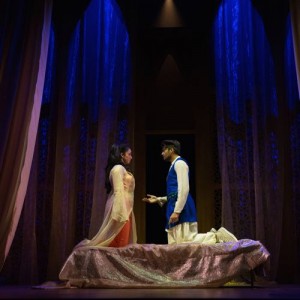
Mona Goodwin and Reece Bahia in Laila the Musical at Watford Palace and Touring. Picture: David Fisher
Laila the Musical continues at Watford Palace Theatre until 17 April and the show tours until 4 June.
Star rating: four stars ★ ★ ★ ★ ✩
Pravesh Kumar introduces his new musical Laila in the programme, writing: “I first heard the story of Leila Majnu from my grandmother when I was nine. I had noticed her call one of my uncles a ‘Majnu’ and questioned her about it. In South Asian and Middle Eastern culture pining young lovers are often called Laila or Majnu. I knew the story of these star-crossed lovers long before I had ever read Shakespeare’s Romeo and Juliet, which is remarkably similar in places.
“It made me wonder why the greatest love story in the East is still relatively unknown in the West… I spoke to many young people in the British Asian community who are stuck between two cultures, trying not to disappoint their families and often honouring their parents over their own heart. It reminded me of this story. I had to look deeper at the conflict of the two families – what honour really means to them. It is unfortunate that centuries later, the story of Laila Manju is still very relevant. I wanted to give all those silent Lailas a voice to shout out loud and sing.”
And so he does. I thoroughly enjoyed this new musical, from its dramatic opening set in a 21st century bookshop with expressive and beautifully danced choreography by Cressida Carré, to the differently told but instantly recognisable 7th century Persian story of doomed lovers from feuding families.
With much attention to detail, effective staging, sumptuous costumes, billowing silks and some very beautiful lighting, Kumar’s excellent and characterful ensemble cast fully commit themselves to this story with strong and witty performances, some playing several roles.
Mona Goodwin particularly shines as Laila, proving herself a charismatic and warm singer/actress with Reece Bahia’s Qays as her young, idealistic but ultimately doomed lover.
A vibrant, evocative score from Sumeet Chopra is a fantastic East/West fusion with traditional Sufi musicians playing alongside modern rock instrumentalists. Catchy, poignant and powerful songs sweep us along, as well as some beautiful, delicate melodies and moments.
Surinda Singh Parwana (playing the Father and the Princess) who was the star of this company’s previous musical two years ago, Britain’s Got Bhangra, is not only a singing ‘star’ in his own right, but is also an incredibly strong and charismatic singer.
I would buy this cast CD for the music (despite a few crass lyrics which could possibly be re-scripted). The songs ‘Laila and Her Majnu’, ‘Follow the Wind’ and ‘It is You’ are the standout songs, but I loved all the tracks and was very impressed by the instrumentation and arrangements of the entire score.
The production also uses effective shadow puppetry to set the (ancient) scene which is instantly recognisable as similar to that used in Tori Amos and Samuel Adamson’s wonderful The Light Princess at the National Theatre two years ago and sure enough this was designed by the same puppet designer Matthew Robins.
Production company Rifco has something very important and impressive to offer to British theatre and in 2016 the question needs to be asked as to why ‘Asian’ theatre is constantly being pushed into an ‘ethnic’ place rather than simply being part of mainstream British theatre, since that is what it is.
Judging from the enthusiastic audience reception at the Watford Palace, Laila will deservedly be much enjoyed and appreciated as it tours throughout the UK.
The show is a vibrant and very welcome addition to British musicals from Pravesh Kumar (book), Sumeet Chopra (music) and Dougal Irvine (lyrics).
Catherine Françoise
SHARE THIS POST:


Comments are closed.