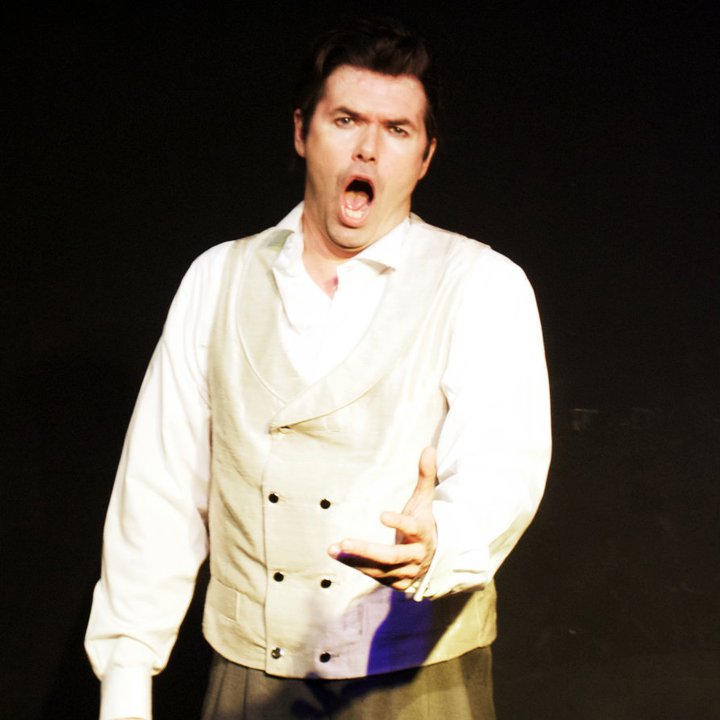
Andrew Bain in Lanza at St Mary’s Church, Perivale
Lanza was performed at St Mary’s Church, Perivale as part of the Ealing Autumn Festival.
Andrew Bain has brought off a remarkable double act by starring in his own play about singing legend Mario Lanza.
Lanza was a singing phenomenon of the post-war years who from 1949 onward, when he made his screen debut in That Midnight Kiss, was as popular as Bing Crosby, Frank Sinatra and Doris Day, both as a recording artist and motion picture star. The three of them began their apprenticeship as singers in big bands, Lanza studied singing from his father’s collection of Caruso records and later from a professional voice coach, yet he never fulfilled his desire to appear on the operatic stage. His early death at the age of 38 was brought on by an excess of wine, women and song, yet his name still resonates today through his records, the numerous radio programmes that have been produced about him, and the stories of his notorious behaviour in Hollywood, the place that had made him a star, yet one he came to despise.
Bain looks like Lanza, though he stands considerably taller, with a commanding presence on stage, in this case the nave and chancel of St Mary’s, an historic church in Perivale in west London, with an excellent acoustic. He sings with power and grace. His voice, modelled on but in no way a slavish copy of Lanza’s tenor, has a baritone resonance. He catches Lanza’s brash style and open vowels of Philadelphia to the manor born. His quieter singing is a pleasure to hear as at the beginning of Romberg’s ‘Serenade’ (‘Overhead the moon is beaming…’) as well as in his commendable restraint in ‘You’ll Never Walk Alone’, a song he sings most movingly. It’s possible that Bain may not know the power of his own voice. It travels so easily, has such resonance, that he might consider holding back the volume, keeping something for future performances in reserve.
His is a passionate portrayal revealing the vulnerable Lanza, a figure aware of his lack of standing in the operatic world, where he craved to be, as well as a person capable of drunken fits, striking his wife or reversing his car into the porch of the house of Joe Pasternak, the Hollywood producer, who masterminded his starring role in the screen biopic of Lanza’s hero, The Great Caruso.
The written lines flow effortlessly beween the 14 musical numbers played on piano by the only other character we see on stage, Lyndall Dawson. Her non-speaking roles include Mrs Lanza and a nurse, dressed in white uniform, whose silent but uncanny presence at the beginning and the end of the story is a clever theatrical ploy by director Anthony Shrubsall that brings Lanza’s tragic tale full circle. This is an entertainment without a dull moment, skilfully put together and well worth a visit.


Comments are closed.