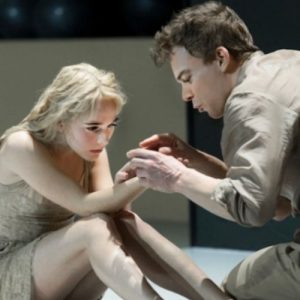
 Lazarus, streamed on dice.fm.
Star rating: five stars ★ ★ ★ ★ ★
David Bowie’s Lazarus is a stage musical sequel to movie The Man Who Fell to Earth, co-written with Enda Walsh and directed by Ivo van Hove. It was the late rock star’s last major project, along with his album Blackstar. Re-reading the critical reaction to the show’s 2015 London premiere, what is striking is the variety of responses. All praised its set, projection work, and acting, but many were turned off by its difficult and opaque narrative.
I fell in love with that original production. Like many others who through impeccable taste and/or infuriating teenage pretension didn’t quite vibe with the polished bubble-gum of noughties pop music, David Bowie was a key musical icon of my younger years. With its score of distinctively-him original songs and reworked classic hits, Lazarus pulled on my every heartstring. The protagonist felt alien to the world around him, hope was represented by a child of the age I was when my Bowie obsession was at its peak, and I had red wine to drink. It was a surprisingly emotional night that remains one of my London theatrical highlights.
To commemorate Bowie’s birthday and the fifth anniversary of his shocking death, a filming of that King’s Cross Theatre production was made available for the first time via online streaming. If the current high watermark for filmed musicals is Disney’s movie of Lin-Manuel Miranda’s Hamilton, then despite its presumably smaller budget and far more theatre-specific projection set pieces, this presentation is absolutely in the same ballpark. The filming may not replace being there in person, but it at least works with the performances to become a piece that can be enjoyed in its own right.
The camera work is phenomenal. Wide shots are eerily wider than you would expect, and close-ups fill the screen with the actors’ facial tics. The heroic camera operators glide back and forth smoothly, anticipating the performers’ every move. The aspect ratio is cinematic, and for a musical recorded live, it looks not unlike a sci-fi movie.
The music is well-presented, with the live guitars given just enough power to transmit the rock ‘n’ roll spirit of the songs, but with just enough of a midrange cut to never overwhelm the vocal lines. Nothing can ever replace a live theatrical experience of course, but we aren’t going to get another one of those for a while yet. I would be quite content to see many a play recorded with this level of care.
This film is also a fantastic document of these actors’ excellent performances. The close-ups allow us to appreciate Michael C. Hall’s committed, inhuman characterisation of the alien protagonist, Newton. His performance is extremely kinetic, and he throws himself to every corner of the wide stage. Aside from a complete identity breakdown, Amy Lennox is given more relatable human emotions to work with as Newton’s assistant Elly. She delivers an engaged and showstopping complementary performance to Hall’s alien otherworldliness.
Newton finds salvation in his muse, a young girl who is simultaneously a figment of his imagination and a very real ghost. Her name is Marley, played by Sophia Anne Caruso. A performer of any age would struggle with the balancing act of singing quite difficult vocal lines while bringing to life this being of pure joy and hope, but Caruso is singularly gifted. Michael Esper is terrifying as Valentine, the unnerving and unstable angel of death. The stage is darker during his scenes, and not just because of the impeccably well thought out lighting work.
The set design and projection are extraordinary, and it is great to see it captured here at all the right angles to fully showcase its ingenuity. It would spoil the show to reveal too much, but it is used cleverly to show alternate timelines, the future, and the dark recesses of Newton’s mind. Such technology can sometimes be overused by overzealous designers in high-budget theatre, but in an arty sci-fi show such as this it really works.
Jukebox musicals are often wonderful, joyous experiences that everybody can enjoy. It is important to be clear that this play is not a traditional jukebox musical. If you recognise a song, it won’t be performed the way you heard it on the record. There won’t be any singalongs. The plot isn’t a device to justify singing some more songs: it is difficult to understand, if indeed it actually makes sense at all. This may be a complex work of genius, or it may be impenetrable, pretentious nonsense. It will provoke polar-opposite reactions in equally cultured and intelligent people. As with all art, no opinion is wrong. This is exactly the show that Lazarus had to be.
Over the years, many music-lovers have formed a unique personal relationship with Bowie. Famously, he inhabited a multiplicity of characters throughout his career. Everybody’s connection to his mythos will be different, and many of these connections will be deeply-felt. Lazarus’ enigma is necessary to allow us to project upon it the experience we need to have. It is a Rauschenberg approach to theatre that is as universal and accessible as a musical by David Bowie, with all his high art influences and desire to play the game differently, could ever have been.
Ian Bowkett
SHARE THIS POST:


Comments are closed.