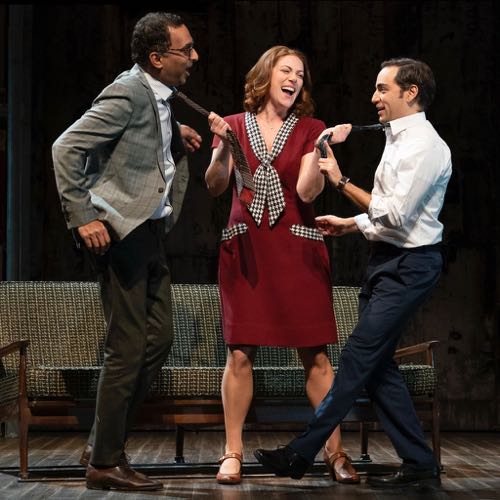
Merrily We Roll Along continues at Roundabout Theatre Company’s Laura Pels Theatre, New York until 7 April 2019.
Star rating: five stars ★ ★ ★ ★ ★
Yes, it’s another day and another iteration of Stephen Sondheim and George Furth’s Merrily We Roll Along, the show that flopped on Broadway in 1981 and through a series of revivals and revisions has morphed into one of the most beloved entries in the Sondheim canon.
This time around in a production by the insanely talented group of theatre-makers known as Fiasco, supported as a resident company by the not-for-profit powerhouse Roundabout Theatre Company, the show once again proves its brilliance, with Sondheim’s ear- and soul-filling score and the poignancy of its intention overcoming whatever clunky defects remain in its unconventional storytelling.
The script, as you well know, tells how the deep youthful friendship of three creative people grows toxic under the pressures of fame, money and personality. And like the 1934 George S. Kaufman-Moss Hart play of the same title that inspired it, the show tells its story by going backwards in time over nearly a quarter of a century.
“We wanted to bring out the passion, fun and the let’s-put-on-a-show energy that infused the 1981 script,” says Jessie Austrian, one of Fiasco’s three co-artistic directors, in an interview printed in a Roundabout booklet accompanying the production. And indeed, that energy, with the cast pared down to just six terrific performers under the inspired direction of Noah Brody, also a Fiasco co-artistic director, is one of the key elements making this redo such an exhilarating experience.
Also crucial are the orchestrations and new arrangements for the eight-piece orchestra by Alexander Gemignani, giving the intricacies of the Sondheim score their full due. (Gemignani is the son of Paul Gemignani, one of Broadway’s leading music directors and a frequent Sondheim interpreter; Alexander is also a notable Broadway performer, most recently receiving a Tony Award nomination for his Enoch Snow in last year’s revival of Carousel.)
Ben Steinfeld, the third member of Fiasco’s artistic triumvirate, plays Franklin Shepard (or reflecting the pared down nature of the show, identified in the cast list simply as Frank), the gifted musical theatre composer who deserts his art – and his devoted first wife Beth and his devoted songwriting partner Charley Kringas – to toil as a film producer in the Philistine fields of Hollywood.
Manu Narayan plays Charley, who feels embittered by Frank’s abandonment but nevertheless finds success on his own as a playwright, while Austrian embodies the writer Mary Flynn, the distaff side of the bond made by her, Charley and Frank when they come together as young career-seeking hopefuls on a New York rooftop to watch the Russian space rocket Sputnik travel the nighttime sky.
Each of the three is vividly drawn. Steinfeld’s quotidian looks provide an interesting psychological base for Frank’s trajectory, and while you may dislike him, you feel for him as he loses touch with his fledgling idealism and aspirations.
Narayan’s sturdy persona makes Charley’s attachment to Frank somehow purer and more touching rather than neurotic, while Austrian’s Mary, her writing career driven off track to too much alcohol by her unspoken romantic yearnings for Frank, is a magnet for our pathos.
When they join together celebrating their togetherness and youthful aspirations in such Sondheim gems as ‘Old Friends,’ ‘Opening Doors’ and ‘Our Time,’ it’s an exhilarating ode to friendship that overrides the more cynical aspects of the story.
The other three cast members take on multiple roles with aplomb, but each has one significant portrayal. Brittany Bradford plays Frank’s first wife Beth. Her bitter rendering of the soaring ‘Not a Day Goes By,’ when Franks tells he he’s divorcing her, is a heart-breaker.
Paul L. Coffey plays Joe, the Broadway producer who urges the Shephard-Kringas team to write songs you can hum and gets them to create the flashy, commercial shows that ignite their careers. He finds both the humour and humanity in the man, his unhappiness when he loses his wife, Gussie, a Broadway star, to Frank.
As Gussie, Emily Young can’t quite shake off a youthful demeanour that doesn’t quite jibe with the character’s core as a sophisticated, man-trapping Broadway dazzler. Still, she handles her vocals fetchingly and the disparity oddly offers an affecting nod to the first production, when a cast loaded with teenagers portrayed characters whose ages spread way beyond their own, often leaving audiences confused.
Furthermore, Young melds beautifully with the rest of the cast in the show’s vibrant ensemble numbers, such as ‘Rich and Famous’ and ‘The Blob’. These and many of the other musical numbers are given extra punch by Lorin Latarro’s choreography, smartly adding to the moods and intentions of the songs.
The score has been thinned but with no feeling of disruption. In particular, a number of the transition interludes – variations on the title song that opens the show — have been cut in favour of having cast members shout out the year in which the following scene takes place. Also gone, as it often is, is the original production’s closing song, the hymn-like ‘The Hills of Tomorrow’.
The whole show with no intermission comes in at under two hours. But never fear, there is plenty to savour. In addition to the highlights mentioned above, there are Narayan’s strong takes on such varied numbers as ‘Franklin Shepard, Inc.’ and ‘Good Thing Going’; Steinfeld’s thoughtful ‘Growing Up’ (added to the score after the 1981 production), and Austrian’s touching ‘Like It Was’.
The imagination at work in the performances is also reflected in the set design by Derek McLane, a sort of backstage space bordered by shelves overflowing with props, costume pieces and even a discarded marquee sign from the Alvin Theatre, where Merrily premiered (it’s now called the Neil Simon).
The costumes by Paloma Young and Ashley Rose Horton are another asset, elemental but adroit. Especially notable is Austrian’s montage-like shedding of one gown after another during ‘Old Friends,’ trimming down the middle-aged Mary’s alcohol-induced poundage to the slim figure of her youth. Like much of the show, it’s simple but wondrous “let’s-put-on-a-show” magic.
Fiasco’s serving of Merrily may not be the ultimate redo of this show that seems to be ever in flux (will there ever be a definitive version?), but it’s certainly one to cherish.
Ron Cohen
SHARE THIS POST:


Comments are closed.