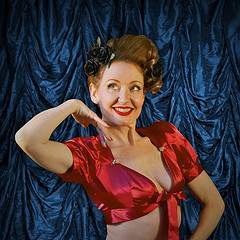
Amber Topaz in Miss Nightingale – The Burlesque Musical, currently on tour
Miss Nightingale – The Burlesque Musical, a touring production, reviewed at the Theatre Royal, Nottingham (23-25 May).
Sex, scandal and showbiz in London 1942 is the subtitle of Miss Nightingale – The Burlesque Musical, a show that highlights the dangers that beset freethinking performing artists in a backward-looking war-torn England, where lust lingers but sexual preferences and being yourself all too easily spell blackmail.
Matthew Bugg has written and composed this unusual piece, which avoids the more glitzy kind of musical and yields a rather restrained, variably paced play with music.
Bugg’s tender-hearted story focuses on a vocal north of England Edith Piaf-type, Maggie Brown (the cheekily suggestive, slyly sexy Amber Topaz) who emerges as the hit wartime singer Miss Nightingale.
Around Brown are two men – the gay mid-European Jewish composer George Nowodny (Ilan Goodman, with just a whisper of David Walliams campness) and her bisexual patron Sir Frank Worthington-Blythe (Tomm Coles) – who grope for identity and each other, while her jettisoned blackmailing ‘ex’ (Alex Tomkins) tries to prise all three apart.
Miss Nightingale’s best numbers are those that catch the risqué flavour of inter-war Berlin. The show also encompasses grim, pithy jokes (“I’m Polish and I’m Jewish – happiness is a genetic impossibility”) and significant ironies (“It’s the male nightingales that sing”).
One attractive feature is that virtually all the actors make up the band. Adam Langstaff, a quality percussionist, doubles up as Maggie’s brother, Harry. Tobias Oliver, an incredibly proficient stage manager in shabby brown overalls, plays tiny roles and emerges creepily as rather a star.
More importantly, Coles repeatedly raises a saxophone and dazzles, Goodman jams serenely or wanly on clarinet, while Bugg coaxes everyone from a pleasingly unobtrusive piano.
In a seemingly family affair, Carla Goodman designs – aptly old-fashioned, including an expressionistically suggestive mini-proscenium for Nightingale and some stylish costuming – and the great actor Henry Goodman supplies a recorded BBC news bulletin.
Several of Bugg’s numbers bring the house down. ‘The Pussy Song’, ‘Meine Liebe Berlin’ (‘we cater for every whim’), ‘Piano Man’, and in the tenser Act II, the stupendous ‘Mr Follow Spot’ which metamorphoses into the climactic ending, all hit the solar plexus.
Some, like George’s introverted ‘I’ll Sing For No One But Myself’, sound melodically thinner and musically weaker. In three-part numbers, the part-writing periodically lacks imagination.
Topaz makes the untrainedness of Maggie’s voice a charming feature in itself. Coles’ Frank, like a teenager movingly discovering gay leanings, is a scorching master of ceremonies, because he speaks and moves so electrifyingly.
This is a brave, original show: and it rewards in a subtle way.
Roderic Dunnett
SHARE THIS POST:


Comments are closed.