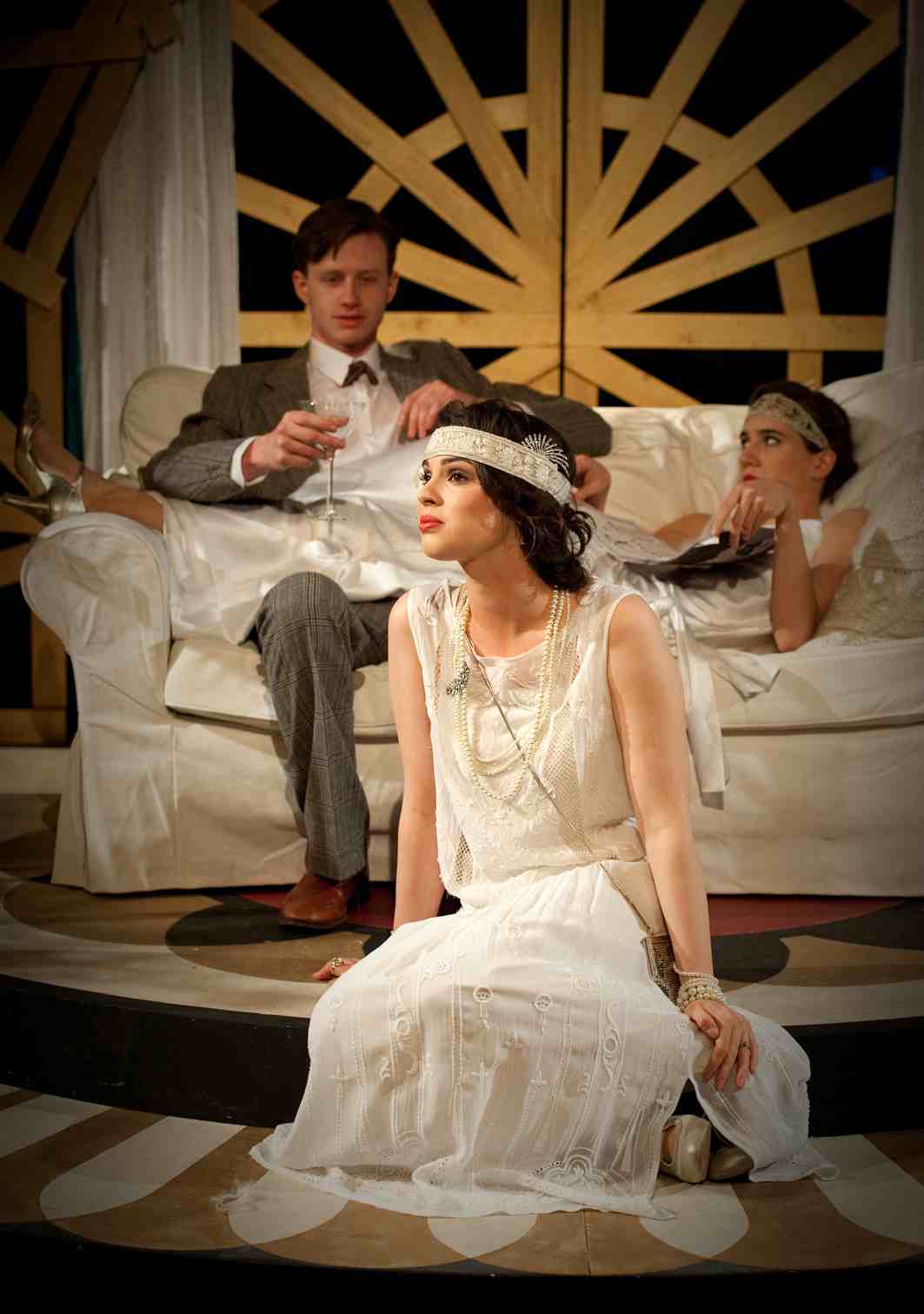
Sid Phoenix and Imogen Daines with Matilda Sturridge (foreground) in The Great Gatsby at the Riverside Studios, London
Playing at the Riverside Studios, London until 8 June.
It is clear from the outset that a Fringe musical of F Scott Fitzgerald’s classic novel The Great Gatsby could never compete on scale or budget with Baz Luhrmann’s $100 million-plus Hollywood adaptation. But nor should it attempt to – and Ruby in the Dust’s production wisely shuns trying. Instead, the limitations inherent within Fringe theatre become its greatest strength, focusing on the crumbling foundations on which the façades of hedonistic 1920s opulence are constructed.
Take Christopher Hone’s set. Architecturally reeking with Art Deco influences, where a bigger budget production might use chrome, everything is constructed from wood. Huge marquee letters spell out ‘G.A.T.S.B.Y’, but we see their reverse: this is a construction, just as Gatsby himself is artifice personified. Conversely, there may be a reason why the railings around the set’s central dais are in place: however, they mainly serve to make entrances and exits as uncomfortable as possible for the performers.
And the cast – many of whom double up as musicians – bring a sense of energy and vitality that allows us to believe that we are experiencing the key slivers of Gatsby’s huge parties, rather than needing to see the whole. This is helped by Joe Evans’ compositions, which drip with affection for the Jazz Age and have been delightfully orchestrated by Chris Walker.
Michael Lindall plays Gatsby himself with an appropriately lantern-jawed, confident swagger until his reunion with Daisy reveals the heart beneath. Matilda Sturridge imbues Daisy with a sense of romantic melancholy that appropriately imbues the whole production with the sense of foreboding it needs, while Ian Knauer as her violent husband Tom and Naomi Bullock as his crimson-lipsticked mistress Myrtle capture the seedier, unpleasant side of Fitzgerald’s Long Island to a tee.
But the real stars of the cast are the outsiders. Sid Phoenix’s Nick Carraway – Daisy’s poorer relative who finds himself drawn into the games played by his rich cousin and her friends – is a rheumy-eyed innocent who, while struggling in his solo musical numbers, nevertheless draws the audience in with him. Without him to engage us into the world of the residents of West Egg, the funereal Act II would be far less affecting.
Throughout, though, all eyes must surely be drawn to Imogen Daines’ scene-stealing Jordan Baker. Daines brings a light and breezy touch that enlivens all those around her, bringing warmth to a character that could so easily be dismissed as a supporting role.
If there are drawbacks to this frugal approach to a portrayal of opulence, they are most noticeable when some of the key scenes of Fitzgerald’s story must happen offstage – most notably at the end of Act II. While concentrating on the aftermath of tragedy fits in with the production’s emphasis on the underlying lives of the characters, there’s a sense that here, at last, Fringe theatre budgets get in the way of the story. But when a production aims so high, even those points where its ambition doesn’t quite pay off are immensely enjoyable.
Scott Matthewman
SHARE THIS POST:


Comments are closed.