 JEREMIAH JAMES is responsible for the original concept behind musical romantic comedy It Happened in Key West which receives its world premiere at the Charing Cross Theatre this month with its official opening on Tuesday 10 July 2018.
A lead producer on the project, he is also credited as a co-writer of the book (alongside Jill Santoriello, also music and lyrics, and Jason Huza, also additional lyrics).
It Happened in Key West is inspired by shocking true events that rocked the tiny island of Key West in the 1930s. After decades of searching for his dream girl, eccentric scientist Carl finally finds Elena, only to lose the young beauty to the fatal disease of tuberculosis. But for Carl, the eternal optimist, death is only the beginning. He steals Elena’s body from the graveyard and takes her home, embarking on the most ambitious “fixer upper” project in history as he tries to bring his beloved back to life…
The show has been described as “Richard Curtis meets Tim Burton”. Broadway actor Wade McCollum (The Wizard in Wicked) plays scientist Carl opposite Alyssa Martyn (The Clockmaker’s Daughter, Landor Theatre/St James Theatre Studio) as the tragic love of his life, Elena.
Here, the producer, director, actor, writer and member of international recording group Teatro is in conversation with Musical Theatre Review’s Tal Fox.
How did you come across this story?
I was on tour doing the National’s version of Oklahoma! that Hugh Jackman starred in all those years ago. I was playing Curly, and I came home late one night and there was this thing on HBO called Autopsy. It was one of those re-creation shows and they said: “At the end of the programme, we’re going to tell you this weird story from Key West.”
So that is how I first discovered it and I was really touched by it. It was macabre and strange but there was this undertone of this touching love story. I thought about it for years and would look it up from time to time, but this is the age before Wikipedia had every answer and YouTube had every clip, so I couldn’t find it for a long time. But it was always in the back of my mind.
What stood out to you about this story?
After all of the crazy things, living with this dead body, after he was found out, these psychiatrists interviewed him to see if he was fit to stand trial, if he was totally insane. All three of these doctors found him to be completely sane, that he was totally aware that she was dead, that he believed she would come to him spiritually and the body was more of a vessel.
We hear stories like that throughout our lives and I was just really touched by this idea. If he’s not loony then who are we to say that she wasn’t there? That’s what stood out for me.

Wade McCollum and Alyssa Martyn in rehearsals for It Happened in Key West at the Charing Cross Theatre. Pictures: Darren Bell
What made you think this would make a great musical?
You skip ahead like six years and I was reading National Geographic in my living room and I looked up that Key West story again. I found that there was now a Wikipedia page, all these clips on YouTube and I thought: “Oh my god, this is that story.” And the more that I was reading the core documents for this, I felt the story was so grand it begged to be told in a musical format.
If you think of things like The Phantom of the Opera, these stories of grandeur. So that is what clicked for me, it was so grand. I also thought about how much fun you could have because you read about the story and the first thing you do is chuckle, people say: “He did what? He took her home, he fixed her up?” It’s so odd and strange and macabre that you have to kind of laugh. I thought this could make a great romantic comedy-like story that the world had never seen before.
How do you find a balance between the comedy and the macabre?
The thing that’s so cool about my two writing partners, Jason Huza and Jill Santoriello, is when we all sat down and I pitched the idea, they instantly understood what I was trying to get across. The difference between The Phantom of the Opera, Sweeney Todd and our show is first of all, our show takes place in the Caribbean, where the sun shines and it’s bright and colourful and it’s full of colourful characters, even to this day.
If you go, Key Westerners are very proud, quirky people, proud of their heritage. The island itself has tried to secede from the United States 40 something times, and when you fly into the airport it literally says: “Welcome to the Conch Republic”. It doesn’t say “Welcome to the USA” because they’re very independent in their nature and very quirky, warm and loving.
So for me the light-hearted side of the show could already be found in the way the island lived and how the people protected themselves and each other – and then there’s this weird thing that he did.
The aspect of the love story that really touched me was that this man really believed that she was his destiny. Then the show is like Man of La Mancha and some of the other musicals over the years that have that fantastic core theme surrounding the ability to love. In The Phantom of the Opera, he kills X amount of people in that show, right? He drops the chandelier and in the first 15 minutes he kills Buquet and does all these things throughout, and then at the end of the show everyone goes: “Awww, Phantom!”
Our guy doesn’t kill anybody. That was kind of the balance – it came directly from the macabre and the love story was already there because she came to him. He said that she was there and when he was discovered he received tens of thousands of letters of support from all over the world.
Key West was quite split over this story, what were your initial thoughts?
In a way I was really heartbroken for him and it made me think of what a beautiful, heartbreaking story it was.
Obviously a lot of time has passed but it was quite a controversial story so have you had any people who still take issue with this story today?
I can honestly tell you that there hasn’t been much controversy. It was universally panned when we pitched the idea, from producers to directors and actors. The thing about this is it’s ‘The Little Show That Could’ because it was difficult for us to get people really excited about it.
It always is an uphill battle but when you come to them with this true story and this guy that lived with a dead body… I mean we pitched this to every Broadway director that we came across that we thought would be right for it and we were universally turned down.
Sometimes they didn’t even open the emails we sent or read the script, they would just Google what the story was about and see this misinformation that was out there about the story and say: “I couldn’t do that, I’m a family man” or “That’s too upsetting, I don’t know how you could possibly make it interesting or funny.”
Across the board people just said: “This is a terrible idea and best of luck!” When I would take meetings with producers and co-producers or independent investment producers or actors, you name it, my argument was always: “Well, what’s your favourite Sondheim show?” and they would say: “Sweeney Todd”!
He murders people on stage, he grinds them into meat pies and they eat them and sing songs about it. Our guy just happened to live with a dead body, that’s it. The fact that it’s a true story and not fantasised strikes them. Nobody has ever really had a response: “Well, maybe…” It is something that we have always fought against since its inception eight years ago.

The cast in rehearsal for It Happened in Key West
So how did you manage to launch the show?
This show came to life because of the dedication of a lot of wonderful people. Friends in the industry, friends of mine and my writing partners, and friendships that I had in general. Our director [Marc Robin], who I’d worked with, happened to come into my dressing room while I was listening to some of the music or getting ready to fix something in the script and we started talking about it. He’s also a writer, lyricist and composer and he and I kept sparking up conversations about it over time.
We did an Indiegogo campaign because we couldn’t get co-producers or investors to save our lives and luckily the internet is a place you can now put it out there. So many wonderful friends and family believed in us which meant we could get the show to its 29 hour reading.
Marc and his theatre at the Fulton Opera House, invited us there to do this lab which ended up selling out and we had to open up other parts of the theatre and it became this wonderful thing. If it was not for those people, we would not be where we are today.
The goal to bring it here [London] was always the intention and again I was able to reach out to people in my life who supported me as an actor and when I was part of my band Teatro. I’m just very lucky that I have such wonderful people in my life who said: “You know what? I believe in this.” They set up meetings with theatres and theatre owners and here we are.
Why did you decide to bring the show to London?
I lived here for almost three years and theatre is built into your culture in a way that it’s not in the United States. New York is a microcosm and then you’ve got this vast space of America where there’s little regional theatres here and there and a lot of them do quite well. There’s a sensibility here, you guys embrace it in a different way than we do in America. If it’s a new show you’ll go see it, America says: “It’s not Anything Goes, 42nd Street or Guys and Dolls.”
It’s just too risky because it costs so much money to lose on a new show but there are shows here that you love that would never come to America, like ever.
I loved We Will Rock You, I know people gave it a hard time but I loved it. Here was a jukebox musical that said: “Hey, we’re a jukebox musical, wink wink, we know and we’re having a good time.” It toured the US but it would never come to Broadway, there’s a lot of shows like that, there’s like a quirkiness to them. The Brits response is: “Yeah, come on, entertain us!” It’s just a bit more open.
Matilda is a great example. It started here at the RSC and it’s very panto in my opinion, with the guy playing the evil school ma’am and then America goes: “Gimme, gimme, gimme!” because it’s such a big hit. I always felt that if we brought it here and the British theatre-goer was with us, then we would be in a really great place to then take it to other places – America, Germany – places that have really great theatre followings.
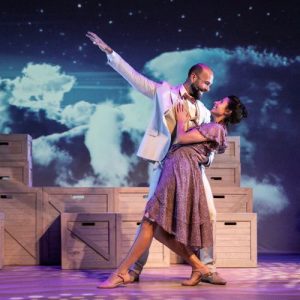
Wade McCollum and Alyssa Martyn in It Happened in Key West. Pictures: Darren Bell
Do you think it’s also easier to do it here because there is more distance between a British audience and the story?
Yes and no. Yes, there’s a bit of a detachment but actually what I found out is that London is the second largest tourism market for Key West, I had no idea! I wish I could say I had some grand knowledge of that before I made this decision but I didn’t. Yes, partially the content, a bit of disconnect but also it was just something that we thought British audiences would go for, you guys enjoy quirkiness in a different way and Americans are more: “Hmm, I’m not so sure.”
Would it be fair to compare the story to Frankenstein?
He does do something very similar, trying to use these things to bring her back but nothing so heavy. This show is if you take the joy of Gershwin’s Crazy for You, the silliness of those characters, the silly gun fights they do for tourists and all of that silly back and forth slapstick, you mix it with a little Man of La Mancha because – was he delusional, was it all a dream, or wasn’t it? Then you mix that with some movies like Lars and the Real Girl, Weekend at Bernie’s and Mannequin from the 80s, and that’s pretty much what the show is.
It’s fun because the people in Key West are fun and yet it really is this beautiful story full of heartache and loss. The show is truthfully about acceptance and understanding.
Going back to the developmental lab, how does that work
The lab was a loosely staged version of the show, we had two weeks of rehearsals, two weeks including tech, so it was a fast and furious process. We did basic staging, it wasn’t an on book presentation, it was a show and we wanted to give it as much of a go as we could without it being a full production.
The funny thing was with that, it was a learning curve. The Fulton Opera house in Lancaster Pennsylvania is a very conservative Christian area. The residents are very religious and get offended by certain things that push against their religious beliefs, they’re a very hard crowd, so I gave all the tickets away for free. There was no money for us at all because I wanted to know what real theatregoers thought. When you do shows like this, everybody wants to give you their opinion as a theatre person: “Here are my notes,” “Here are my notes….” You have to have a good filter to know where it is a worthwhile project or not. The people we don’t listen to enough are the people who buy the tickets.

Miguel Angel, Johan Munir, Guido Garcia Lueches, Alexander Barria and Wade McCollum in It Happened in Key West
Look at something like Joseph and the Amazing Technicolor Dreamcoat. Joseph is done, it sells like gangbusters, and it often gets horrible reviews. The critics write: “This show is dumb, I’m here because I work for the newspaper, this isn’t Lloyd Webber’s best,” but it sells out because it’s joyous and because people think it’s beautiful and fun and there are touching moments and they know the story so they’re on board.
I wanted to know what those people thought after every performance at the lab, everybody was welcome to stay and we would do a microphone talkback for as long as people wanted to chat with us to get a sense of what real theatregoers wanted. It was free so they would say: “I would have paid $100 for this,” or £50 or £20 and “I would come back again and again for that price.”
Then you can get an understanding that you might be on the right track. The thing that was so amazing about the lab was that we had all these things we’d spoken to professional illusionists about but we did this stripped down version and people said that that’s what they loved most. They loved that it was simple and focused on the story and they were so on board with the performers. We had grown men crying because their wife died of cancer saying: “the show really touched me because you really understand love and loss and how it could make you feel crazy and what you would do to save the person you love.”
There’s a sensibility that losing someone can drive you to a certain point. It was really unbelievable, people in these talkbacks spoke about how touched and moved they were. These were really conservative audiences and it was really quite beautiful. It taught us so much about what we needed to do and all the little fixes we needed, it was very exciting.
So that was what the lab was, it was our place to experiment and it was really amazing because then we realised we didn’t need any of these magic tricks, we didn’t need any of these grand effects. We could upgrade the technology we were already using, better staging with more actual rehearsal time, and then we would be off to the races. Essentially that’s what your audiences will see, a version of that but with better technology.
Did you deliberately choose the Charing Cross Theatre?
We had a choice between three or four different venues that we were having conversations with. I didn’t want to put us into a giant theatre because the show only has 12 cast members and two swings. I wanted something that was intimate, I want the show to get the recognition that I believe it deserves and there aren’t too many theatres in that size bracket that can also give us all the things we’re looking for, location and getting people there. You don’t want to be too far off the beaten path.
A dear friend of mine who had done productions with that theatre recommended it. I was able to sit down with managing director Steven Levy and he was an absolute joy and he reminded me that I had actually sung in his living room once many years ago when I was hired to play Billy Bigelow in a revival of Carousel. I was put on tape for Rodgers in his house so we had this connection from a decade ago. From there forward, that was the right spot.
 You’ve been in possibly every position in the theatre industry. How do you decide to hand over the reins to someone else and not just take on every role yourself?
It’s not easy but I’m very lucky to have incredible people around me. I wish I could take credit and say that I’m smart enough to stand back but you always have that sensibility that you want to be hands-on and want to fix everything, but you have to realise that this is why you have other people, that you have to trust in others. I’ve always been told by one of my mentors who brought me into producing in general that you should build a family. This is a family so it’s not always going to be perfect, but you have to trust these people and care for them and know from a producer standpoint that everybody is treating each other with respect and that’s respecting their artistic vision as much as you want to put your stamp on things.
Though you may think that you have this grand understanding, they actually know what they’re doing as well and you must give leeway to each other to make mistakes so they can figure it out. It’s always a challenge for anybody in my position, especially someone who has been a performer and writer. It’s always difficult, but I’m really lucky that I have such incredible people around me. I can stand back and say: “You’ll handle it, I’m not worried.” I’m very lucky in that way.
We seem to be in the era of the revival so how do you feel about presenting new work in this environment?
I’m really excited about it, I can honestly say that there’s nothing like our show right now and it’s very exciting to present something new. People have asked me in the past what my favourite moment was in my career, was it when I met the Queen at the Royal Variety Show or was it doing this or touring that and I can honestly tell you, for me it was the first time I was sent a fully realised script of this show.
To be able to know that there is a song that only exists because we willed it to exist, that a story is going to be told in this way because we willed it to happen. I know this is cheesy, but that it would live long past us. It’s very exciting to bring something new into this world right now that’s been risky and to do what I have always loved.
 I remember when I worked with Julie Andrews, I asked her if it bothered her when people brought up Mary Poppins or The Sound of Music and she said: “No, why would it bother me? It’s brought joy to millions and millions of people all over the world. Isn’t that why we got into this business in the first place?” And that’s what excites me most, bringing so much joy to people with a show because it’s really touching and we wrote it from a place of wanting people to feel uplifted.
They’ll walk out and have laughed so much, were moved and maybe cried a bit, feeling it was everything that a musical should be from that old style of shows that we love and those revivals to what we love from new shows. So that’s what’s been very exciting for me, to present new work.
What are your plans for the show after Charing Cross?
Everybody’s hope is that the show gets transferred to a bigger theatre and run forever. If something like that came to pass, it would be amazing. We hope to have it running here and then do the United States premiere and then Broadway. Our goal is to go to Broadway and have that opportunity and be up for Tony Awards and all that sort of thing.
What do you hope audiences will leave the theatre with in mind?
Understanding and acceptance. It’s easy to say that someone’s crazy, it’s easy to dismiss people, it’s easy to put people in a bracket and we usually do that. I think we don’t take the time to look a little further. My hope is that people walk away uplifted and take away this message of love and acceptance and understanding. If we do that, we will be in pretty good shape.
What other projects do you have in the pipeline?
I have a one man play that I’m also developing about the life of a gentleman named Dave Droxler and his love for Robin Williams. I will be finishing here and then, as an actor, I will be going back to the Fulton Opera House for the huge premiere of the show that our director, Marc Robin, wrote called Treasure Island – based on the classic. I also have a book that I have written which will be published before the end of the year so it’s a crazy year and I’m humbled by all of it. It’s been a lot of hard work but I’m excited about each one of the projects.
It Happened in Key West continues at the Charing Cross Theatre, London until 22 September 2018. Tickets are available HERE.
Jeremiah James: As a producer, Jeremiah James has developed and produced various theatrical productions, one-person shows, and staged readings in New York, LA and as far afield as Africa. His first venture into producing was the international recording group Teatro (of which he is a member). As a writer, James has projects in various mediums. Along with co-writer and collaborator Devon Cannon, he has two new musicals currently in development. A TV show, The Theatre Re-Invention Project, conceived by James and written by himself and Karen Moline, is in its final stages of development for network television. After being invited to attend the Eugene O’Neill Cabaret Conference, James ventured into the world of writing and directing one-person shows.
SHARE THIS POST:


Comments are closed.