Picture: Alex Brenner
Precipice continues at the New Diorama Theatre, London until 13 December 2025.
Star rating: three stars ★ ★ ★ ✩ ✩
Post-apocalyptic, dystopian fiction has been a staple of film, TV and video games for many years – think The Last of Us or The Walking Dead, WALL-E or The Day After Tomorrow. It’s less common on stage, although not unknown, from Caryl Churchill (1971’s Not Not Not Not Not Enough Oxygen and 2016’s Escaped Alone) to Mike Bartlett’s Earthquakes in London (2010) and more.
It’s far rarer, though, for such a setting to be the basis of a musical. That in itself immediately sets Precipice apart. Set 400 years in the future, we join five residents of a community which, a few years after our own time, seek refuge in an abandoned residential tower block in Greenwich, sealing themselves off from the rest of the world.
The work has been devised by new company Timelapse’s six-strong creative team, including composer Darren Clark (The Curious Case of Benjamin Button) and director Adam Lenson. Adopting an approach inspired by the writers’ room approach of many US television shows, there is no denying that the result benefits from a multiplicity of voices – even if that is, at times, at the expense of clarity.
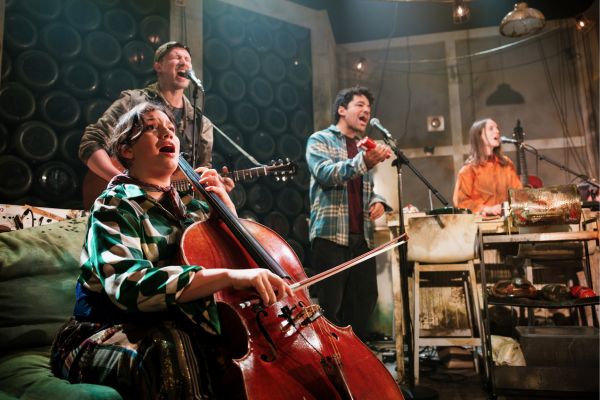
In 2425, we witness the preparations for Founder’s Day, an annual celebration of the community’s foundation. As a special treat, the residents have put a band together, using historical instruments – electric guitars, synths, even a vocoder – for the annual party. This setting allows for songs that explore both the residents’ current situation, viewing the Thames from their window and looking out on a desolate, deserted London beyond, and nostalgia about the lives that existed before.
True, a song that focuses on wondering how the building’s 21st century residents went about their days, including how to make a sandwich, has scope for humour that remains untapped. Max Alexandar-Taylor’s Biscuits, the driving force behind the band, remains the focal point of the musical’s attempts at comedy, his charismatic personality joking through life even as it rubs the other residents up the wrong way.
But at least when Precipice views pre-apocalyptic life from the residents’ perspective, it illuminates their own personalities and struggles in ways that can chime with our own. Some people make fun of history, some lose interest in it, and others become so subsumed in the lessons of the past that they struggle to move on.
Where the musical really shows signs of struggling is its need to pull focus back to our time, as two residents of the then-new residential block move in. Holly Freeman and Eric Stroud’s couple – Emily is an environmental civil servant, her boyfriend Ash is a research scientist – comprise the metropolitan elite at which such housing projects are aimed. But their dialogue is relentlessly stilted and dull, which makes the musical’s repeated visits to their time grate from early on.
Of course, the pair become tied up in the event that precipitates the global calamity, and the repeated returns to their time explores the events leading up to the existential crisis that follows. But honestly, the events prior to, and causing, the disaster are far less interesting than the community in the future. In 2425, we hear archival voice recordings from the woman who found the abandoned building, who set up the community, and who fretted about whether the ecosystem she helped found could support any more refugees seeking shelter in their tower block.
Those glimpses, however on the nose their metaphor may be, feel like missed opportunities for exploration, lost to more tedium with Emily and Ash. If there’s anything more frustrating than playing Monopoly, it’s watching two bickering adults play Monopoly while the rest of the cast is performing a song about Monopoly.
That couple continues to recur into Act II. They do become more interesting when, as it is clear that a flooding London may not be salvageable, they argue about whether to stick it out in their high-rise flat or evacuate to the countryside. Yet still, the events centuries in the future remain far more interesting.
Like all the best science fiction, the parallels to the present day make for the most resonant scenes even when, as occasionally here, they are slightly overplayed. The community’s self-sufficiency is threatened by an energy shortage, made worse by individuals all taking more than they should. That the electronic and electric instruments being used for the Founder’s Day concert – not just on the day, but in the month of rehearsal – should be a contributing factor to the community’s downfall is a nicely played ironic twist in a script that’s not prone to underplaying its message.
A temporary power loss prompts an acoustic performance of the show’s best number, ‘Mudlarker’, about a man who scours the tidal beaches of the Thames (and who, in Precipice’s mythology, is the first person to contract the plague that is spread by the river’s poisoned water). That balance of nostalgia for our present day, and the cyclical sense of two societies centuries apart but both on the brink of erasure, distils what the musical is setting out to be.
If only that sense of a thrilling and relevant piece of dystopian speculative fiction weren’t held back by all the unnecessary distractions. While the six-piece creative team (which also includes Stu Barter, Rachel Bellman, Annabelle Lee Revak and Shaye Poulton Richards) elicit a musical catalogue that mixes a variety of song styles into a cohesive whole, the book instead feels like a jumble of ideas in need of a stronger hand. This is mirrored in the show’s ending, which ends up about as anticlimactic as possible. There are ways to end these characters’ journeys on stage that leaves us thrilled and wondering about what happens next, but Precipice feels unable to leave us with even that.
In the 21st century, it can feel as if we are teetering on a precipice of our own making. The community that we witness, 400 years on, has a lot to say; 2425 has lessons for 2025. But sadly, the biggest lesson is that one reason dystopian science fiction and musical theatre haven’t been the greatest bedfellows before now is that it takes a lot of hard work for the two to mesh. Precipice tries its hardest to make the combination work, and even an unsuccessful attempt should be applauded for at least trying.
Scott Matthewman
SHARE THIS POST:


Comments are closed.