
Daniel Krikler, Rebecca Lock, Jess Douglas Welsh and Jordan Luke Gage (front) and the cast of Redcliffe at Southwark Playhouse, London. Pictures: Pamela Raith
Redcliffe A New Musical continues at the Southwark Playhouse, London until 4 July 2026.
Star rating: four stars ★ ★ ★ ★ ✩
It’s no understatement to say I was blown away by a workshop performance of Jordan Luke Gage’s debut musical Redcliffe at The Other Palace in 2024. Even at that stage, the piece had much to recommend it, from its timely, witty and powerful book to a score that embraced a range of musical genres while maintaining a distinctive identity of its own.
Now, a wider audience can witness all that early promise in the show’s first full production. While there remain areas that could benefit from further development, the foundations are remarkably strong and what already exists is something genuinely special.
Gage, already hugely popular with musical theatre fans for his leading roles in Bonnie & Clyde, & Juliet and more, was inspired to write the musical after discovering the true story of the forbidden love between William Critchard and Richard Arnold in Redcliffe, Bristol during 1752 and 1753.
William, a footman in service to a local family, has returned to Redcliffe to spend Christmas with his mother and sister and meets visiting naval lieutenant Richard at the local inn. Both men are eager to learn more about one another and dare to hope that their attraction is reciprocated. Yet such feelings come with considerable risk. Discovery could lead to prosecution and even execution, with the punishment for “the detestable crime of buggery” being death by hanging.
It is no easy task to weave together the different strands of this story into a cohesive whole. The focus cannot rest solely on the sweeping romance at its centre, yet Gage demonstrates a remarkable maturity in balancing the musical’s competing demands.
In its early stages, the audience is invited to get to know William’s devoted sister Abigail and his ebullient Mother, whose greatest concern is finding her son a suitable bride. The warmth and humour of these scenes make the later proceedings hit even harder. By Act II, William and Richard find themselves facing the gallows after their relationship is discovered, and the impact extends far beyond the two men. As the local community turns its back on the family, we witness the anguish experienced by the women left to endure the consequences alongside them.
Amidst all this, Gage never loses sight of William and Richard’s personal journey. He captures both the terror of risking everything “for a feeling” and the exhilaration of finding love, hope and acceptance, however fleetingly. Just briefly, the men can celebrate their authentic selves.
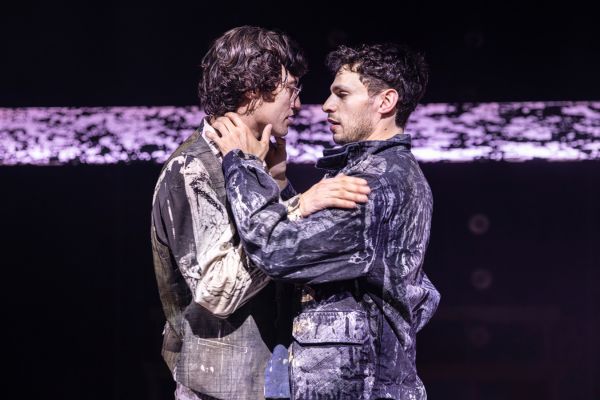
Jordan Luke Gage and Daniel Krikler in Redcliffe at the Southwark Playhouse
Gage’s rather beautiful score plays a crucial role in the storytelling, charting William and Richard’s journey from the flirtatious charm of ‘A Million Things I Know’ to the profound passion of ‘I Am Found’ and ‘My Man’, while also capturing the optimism of Mother in ‘The Most Amazing Wedding’ and her feelings of devastation in ‘Hurricane’ (incredible vocals from Rebecca Lock). There are traces of folk, rock, pop and traditional musical theatre throughout, yet the songs never feel derivative.
The choral passages and the soundscape of the port also add a haunting atmosphere, evoking the sense of lives shaped by forces beyond their control. Credit all-round to musical supervisor Katy Richardson, Ben Tomalin (associate MD/orchestrator) and Ben Ferguson (additional orchestrations), not to mention sound designer Alistair Penman.
Occasionally, certain melodies can feel somewhat repetitive, and a few of the lyrics would benefit from further refinement. Nevertheless, there can be little doubt that Gage has established himself as a musical theatre writer of considerable talent, excelling as librettist, composer and lyricist alike.
Gage also reprises the role of William, bringing a deep understanding to a character who lives in a community whose motto is, ironically, ‘you’ll never be alone’, yet is consumed by isolation. The success of the piece depends on our believing in the connection that develops between the central couple in a relatively short space of time, but that is never in doubt thanks to the strength of both Gage’s performance and Daniel Krikler’s as Richard.
Krikler is particularly effective at revealing the sadness and vulnerability that lie beneath Richard’s confident exterior. Indeed, it is William who finds the courage to speak for them both at the show’s conclusion, as they bravely refuse to repent for their supposed ‘sins’.
Within a strong ensemble, two other performances stand out. Jess Douglas Welsh is delightful as Abigail, excited by the prospect of a future with local boy Arthur (Joseph Peacock), yet fiercely devoted to her brother. As events unfold, she conveys both Abigail’s warmth and her growing heartbreak with great sincerity.
Rebecca Lock is a tour de force as Mother. Initially hilarious in her relentless enthusiasm for finding suitable matches for her children, she gradually reveals far greater emotional depth as tragedy strikes. Bewildered by her son’s arrest yet unwavering in her loyalty and love, Lock charts the character’s journey with generosity and humanity. Her heartfelt response to Richard in the final stages of the story is particularly memorable
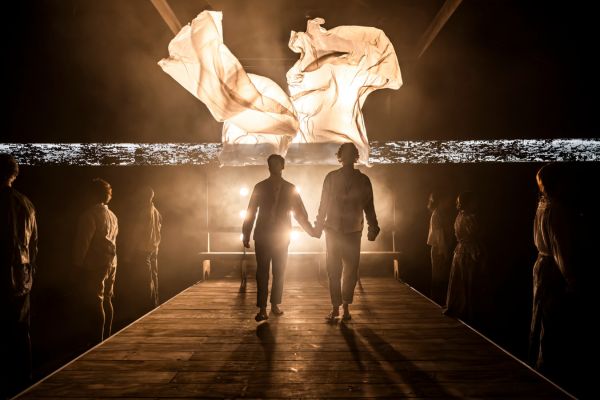
In the intimate surroundings of Southwark Playhouse, director Paul Foster brings together music, movement (choreography by Emma Woods) and striking visual imagery to powerful effect (lighting by Matt Hockley). The storytelling unfolds at a measured pace, allowing audiences to invest fully in the characters and their journey. There are occasions, however, when sudden shifts in tone between scenes feel somewhat abrupt and momentarily disrupt the production’s flow.
Foster’s work is enhanced by a design aesthetic that successfully blends the traditional and the contemporary, reinforcing the idea that this story does not belong solely to the past. Andrew Exeter’s wooden thrust stage, complete with benches, crates and a channel of water, evokes the world of 18th-century Bristol while remaining fluid enough to create a variety of locations. Meanwhile, the illuminated elements surrounding the stage introduce a more modern language. A similar approach can be seen in Martin Hanly’s costumes, which draw on period workwear while incorporating shades and patterns that subtly connect the story to the present day.
Rooted in real events, Redcliffe imagines the emotional lives of William and Richard beyond the surviving historical record. While Gage’s interpretation is undoubtedly romanticised in places (for instance, there was a significantly larger age gap between the two men), he never loses sight of the brutality, pain and injustice they endured.
Redcliffe is an important piece, not only because it offers a beautiful portrayal of queer love in the past, but because of the way it speaks to the present. At a time when hate crimes against the LGBTQ+ community continue to rise in the UK, and there remain 12 countries where homosexuality is punishable by death, its themes feel tragically relevant.
Gage breaks our hearts with the reminder of how much this story still resonates today. Yet in the final scene, as Richard kisses William’s hand before they are “launched into eternity”, he also offers a glimmer of hope. Love and kindness endure, even in the face of hatred and intolerance. And perhaps that is what we have to hold on to.
Lisa Martland
SHARE THIS POST:


Comments are closed.