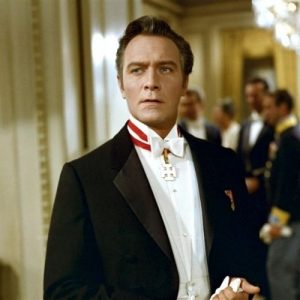
 The veteran Canadian actor Christopher Plummer, who has died at the age of 91, was a man of impressive stature with a commanding presence, which fitted the parts he played. Rarely a performer to take on the role of the average man, he was an actor born to play kings and kaisers, grand dukes and generals, field marshalls and high commissioners, monsignors and movie moguls. Michael Darvell assesses the extraordinary life of a great all-round actor and his 75-year career…
One of the many characters that Christopher Plummer played in a lifetime of appearing as men in power was in the film that most cinema audiences will remember him for – Robert Wise’s 1965 version of Rodgers and Hammerstein’s The Sound of Music. Here, however, he was but a lowly retired naval officer, one Captain Georg von Trapp, the martinet father of seven children whom he ruled with military discipline almost to the point of disdain.
In the musical Plummer sings just three songs, ‘Something Good’, ‘Edelweiss’ and the title number. Initially, Plummer did not wish to play the part and refused it on a number of occasions. Other actors, including Bing Crosby, Sean Connery, Richard Burton and Yul Brynner, had been considered for the part, and it was only when Plummer insisted that screenwriter Ernest Lehman work with the actor on improving the role that Plummer signed up for it.
With Julie Andrews as the star, playing the young novitiate from a Salzburg convent who becomes the governess of the Captain’s children, it seemingly couldn’t go wrong. The stage musical had been an enormous success, so an equal if not greater success was predicted for the film. Twentieth Century-Fox approached Robert Wise to direct as he was the man who had previously brought West Side Story to the screen. However, he was not initially available as he was working on The Sand Pebbles film. So then William Wyler agreed to direct but he later dropped out and Robert Wise was finally signed.
The finished film opened to mixed critical reviews but went straight to the top of the box office league tables and was truly popular with audiences around the world, becoming the highest-grossing film of 1965, garnering five Oscars at the Academy Awards. Nobody, least of all Plummer, could really complain about that. But in fact Plummer never liked the film, calling it “awful, sentimental and gooey”. However, it gave him a fortuitous chance to be seen by more people than for any of his previous films. His career took a turn for the better following The Sound of Music, although he had been doing pretty well up to then anyway.
He was born Arthur Christopher Orme Plummer in Toronto and grew up in Sennevile in Quebec. He was the only child of stockbroker John Orme Plummer and his wife Isabella Mary Abbott, a secretary. His parents divorced soon after Christopher was born and so, as an only child, he lived with his mother. Initially he planned to train as a concert pianist but the theatre got to him and it stayed thereafter in his blood and his heart.
 Inspired by Olivier’s 1944 film of Henry V, he began acting in High School and became an apprentice at a local repertory theatre. In 1946 he was spotted in a production of Pride and Prejudice by a director at the rep theatre who cast him as Oedipus in Cocteau’s La Machine Infernale. It was a role that he would later play on film. He appeared on stage from 1953 and worked with such theatrical luminaries as Edward Everett Horton, Katharine Cornell, Tyrone Power and Julie Harris. He he also worked with director Elia Kazan on his 1958 production of Archibald MacLeish’s Pulitzer Prize-winning play J.B.
It was in this production that Christopher Plummer, at age 29, gained his first Tony Award nomination. He later won two Tony Awards, firstly for Cyrano, Michael J. Lewis and Anthony Burgess’ 1973 Broadway musical based on the play by Edmond Rostand, and then for Barrymore, William Luce’s play about the American actor John Barrymore in 1997.
He also joined the Stratford Ontario Shakespeare Festival, playing Mark Antony in Julius Caesar, Ferdinand in The Tempest, the title roles in Henry V and Hamlet, Andrew Aguecheek in Twelfth Night, Leontes in The Winter’s Tale, Bardolph in Henry IV, Part I and Benedick in Much Ado About Nothing. He returned later to Stratford Ontario for King John, Romeo and Juliet, Macbeth, Antony and Cleopatra and Rostand’s Cyrano de Bergerac. He also joined the Shakespeare Memorial Theatre which subsequently became the Royal Shakespeare Company in Stratford-Upon-Avon and London. He was also in Medea with Judith Anderson in Paris, and for a while he was with the National Theatre in London.
In 1953 he had made his TV debut in the CBC production of Othello starring Lorne Greene, after which Plummer then became a regular performer on television in such productions as Hamlet at Elsinore, Don Juan in Hell, After the Fall, Arthur Hailey’s The Moneychangers, Dial M for Murder, The Thorn Birds, Crossings, Berlin Lady, Counterstrike, On Golden Pond and Departure.
He entered films in 1958 with Sidney Lumet’s Stage Struck. Then he was in Nicholas Ray’s Wind Across the Everglades with Burl Ives and Gypsy Rose Lee, followed by Anthony Mann’s epic The Fall of the Roman Empire with Sophia Loren, Stephen Boyd and Alec Guinness. Then there was The Sound of Music (1965). The same year saw him in Inside Daisy Clover, Robert Mulligan’s adaptation of Gavin Lambert’s novel in which Plummer played a Hollywood studio head, with co-stars Natalie Wood and Robert Redford.
His film career burgeoned with his role as a Nazi spy in Triple Cross, with Romy Schneider and Trevor Howard, then he was Field Marshall Rommel in The Night of the Generals with Peter O’Toole and Omar Sharif, and had the title role in Philip Saville’s Oedipus the King with Lilli Palmer and Orson Welles.
More figures of authority loomed with his being cast as the High Commissioner in Nobody Runs Forever, a Squadron Leader in Guy Hamilton’s Battle of Britain, and the Inca leader Atahualpa in The Royal Hunt of the Sun. He was the Duke of Wellington in Waterloo with Rod Steiger and Orson Welles, and played Rudyard Kipling in The Man Who Would Be King with Sean Connery and Michael Caine. The Day That Shook the World was about the events that led up to the First World War in which Plummer played Archduke Franz Ferdinand of Austria. He also played Lord Foppington in Lionel Bart’s period musical comedy Lock Up Your Daughters, with Susannah York and Glynis Johns.
Plummer never seemed to be short of film work, appearing in movies throughout his career from the early 1960s right up to 2021, making over 200 appearances in films and on television. Among his films from the 1990s onwards he was in Star Trek VI: The Undiscovered Country as General Chang, played the prison chaplain in Spike Lee’s Malcolm X with Denzel Washington, and was Dr Leland Goines in Terry Gilliam’s Twelve Monkeys. He was also in Gilliam’s The Imaginarium of Doctor Parnassus, in the title role. Michael Mann cast him in The Insider with Al Pacino and Russell Crowe, Ron Howard put him in A Beautiful Mind with Russell Crowe again, and Douglas McGrath’s cast him as Ralph in Nicholas Nickleby. Closing the Ring was Richard Attenborough’s last film in which Plummer played opposite Shirley MacLaine.
Plummer was nominated for an Academy Award playing Leo Tolstoy in Michael Hoffman’s The Last Station (2009) and, when he took over the role of J. Paul Getty from Kevin Spacey who had to leave the production of Ridley Scott’s All the Money in the World, Plummer was duly nominated again. And at 88 he became the oldest actor to be Oscar-nominated. He didn’t win but he had already won an Oscar in 2011 for Beginners in which he played a 75-year-old man who suddenly comes out of the gay closet, a story based on director Mike Mills’ own family circumstances. At 82 Plummer was the oldest person ever to win an Academy Award.
Plummer was no stranger to doing voiceovers, having worked on An American Tail, The Tin Soldier, The Man Who Planted Trees, The Gnomes’ Great Adventure, Rock-a-Doodle, Dragon and Slippers and Up etc. However, his best voice work came in My Dog Tulip, Paul and Sandra Fierlinger’s amazing animated version of gay writer J.R. Ackerley’s book about his life with his dog in which Plummer provided the voice of the author. Plummer’s last films were Rian Johnson’s mystery thriller Knives Out, reminiscent of an Agatha Christie plot with an all-star cast including Daniel Craig, Jamie Lee Curtis, Don Johnson, Toni Collette etc, and The Last Full Measure, Todd Robinson’s war drama with William Hurt, Ed Harris, Peter Fonda, Samuel L. Jackson, Jeremy Irvine, Diane Ladd and Amy Madigan.
Plummer was previously married to actress Tammy Grimes from 1956 to 1960, then journalist Patricia Lewis from 1962 to 1967, and finally actress Elaine Taylor in 1970. With his first wife he had a daughter, the actress Amanda Plummer.
Apart from his single Oscar, Plummer won many other awards including a Primetime Emmy for The Moneychangers, a BAFTA for Beginners and many other professional awards in Canada and the USA. He was also invested with many Canadian Honours System awards including Companion of the Order of Canada, The Queen Elizabeth II Silver and Golden Jubilee Medals for Canada, The Queen Elizabeth II Diamond Jubilee Medal for Canada and The 125th Anniversary of the Confederation of Canada Medal. He also received Honorary Doctorates from a number of Canadian Universities. He wrote a memoir, In Spite of Myself, in 2008.
Christopher Plummer was a versatile performer, a great man of the theatre, the cinema and television with a remarkable range, a true professional in his work and a man much honoured by his country of birth. We will probably never see his like again.
Christopher Plummer: 13 December 1929-5 February 2021. R.I.P.
SHARE THIS POST:


Comments are closed.