
Picture: Roy Tan
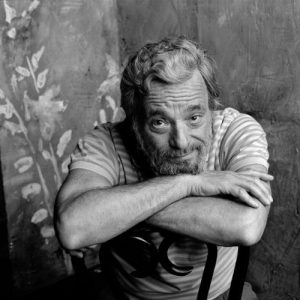
Stephen Sondheim rewrote the history of the Broadway musical in a career lasting over 60 years. Michael Darvell looks back, show by show, at the genius that was Stephen Sondheim.
It is an unquestionable fact that Stephen Sondheim was responsible for taking the rather moribund genre of the Broadway musical and breathing new life into it, by helping to create at least 18 major works of musical theatre, alongside contributions to films, television, cabarets and other entertainments. Never content to rest on his laurels, he found it very difficult even to please himself. He would never go for the easy way out or a lazy rhyme because he set himself such high standards in his composition of music and his writing of lyrics. In both instances he was unbeatable. From West Side Story to Bounce he made a definite difference.
Stephen Joshua Sondheim was born in New York City on 22 March 1930 to Etta, a dress designer, and Herbert Sondheim, a Jewish clothing manufacturer, and he grew up on the Upper West Side of Manhattan. His parents divorced when Stephen was only ten, and he moved to Pennsylvania where he attended the George School, a private preparatory school run by the Quakers. At about 15 years old he wrote his first musical, By George, based on life at the school. He had had a very unhappy and lonely childhood as his mother ill-treated him when her husband moved out.
At that time young Stephen became friends with James Hammerstein, son of the playwright and lyricist Oscar Hammerstein II, and the great man became a father figure for Stephen and influenced him in his writing for musical theatre. About this time Harold Prince also arrived on the scene, and much later became Sondheim’s principal director. Hammerstein gave Stephen four projects to undertake including adapting a play he really liked into a musical, adapting another play that was not so good, working on a novel that could be adapted musically, and creating an original show by the boy himself.
 He chose George S. Kaufman and Marc Connelly’s Beggar on Horseback, Maxwell Anderson’s High Tor and P. L.Travers’ Mary Poppins, plus his own original composition, Climb High. They were good exercises for the budding composer-lyricist but none of the shows was ever produced. Sondheim’s Climb High, for which he wrote both the book and the score, was based on the life of a college graduate friend who had been in the Navy during the war. Even then at an early age he was aiming high.
Later on he attended Williams College in Massachusetts where he studied music under Robert Barrow. He also had instruction from the composer Milton Babbitt while he was there. His early professional career found him writing for the television fantasy sit-com series Topper and auditioning songs for his 1955 musical Saturday Night. At that time the show remained unstaged, following the death of the producer Lemuel Ayers, and it didn’t reach London until 1997 at the Bridewell Theatre. It then played Chicago the following year and Off-Broadway in 2000, opening at London’s Jermyn Street Theatre in 2009.
However, his luck really changed when he met the playwright, screenwriter, producer and director Arthur Laurents. Sondheim was at a party with theatre writer Burt Shevelove, who was later to write and direct Sondheim’s A Funny Thing Happened on the Way to the Forum, and they happened to meet Laurents who informed them they he was preparing a musical version of Romeo and Juliet with composer Leonard Bernstein and choreographer Jerome Robbins. They were looking for a lyricist because Betty Comden and Adolph Green were working in Hollywood and were unavailable. Sondheim got the gig.
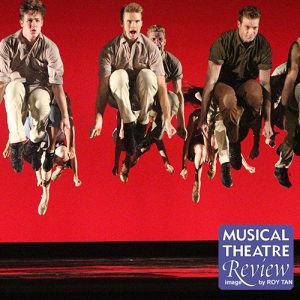
West Side Story. Picture: Roy Tan
The rest is theatrical history because the show was West Side Story. Directed by Jerome Robbins and produced by Harold Prince, it had try-outs in Washington D.C. and Philadelphia, before opening on 26 September 1957 on Broadway where it ran for 732 performances. It came to London the following year and then toured the US and has been revived many times since around the world, including a Broadway revival for the fifth time in 2020. It was nominated for six Tony Awards but only won two, and they were just for Best Choreography and Best Scenic Design – but there was nothing for the music, the book or the lyrics.
However, the 1961 film version won ten of its 11 Academy Award nominations including Best Picture, Best Direction, Best Cinematography, Best Art Direction, Best Costume Design, Best Sound, Best Editing, Best Music Scoring and Best Supporting Actor and Actress for George Chakiris and Rita Moreno. So how many Oscars will the Steven Spielberg remake receive? It opened on 10 December 2021.
After West Side Story came Gypsy (1959), a musical about stripper Gypsy Rose Lee with Ethel Merman as her mother, Mama Rose. It was written for the actress by composer Jule Styne with a book by Arthur Laurents. Sondheim would have preferred to write both music and lyrics but Miss Merman felt he was not experienced enough and she didn’t want to jeopardise her own career in case it flopped. In the event it ran nearly as long as West Side Story.
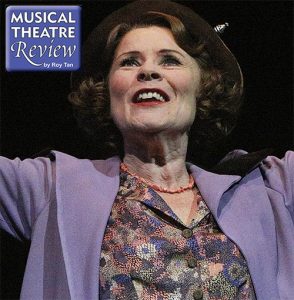
Gypsy. Picture: Roy Tan
However, Sondheim then finally did get to create a show for which he wrote both music and lyrics, A Funny Thing Happened on the Way to the Forum. This was an adaptation by Burt Shevelove and Larry Gelbart of the comic farces of Titus Maccius Plautus (254-184 BC), a Roman writer from the Old Latin period. It starred Zero Mostel as the slave Pseudolus, with Jack Gilford as Hysterium, David Burns as Senex and John Carradine as Marcus Lycus. It opened on Broadway in 1962 and ran for nearly a thousand performances.
The show won six Tonys including Best Musical, but nothing specifically for Sondheim’s music or lyrics. The London production in 1963 starred Frankie Howerd, Kenneth Connor, Eddie Gray and Jon Pertwee and ran for nearly two years. It was revived in London in 1986, again with Howerd, and the National Theatre staged a very good production in 2004. The 1966 film version directed by Richard Lester didn’t really work as the show was a very theatrical piece.
Sondheim’s next two shows were problematic. Anyone Can Whistle (1964) had a book by Arthur Laurents to the music and lyrics of Sondheim. The subject was not over appealing, dealing as it did with a poor town with a corrupt mayor who creates a fake miracle to attract visitors, and it also involves inmates of a mental asylum. With Lee Remick and Angela Lansbury (in her stage musical debut) it was literally a nine-day wonder, closing after a dozen previews and nine performances. It did, however, have some excellent Sondheim numbers including ‘Me and My Town’, ‘There Won’t Be Trumpets’, ‘Everybody Says Don’t’, ‘With So Little To Be Sure Of’ and the title song.
Do I Hear a Waltz? (1965) was a show that Sondheim didn’t really want to write. It was to have been a Rodgers and Hammerstein piece, but after Hammerstein’s death Rodgers was looking for a lyricist and Mary Rodgers, Richard Rodgers’ daughter, asked Sondheim to take over. It was based on Arthur Laurents’ play The Time of the Cuckoo, the basis of David Lean’s 1955 film Summertime (aka Summer Madness) with Katharine Hepburn.

Anyone Can Whistle. Picture: Roy Tan
Elizabeth Allen played an American woman who has a romantic fling in Venice with an Italian man (Sergio Franchi). Laurents was unhappy with the casting and, although it garnered Tony nominations for Best Actress, Best Design and Best Musical, it won nothing and ran for just 220 performances. Re-cast it fared better in regional tours, a New York revival and a revised version in New Jersey and elsewhere in other productions. London saw it in 2003 at the Landor in Clapham. Again, like Anyone Can Whistle it had some very enjoyable songs such as ‘This Week Americans’, ‘Moon in My Window’, ‘We’re Gonna Be Alright’, ‘What Do We Do? We Fly’ and, of course, the title song.
Taking a break from the theatre, in 1966 Sondheim wrote a musical for television. Working for the first time with James Goldman adapting a John Collier short story, Sondheim wrote the music and lyrics for Evening Primrose. It concerns a poet who hides out in a department store and meets a collection of people who occupy the store during the night. The cast included Anthony Perkins, Charmian Carr, Larry Gates and Dorothy Stickney and the piece was filmed for TV in a Manhattan store. The first professional theatre production was in London in 2005 in Ian Marshall Fisher’s Lost Musicals series at Sadler’s Wells, with Betsy Blair, Michael Matus, Jennifer Higham and Gary Raymond. New York had a semi-staged performance in 2010.
From 1970 Sondheim continued to write all his own music and lyrics and the resulting shows improved beyond measure. With Harold Prince directing he produced Company which was not your usual musical show with a definite narrative plot but a series of scenes (sketches, even) on married life as he, as a bachelor, saw it. He produced a perfect score with any number of felicitous lyrics which bolstered the at times thinness of the plot, such as it was. The scenes written by George Furth covered the various stages of relationships – what couples do together, falling in and out with each other, the irritating things partners do, looking for action outside the home, being alone in a big city, the fear of getting married, brief one-night stands, and not being able to commit to another person.
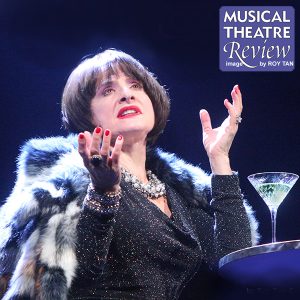
Company. Picture: Roy Tan
It was centred around Bobby (Dean Jones) who, at 35, cannot commit to a permanent relationship. Amazingly the show is so good that there is not a dud song in the whole score, from the title number through ‘Someone is Waiting’, ‘Another Hundred People’ and ‘Getting Married Today’, to ‘Barcelona’, ‘The Ladies Who Lunch’, ‘Being Alive’ and ‘Side By Side’, just a few of some 14 brilliant numbers. It played over 700 performances in New York but rather less in London with just under half that number. It won six Tony Awards including for Sondheim Best Musical, Best Score and Best Lyrics.
A film of the recording of the Company cast album, Original Cast Recording, was captured by the celebrated documentarist D. A. Pennebaker. At one point it shows a frustrated Elaine Stritch as Joanne in trouble performing ‘The Ladies Who Lunch’. She later claimed that “It’s OK if you want to see Margaret Rutherford doing the Judy Garland story.” Company went on to enjoy many revivals, the latest being in 2018 in London when some characters changed sex so that Bobby became Bobbie (Rosalie Craig) while a same-sex couple was introduced so that Amy became Jamie (Jonathan Bailey) for ‘Getting Married Today’.
Having dreaded what to expect, I have to admit that for me it worked even better than the original production and I would cite it as the best production in the show’s history. It received nine nominations in the Olivier Awards and ran for six months. Broadway saw it with Patti LuPone as Joanne in March 2020 but, because of Covid-19, it closed prematurely while still in preview. The production resumed in November 2021 and Sondheim saw a preview just before his death a week later.
The trouble with Follies (1971) was that it cost too much to stage and to run and recoup its outlay. It was, nevertheless, a brilliant concept with something akin to Company, and one which, like Company, gathered together a collection of characters with something in common. This time it was a reunion of performers from the heyday of vaudeville, the stars of the Ziegfeld Follies type of shows, productions that burgeoned between the First and Second World Wars. Old friends from the follies shows meet up at a Broadway house, the Weismann Theatre, that is about to be demolished. The owner, Dmitri Weismann, has invited his former employees to one last reunion, with all the promises that that implies – nostalgia for the past, a chance to remember and relive those good old days plus some of the regrets and the sorrows that come with recalling old times.
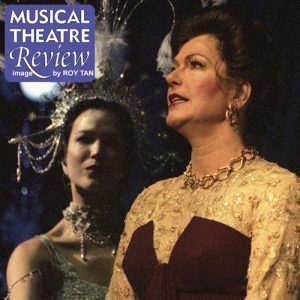
Follies. Picture: Roy Tan
James Goldman provided the book for Sondheim’s music and lyrics. Veteran singers, comics, dancers and old chorus boys and girls all gathered together to play out some of the songs and routines from their salad days. Sondheim does brilliant pastiches of the songs that famous composers might have contributed during those golden years of the Follies, including nods in the direction of Cole Porter, Irving Berlin, Jerome Kern, Frank Loesser, Rodgers and Hart and George Gershwin et al. It had a huge cast directed by Harold Prince and choreographer Michael Bennett, but its running costs were so huge, it was never destined to recoup its initial investment and it ran for only just over five hundred performances.
Having said that, it did have a wonderful cast with Alexis Smith, John McMartin, Gene Nelson, Dorothy Collins, Yvonne De Carlo, Fifi D’Orsay and Ethel Shutta etc. And of course the songs were something else again. Who could fail to be moved by ‘Beautiful Girls’, ‘Waiting for the Girls Upstairs’, ‘The Road You Didn’t Take’, ‘In Buddy’s Eyes’, ‘Losing My Mind’, ‘Could I Leave You?’, ‘Loveland’ and ‘I’m Still Here’ among many others? Once again it appeared that Sondheim was incapable of writing a bad number.
Having lost its entire Broadway investment Follies took 16 years to reach London when Cameron Mackintosh finally staged it at the Shaftesbury Theatre with Diana Rigg, Daniel Massey, Julia McKenzie, David Healy, Lynda Baron, Maria Charles, Dolores Gray and Pearl Carr and Teddy Johnson. Later on in its 644 performance run, Eartha Kitt and Millicent Martin took over as Carlotta and Phyllis. Maybe the star-studded concert version at Lincoln Center in 1985 gave Cameron Mackintosh the signal to stage Follies in London. Lincoln Center fielded among the cast Barbara Cook, George Hearn, Mandy Patinkin, Lee Remick, Carol Burnett, Betty Comden, Adolph Green, Liliane Montevecchi and Elaine Stritch among other great artists. What a cast and what an irresistible show. A film version is currently in preparation.
Nostalgia was also one of the themes of A Little Night Music (1973) but it was, unlike Follies, a great success. The book was adapted from Ingmar Bergman’s 1955 screenplay of Smiles of a Summer Night, a kind of rom-com with which Bergman was not too familiar. He was better at angst rather than romance and nostalgia. Sondheim’s musical version probably improved on Bergman’s rather arch, heavy-handed way with comedy. Written mostly in waltz-time, the music is compulsively charming and presents some of the composer’s best melodies. ‘The Glamorous Life’, ‘Remember?’, ‘You Must Meet My Wife’, ‘Every Day a Little Death’, ‘A Weekend in the Country’, ‘It Would Have Been Wonderful’ and ‘The Miller’s Son’ are all treasurable numbers that lift the book into another realm altogether.
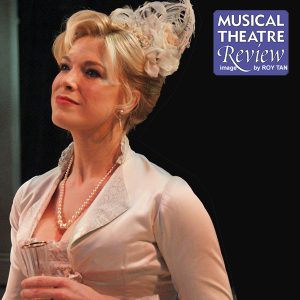
A Little Night Music. Picture: Roy Tan
And, of course, Sondheim managed to have his one and only hit song that everybody has sung and recorded ever since. This is ‘Send in the Clowns’, which he wrote overnight for Glynis Johns’ character Desiree, a touring actress returning to a place where she enjoyed success both as a performer and as the one-time lover of Fredrik (Len Cariou) with whom she now shares nostalgic reminiscences. Nostalgia is of the essence in the ‘Liaisons’ number by Madame Armfeldt, Desiree’s mother (Hermione Gingold), as she recalls her time as a young woman in love. A Little Night Music was a hit, running for over 600 performances in New York and the show was showered with awards including six Tonys.
It also had many successful seasons overseas, including London in 1975 with Jean Simmons, Joss Ackland, David Kernan, Maria Aitken and Hermione Gingold. It was also revived in London in 1989 with Dorothy Tutin, Peter McEnery, Lila Kedrova and Susan Hampshire. In the 1995 London revival Judi Dench as Desiree won an Olivier Award for Best Actress, and there was a further London revival in 2009. Sadly, Harold Prince’s film version in 1977 with Elizabeth Taylor, Diana Rigg, Len Cariou and Hermione Gingold did not transfer well to the screen as it was and still is an essentially theatrical work.
And now for something completely different – not that Sondheim ever repeated himself, for he was originality writ large. The Frogs (1974) was an adaptation of Aristophanes’ ancient Greek comedy. In the musical Sondheim introduced Shakespeare and Shaw in a competition to decide who is the better writer. The original production took place in the swimming pool at Yale University for a mere eight performances, although it was staged elsewhere including New York in 1975. For the UK we had to trip out to the Old Brentford Baths in west London in 1990, and then it played Coventry in 1991 and eventually was seen in a concert version with Nathan Lane at the Library of Congress in Washington D.C. An expanded version opened in 2004 at the Lincoln Center for almost a hundred performances, and it was regularly revived in the US and Australia and finally reached London’s Jermyn Street in 2017.
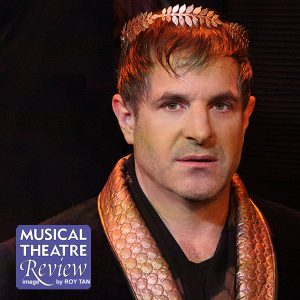
The Frogs. Picture: Roy Tan
Another big gear change came with Pacific Overtures (1976) when Sondheim again reinvented the Broadway musical, although in fact it is more like an opera. The book by John Weidman concerns the opening up and Westernisation of Japan in 1853 by a fleet of American ships. Sondheim’s music was composed in an Oriental style while the production was staged as a Japanese Kabuki play with men playing women and with the set changes made by black-dressed figures. The score was enticing in its gentleness and exciting in the more rousing numbers. Outstanding among the score were ‘There is No Other Way’, ‘Four Black Dragons’, ‘Chrysanthemum Tea’, ‘Welcome to Kanagawa’, ‘Pretty Lady’ and ‘Someone in a Tree’, the last being Sondheim’s favourite song in the whole of his canon.
It has never been that popular with either the critics or the public, but still remains one of Sondheim’s most interesting experiments. It ran for six months on Broadway and was nominated for ten Tony Awards but only won for Best Scenic Design and Best Lighting. English National Opera staged it in London in 1987 and there were further revivals in the US and the UK. The 2003 West End revival won three Olivier Awards for the production but not for the music or lyrics.
Sondheim based his next show Sweeney Todd (1979) on Christopher Bond’s play about the notorious serial-killer, the Demon Barber of Fleet Street, which he saw at the Theatre Royal in Stratford in east London. This is grand guignol at its most horrendous and yet it is also full of humour – gallows humour, that is. Directed by Hal Prince it had great performances by Len Cariou as Sweeney and Angela Lansbury as the appalling Mrs Nellie Lovett, owner of the pie shop which provides Todd with the chance to dispose of his victims’ bodies and a source of food to fill up Nellie’s disgusting baked goods. It won eight Tonys but ran for fewer than 600 performances on Broadway. In London, with Denis Quilley and Sheila Hancock, it lasted for just under 160 performances but nevertheless won the Olivier Award for Best Musical after it had closed. Later productions did very well in the US, the UK and everywhere else around the world.
In my opinion it is one of Sondheim’s best and most enjoyable shows, dubbed as it was, ‘a musical thriller’. Again his complete score has so many riches – just think of ‘No Place Like London’, ‘The Worst Pies in London’, ‘Green Finch and Linnet Bird’, ‘Johanna’, ‘Pretty Women’ and ‘A Little Priest’ – all great songs and that is just some of them from the first half of the show. I was saddened that Tim Burton’s 2007 film version of Sweeney Todd lacked the essential horrors of the stage show.
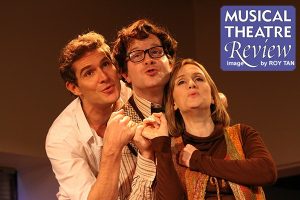
Merrily We Roll Along. Picture: Roy Tan
Sondheim and Prince came a cropper with their next show, Merrily We Roll Along (1981). It was based on a 1934 play by George S. Kaufman and Moss Hart that concerned three friends, Franklin Shepard, a musical composer, Charley Cringle, a playwright and lyricist, and Mary Flynn, a journalist and critic. Shepard quits the theatre to go to Hollywood, leaving his friends behind. The difference in this project is that the action moves backwards in time from the present day to when they were youths at college. It shows how people can change when the circumstances are right for them, irrespective of who they hurt on the way.
Perhaps both the audience and the critics couldn’t take the jolt that the time frame presented. The original production lasted for just 16 performances, following over 50 previews. Subsequent rewrites improved the show’s reputation and it finally found some sort of success in later productions. I well remember Ian Judge’s UK premiere production for the Guildhall School of Music and Drama in 1983 which at the time seemed perfect and has stayed with me as one of the best-ever stagings of a Sondheim musical.
With such songs as ‘Rich and Happy’, ‘Old Friends’, ‘Franklin Shepard Inc.’, ‘Not a Day Goes By’, ‘Good Thing Going’, ‘Bobbie and Jackie and Jack’, ‘Our Time’, ‘The Hills of Tomorrow’ and the title song, I think it is a masterwork. It returned to the UK in 1984, 1992, 2000 and 2007, and in 2012 was at the Menier Chocolate Factory and then transferred to the West End where it was given the Peter Hepple Award for Best Musical by the UK Critics’ Circle. A new film of the show is in production.
Sondheim again played with time in Sunday in the Park With George for which the composer was inspired by a 19th century pointillist painting by Georges Seurat. Sondheim conjectured the situation of the artist at work on his masterpiece with his model muse Dot, while Act II moves forward to a museum in the 1980s when Seurat’s (fictional) great-grandson is showing his latest effort which allegedly harks back to his great grandfather’s work. It is a complex piece but if you can take on board whatever Sondheim offers, the show is very rewarding, and is both moving and comic too. It starred Mandy Patinkin and Bernadette Peters.
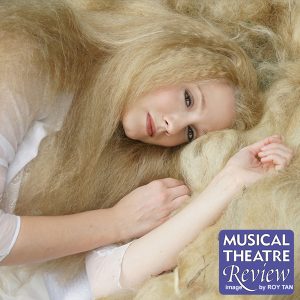
Into the Woods. Picture: Roy Tan
It is amazing that Sondheim went so far as to reinvent the pantomime with Into the Woods (1986). He took several of Grimm’s fairy tales and mashed them up into a single story. Thus we have Cinderella, Rapunzel, Jack and the Beanstalk and Little Red Riding Hood all facing their various fates as they venture into the woods, with a wolf and a witch and a giant to contend with. It’s a very entertaining conceit that is both scary and comical. James Lapine wrote the libretto based on Bruno Bettelheim’s book The Uses of Entertainment. After a try-out in San Diego it reached Broadway the following year with Bernadette Peters as the Witch and notched up over 750 performances.
In London it only rated fewer than 200 performances with Julia McKenzie as the Witch, Imelda Staunton as the Baker’s Wife, Clive Carter as the Prince and the Wolf and Nicholas Parsons as the Narrator. It won Olivier Awards for Imelda Staunton and for the director, Richard Jones. Further productions were staged at the Donmar Warehouse in Covent Garden, the Royal Opera House and the Open Air Theatre in Regent’s Park. It was filmed in 2014 and is really the best movie of any of Sondheim’s stage shows with Meryl Streep, Chris Pine, Emily Blunt and James Corden. It has very memorable songs including ‘Hello, Little Girl’, ‘I Know Things Now’, ‘Agony’, ‘Moments in the Woods’, ‘Last Midnight’, ‘No One Knows’, ‘Children Will Listen’ and ‘No One is Alone’.
In 1990 Sondheim and John Weidman created Assassins, a portrayal of the people who tried to kill or attempted to kill the US Presidents from Abraham Lincoln onwards, taking in James Garfield, William McKinley, Franklin D. Roosevelt, John F. Kennedy, Richard Nixon, Ronald Reagan and Gerald Ford. With its setting of a fairground booth, it was a sobering piece that did not appeal to some audiences on account of a question of taste. But it was a serious work that shed light on some parts of history that were maybe unfamiliar to most. Still, it won five Tonys on Broadway and enjoyed further productions including London in 1992 and 2014.
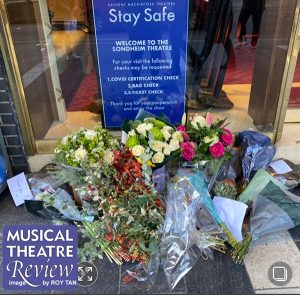
Tributes at the Sondheim Theatre, London. Picture: Roy Tan
For Passion (1994) Sondheim adapted Ettore Scola’s 1981 film Passione d’Amore based on Iginio Tarchetti’s 1869 novel Fosca. It is about the obsession of a sickly epileptic woman (Fosca) for an Italian soldier (Giorgio) who eventually falls in love with her. It is a complex but moving love story for which Sondheim won a Tony for Best Original Score and there were also awards for Best Actress (Donna Murphy), Best Book (James Lapine) and Best Musical. An Olivier Award went to Maria Friedman who played Fosca in London in 1996 with Michael Ball as Giorgio and it was revived at the Donmar Warehouse with Elena Roger and David Thaxton who won an Olivier Award in 2010.
Sondheim’s last completed stage work was Road Show, or as it was previously known Bounce and Wise Guys. It was about the Mizner brothers and their adventures in the US at important times such as the great Klondike Gold Rush and the Florida real estate boom of the 1920s. It was a difficult show from Day One and went thorough any number of different versions and changes but never reached Broadway at all, just making it as far as Off-Broadway in 2003. It played London in 2011 at the Menier Chocolate Factory for a couple of months.
Apart from his stage musicals Sondheim also wrote songs and music for films (Reds, Dick Tracy, Stavisky). His songs have been used in over four hundred films and television programmes, and he co-wrote with Anthony Perkins a film thriller, The Last of Sheila in 1973. He compiled all the songs from his musicals into two massive volumes covering his work from 1954 to 2011, a work of immensely academic detail called Finishing the Hat and Look, I Made a Hat.
Before he died Sondheim had been working on a show called City Square, based on two Luis Buñuel films. However, we haven’t seen the last of him yet, as many of his greatest shows will go on being revived. There are more films on the way including Steven Spielberg’s new version of West Side Story, Richard Linklater’s film of Merrily We Roll Along and Dominic Cooke’s Follies. Stephen Sondheim will always be remembered as a man of genius who reinvented the Broadway musical for a new age and a new audience. He has given so much pleasure in his work and will continue to do so for future generations.
Stephen Sondheim was born on 22 March 1930 and died on 26 November 2021. He is survived by his husband Jeffrey Romley and his half brother Walter. R.I.P.
SHARE THIS POST:


Comments are closed.