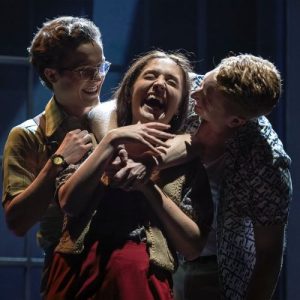
Picture: Craig Fuller
Merrily We Roll Along at the Susie Sainsbury Theatre, Royal Academy of Music, London.
Star rating: five stars ★ ★ ★ ★ ★
It’s some coincidence that Stephen Sondheim’s two big Broadway flops, Anyone Can Whistle and Merrily We Roll Along, should pitch up in brilliantly innovative London revivals within weeks of each other.
Whistle, beset by cast problems and an ‘insanity-of the-so-called-sane’ storyline alien to a musical, lasted all of nine days in 1964; and with audiences baffled by a going-backwards show and voting with their feet (140 walked out one evening), the original Merrily in 1981 closed after 16 performances.
Looking at it now, it is hard to understand why they were so confused 40 years ago, particularly as each year-change was boldly labelled, but then, with so many TV dramas switching dizzyingly from the here-and-now to flashback without warning, maybe we are more savvy these days and the confusion element no longer applies.
It’s also ironic that two of Sondheim’s (at the time) least-loved shows should have spawned some of his finest work. Title song apart, Whistle gave us ‘There Won’t Be Trumpets’, ‘With So Little to Be Sure Of’ and ‘Everybody Says Don’t’ while Merrily boasts one of his cleverest, ‘Franklin Shepard, Inc.’ (curiously omitted from the RAM programme song list, not the only mistake), and the haunting ‘Not a Day Goes By’, not forgetting ‘Old Friends’, ‘Good Thing Going’, the semi-autobiographical ‘Opening Doors’ and the unforgettable ‘Our Time’ rooftop finale.
Although in time it became a cult musical and played the provinces both in the USA and here, it wasn’t until 2000 that Merrily properly reached the West End and not until Maria Friedman’s award-winning 2012 revival heaped with more 5-star raves than any other show in town that it gained the recognition it merited decades earlier.
Yes, it’s not as audience-friendly as Company nor as easy to love as Follies but director Bruce Guthrie, with the considerable help of two eager casts, extracted every nuance and truth from a fascinating tale that ‘begins’ in 1980 with a funeral and ‘ends’ two decades earlier with three optimistic young theatricals watching Sputnik from the roof of their New York apartment and joyfully announcing “this is our time”.
Deep, at times savage with its humour and rarely easy (it’s Sondheim, after all, from George Furth’s book) this evocation of a deep three-way friendship which looks impregnable but erodes with the demands of success is constantly involving.
The plot tells of Franklin Shepard’s rise from budding composer to loud and wealthy Hollywood producer and the ditching of his two longtime friends – geeky lyricist partner Charley Kringas, who crucifies Frank’s lust for fame in an embarrassing TV interview and is cut immediately, and Mary Flynn, a once-promising writer turned bitter critic whose heart he has broken by not seeing how much she adores him.
Later as a party-pooping lush embarrassingly dependent on alcohol and drugs, Mary collapses at Frank’s movie-launch bash and it is her coffin we see first rather than the usual party scene.
Explaining after the show the twist he gave the tale, director Guthrie told me: “It’s a leap through time, Mary ‘looking on’ as the boys put their petty squabbles behind them. Because death is the great leveller.
“The death of their best friend is the catalyst for the show. Without her friends, Frank in particular, with no prospects and facing poverty, she passes away. The funeral brings the boys back together.”
For me it gave this story of great friendships gone sour a finite conclusion that is both sad and hopeful. And how wonderful it was to have that classic score played by RAM’s own 18-strong orchestra under MD Livi van Warmelo’s urgings.
I am told MD Amy Hsu did a wonderful job on two subsequent days with a different cast but on opening night I saw the other team and a priceless performance by Joe Winter as Charley. Admittedly, he had the best part, but he looked and sounded absolutely right and got his big number, the fiendishly tricky ‘Franklin Shepard, Inc.’, off to a T.
Ryan Wolpert’s task was harder as Frank is, most of the time, so unlovable or even likeable. Understandably he was more comfortable when Frank was around his own age. It is interesting that in the Broadway original there were two Franks, the first for his 20s and 30s, the second playing him as a 43 year old.
Jordan Stamatiadis was vocally a joy as Mary but could have been helped to age a bit more convincingly. By the end she was meant to be blowsy and bloated through drugs and drink. Jordan did the blowsy bit fine but perhaps the physical difference not so much.
When you get a song as exceptional as Beth’s big moment in ‘Not a Day Goes By’ – sung twice, once happily on their wedding day with husband Frank and Mary, the second time bitterly when he drops her for the flashy Hollywood starlet Gussie (Lucy Brindle, excellent) – you have to get it spot-on which Lya Luca did. And Mark Lamb’s all-too-short tap-dance has to get a mention. It was so slick it left us wanting more.
As ever with RAM, production values were of the highest quality: full credit to Simon Kenny’s set and costumes, Sarah Jane Honeywell’s choreography – the ensemble had plenty to do – and Guthrie’s new take on this one-of-many Sondheim masterpieces.
- Equally impressed fellow MTR contributor Tina Foote saw the ‘other’ team and reports:
“Our audience gave Amy Hsu and her band a standing ovation and those who stayed behind were treated to a private encore long after the cast had left the stage.
“As for our cast, Laura Delany’s Gussie was a stand-out for her poise, polish and maturity while of the three friends Gabrielle Friedman was the strongest, a very good actress and singer though occasionally a little overpowering.
“Oliver Stockley showed grand comic timing as Charley and he came through well when singing with the performers playing Mary and Frank.
“Joe Keenan’s voice was first-class as Frank and full marks to Gus Kerr for some very nifty tap dancing!
“Sondheim Society Student Performer of the Year Desmonda Cathabel showed great range and control as Beth. Her ‘Not a Day Goes By’ made me cry, it was so lovely, and another tear came with ‘Our Time’ and the realisation for these students leaving RAM that it really is their time. The song moved us all.”
Yes indeed. Performing ‘Our Time’ at the end with the first day of the rest of their lives ahead as they set out on the precarious road to making a living in theatre – a special moment for them.
As one whose time has long passed but who is still bewitched by the talent of youth, one can only wish they get the luck and opportunity to make the most of it.
This was the second time in a matter of weeks, following Guildford’s Performance Preparation Academy’s magnificent Sweeney Todd (among the finest seen at any level), that student productions doing the great works of Sondheim with such style, understanding and joy have left me awestruck. Nothing makes me more hopeful for the future of our musical theatre. How Steve would have loved both!
Jeremy Chapman
SHARE THIS POST:


Comments are closed.