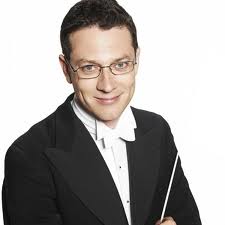
Conductor and arranger John Wilson was the latest interviewee in the Singular Sensations series at the Charing Cross Theatre, London
Singular Sensations: John Wilson, with Edward Seckerson, at the Charing Cross Theatre, London.
The John Wilson Orchestra is responsible for reviving the original orchestrations of famous Hollywood musicals from such studios as Metro-Goldwyn-Mayer and 20th Century-Fox and composers including Gershwin, Berlin, Kern, Harold Arlen, Cole Porter, Lerner & Loewe and Rodgers & Hammerstein. John Wilson has rescued and restored the scores from many MGM musicals, in particular those arranged by Conrad Salinger. He talked to Edward Seckerson and played some of his orchestra’s recordings in the Singular Sensations series at the Charing Cross Theatre, having just completed a UK tour. Michael Darvell reports…
The John Wilson Orchestra has been in existence since 1994 and is made up of a jazz band within a symphony orchestra. It has a huge number of personnel – Wilson used nearly 100 players when the orchestra visited Los Angeles – and it is modelled on the orchestras of the 1940s and 1950s at film studios such as MGM, 20th Century-Fox, Paramount, Columbia and Warner Bros. However, Wilson mainly concentrates on the output from MGM and Fox who released probably more film musicals than any other studios. In particular he favours the MGM movie musicals and their highly talented arrangers such as Conrad Salinger and Johnny Green. Some of the MGM films he has featured include High Society, An American in Paris, Brigadoon, The Wizard of Oz and Singin’ in the Rain.
To open his Singular Sensations interview with Wilson, Edward Seckerson let the audience hear part of the overture played during the credit titles for Singin’ in the Rain (1952). It immediately brought back nostalgic memories of the heyday of the film musical. However, for MGM this heyday vanished after Gigi in 1958, the studio’s farewell to the traditional examples of the genre. But what a legacy these films have produced in their orchestral scores. Unfortunately, many of the original arrangements and orchestrations were lost or simply destroyed when the MGM studios closed down in 1969. With only piano reductions available for many of these classic scores, it has meant that Wilson has had to painstakingly reproduce them again in order to be able to perform the music as it was originally written for the films’ soundtracks.
Wilson is nothing if not thorough because his philosophy is that this work should be done properly, it must achieve the best results without any sort of ‘that’ll do’ attitude, and be nothing less than perfect. This involves a lot of hard work not only for him in transcribing the music, but also lengthy rehearsal times for the orchestral players. It also needs to be fun and absorbing. The members of the John Wilson Orchestra are hand-picked for their professional skills. Apart from a dance band brass section and a rhythm and saxophone section, there are also large woodwind and French horn sections and, most important of all, a huge string contribution to give the orchestral sound a very lush sound – just as it always was in the original movies.
Wilson’s own musical career began in the 1980s studying A-level music at Newcastle College, where he also conducted another almost 100-piece orchestra for a concert version of West Side Story, which, he admitted to Seckerson, he thought was the best score of a musical. As well as studying conducting at the Royal College of Music in London, Wilson also studied composition under Joseph Horovitz. In his time he has conducted a number of UK orchestras and worked as an arranger and orchestrator in both TV and film, but it is through his championing of film music that the John Wilson Orchestra has become most known. His first BBC Promenade Concert in 2007 was a programme of British film music. The 2009 Proms saw his tribute to MGM musicals which gained an audience of some four million, a postbag of 4,000 letters and a jammed switchboard. In 2010 he presented the work of Rodgers & Hammerstein; for 2011 it was a mixed bag in Hooray for Hollywood; and last year he reconstructed Lerner & Loewe’s My Fair Lady and also paid tribute to the Broadway Sound. The John Wilson Orchestra has now become a permanent fixture in the BBC Proms, and his concerts are usually the first to sell out.
It is the richness of the sound that is so important to Wilson and he endeavours to achieve it by ignoring any technical limitations that musical instruments or the human voice may have to offer. However, he needs to train his players to achieve the right sound. This was ably demonstrated in a beautiful arrangement of ‘The Heather On the Hill’, from Lerner and Loewe’s Brigadoon, which Seckerson played to illustrate the lushness of the orchestration. Thus the end product is meticulously achieved, but not without a good deal of fun too, as the resulting sound often makes an audience smile with satisfaction. Still, even listening to his own recordings, Wilson was critical of the result – obviously a man who is very hard to please – and he could not resist almost conducting these scores again as his hands moved up and down with the music Seckerson played.
Another illustration of the brilliance of the MGM orchestrations came in the barn-raising scene in Seven Brides For Seven Brothers (music by Saul Chaplin and Gene de Paul) set to the song of ‘Bless Your Beautiful Hide’. Other recorded musical illustrations during this fascinating insight into the world of Wilson included ‘Well, Did You Evah!’ from Cole Porter’s High Society (1956), played by the John Wilson Orchestra with vocals by Seth MacFarlane and Curtis Stigers. From Rodgers & Hammerstein’s The Sound of Music (1965) Sierra Bogges sang ‘Something Good’ which Rodgers wrote specially for the film musical, as Oscar Hammerstein had died in 1960.
From Rodgers & Hammerstein’s 1956 film of Carousel (a personal favourite of Seckerson) we heard the ‘Carousel Waltz’. Seckerson also surprised his guest with a track from Lerner & Loewe’s Camelot (stage version, 1960) as we heard Julie Andrews singing ‘I Loved You Once in Silence’, with that wonderful purity of voice that is clarity personified.
Finally, it was back to Singin’ in the Rain for the extended song and dance sequence of ‘Broadway Melody’ which, if it does nothing else, pinpoints Hollywood at its best with the best of Metro-Goldwyn-Mayer in the best of film musicals. We should feel blessed that we have John Wilson and his Orchestra to keep reminding us how brilliant Hollywood composers and musicians were in that far gone movie age some 60 or more years ago.
Seckerson’s final guests in this series of Singular Sensations are Patricia Routledge on 19 January 2014, and Jenna Russell on 26 January 2014 at the Charing Cross Theatre.
Michael Darvell
Readers may also be interested in:
Singular Sensations – Janie Dee
Singular Sensations – Kerry Ellis
SHARE THIS POST:


Comments are closed.