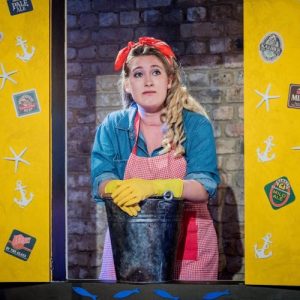
 The Boatswain’s Mate was presented at the Arcola Theatre, London as part of the Grimeborn Festival.
Star rating: four stars ★ ★ ★ ★ ✩
The Arcola Theatre’s month-long Grimeborn Festival centres on operas, including fresh interpretations of classic works as well as new and neglected ones. But it has also been known to extend its remit to musical theatre, as well as to pieces that straddle the generic boundaries between opera and musical.
Ethel Smyth’s The Boatswain’s Mate, although formally an opera, is indebted to the light operettas of Gilbert and Sullivan one generation earlier. The composer even enjoyed good relations with Sullivan, with whom she had much in common, in the 1890s.
Smyth’s opera is presented in this year’s Grimeborn Festival in recognition of the centenary of many women receiving the parliamentary vote in the UK, since, immediately prior to its composition in 1913-14, Smyth spent two years as a leading suffragette – even earning herself a brief prison sentence for smashing the window of a cabinet minister’s London home.
The Boatswain’s Mate is particularly relevant to Smyth’s service to the ‘Votes for Women’ campaign, since its overture liberally quotes her famous suffragette anthem, ‘The March of the Women’. Smyth, who wrote the opera’s libretto as well as the music, is even said to have modelled its heroine Mrs Waters on Emmeline Pankhurst, the leader of the Women’s Social and Political Union.
The interpretation taken by Spectra Ensemble’s production, the brainchild of director Cecilia Stinton and producer Jessie Anand, leans strongly on the side of opera. But it nonetheless judiciously plays its many light-hearted comic elements effectively, not least in the characters’ non-verbal reactions to pivotal junctures in its rather audacious plot.
The Boatswain’s Mate is written in two parts, the first indebted to the English ballad opera tradition with much spoken dialogue in between numbers, and the second more aligned with the serious German through-composed opera of such composers as Wagner and Richard Strauss. The division between the two different musical traditions in this production, performed without an interval, is remarkably smooth.
Whereas the original setting for The Boatswain’s Mate is a country pub somewhere in rural England in the early 20th century, consonant with the short story by W.W. Jacobs on which it was based, Spectra Ensemble resituates the opera in a quintessentially British seaside resort in Margate against the backdrop of the Queen’s Coronation in June 1953.
That said, the opera’s geographical and temporal relocation is not particularly evident from the performance itself, aside from the occasional visual cue such as an oblique seaside bucket and spade reference made for comic effect. While the Mummerset accents traditionally adopted for the characters are convincing for the most part, they seem somewhat out of place given the changed setting to a Kent coastal town.
Throughout the show, one is struck by the phenomenal control the singers exert over their voices, the clarity of their diction, the immediacy with which they hold the audience’s focus in the intimate space of the Arcola Theatre’s Studio 2, as well as their stamina in performing for some 90 minutes without an interval, especially given the hot ambient temperature of the basement room.
Hilary Cronin presents a suitably feisty and authoritative Mrs Waters, the landlady of the pub in which the action takes place. Her beautifully performed ‘What If I Were Young Again’ proves to be one of the show’s most poignant highlights, matched only by her final aria at its climax.
John Upperton delivers a standout performance as Harry Benn, who, despite leering creepily over Mrs Waters, seems to elicit genuine sympathy for his continual rejections. His opening number, the lilting ‘When rocked on the billows’, sets the show off to a commendable start.
Shaun Aquilina as Ned Travers establishes an excellent rapport with Upperton’s Benn as their characters hatch their outrageous plan for Benn to win Mrs Waters’ hand in marriage. He flourishes during the show’s action-packed second part, during which Travers stages a burglary in Mrs Waters’ pub.
Lily Evangeline Scott realises the character of Mrs Waters’ maid Mary-Ann with a perfectly struck blend of innocence and cheekiness, while Michael T.K. Lam contributes many fine touches from within the ensemble.
Some of the show’s biggest laughs are reserved for the moments with pointedly gendered implications, such as Travers’ asking Mrs Waters to remove her ‘pretty’ finger from the trigger of her gun. The bumbling Policeman, ably portrayed by Christopher Foster, recalls the composer-librettist’s own brushes with the authorities during her period of suffragette activity.
Inevitably there are a few instances where this production exercises artistic licence: Mrs Waters brandishes a revolver rather than a shotgun, and Travers is not locked inside a cupboard as per the original libretto. In consequence, one or two of the lines of lyrics align imperfectly with the onstage action – but this is a minor concern.
Musical director John Warner is responsible for an impressive arrangement of the entire score for piano, violin, and cello that works notably well as an orchestral reduction. He leads instrumentalists Claudia Fuller and Heeyeon Chloe Cho proficiently throughout from the keyboard.
Spectra Ensemble’s The Boatswain’s Mate yields a fantastic performance of a rarely presented English comic opera that surely deserves to be presented more often. One can only hope that other UK companies will follow, and that audiences will not have to wait for the next milestone anniversary of women’s suffrage to witness another staging in the UK.
Christopher Wiley
SHARE THIS POST:


Comments are closed.