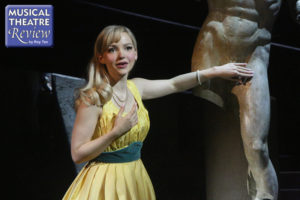
Picture: Roy Tan
The Light in the Piazza continues at the Royal Festival Hall, London until 5 July 2019.
Star rating: three stars ★ ★ ★ ✩ ✩
The Light in the Piazza is based on a novel by the American author Elizabeth Spencer who travelled to Italy on a scholarship and stayed there so long that she thought she knew it well enough.
Later she confessed that she always wrote from an outsider’s point of view, a thought she carries through in her portrait of the central character Margaret Johnson, a role sung here by operatic soprano Renée Fleming. Margaret travels to Florence with her daughter, Clara (Dove Cameron), whom we later learn is has mental and emotional difficulties as the result of an accident in childhood.
Margaret’s dilemma and the pivot of the tale round which the plot unfolds, is how to convey to her daughter’s suitor Fabrizio (Rob Houchen) and his family, the source of her unhappiness. It might seem a fuss all over nothing by today’s standards, but one has to remember that the 1950s were a decade where pre-war social mores and etiquette still ruled. Margaret Johnson is on holiday in sunny Italy but she still wears a hat and a pair of white gloves.
This production is staged on the concert platform of the Royal Festival Hall. It isn’t ideal but the lofty space is filled in part by having the estimable orchestra of Opera North elevated behind the stage set with the action taking place in the foreground. A ruined city wall dominates the stage, the players inhabiting its concave shape dominated on the left by a giant male statue, posterior to the fore, that swings round to face the audience when the location moves to Rome.
The director Daniel Evans keeps the action spinning along with amongst other business a Vespa scooter whizzing across the stage several times. Too bad it was never the young son at the wheel as shown prominently in the programme!
Fleming sang the role of Blanche Dubois in André Previn’s A Streetcar Named Desire, a formidable part, which she made her own. Margaret Johnson is a trickier one to pull off. She’s a not very likeable person, a bit of a prig, and self-centred like most of the characters. Nevertheless in her dialogue scenes with her daughter and her estranged husband (Malcolm Sinclair), you feel the heartache, less so when she sings. This may in part be due to the acoustics in the Royal Festival Hall which leave much of Act I hard to hear, a fact compounded by the spoken Italian and broken English. Surtitles would have helped.
The lovers are an animated pair, most touching in their exchanges, and sing a tricky score with conviction. The lovely title song, following the scene where the mother slaps her daughter in the face, is a highlight, though curiously unmotivated. Alex Jennings, as Signor Naccarelli, is always a pleasure to watch, his urbane facade dropping for one moment to kiss Margaret. The casting also includes another distinguished opera singer, Marie McLaughlin, as Signora Naccarelli and Celinde Schoenmaker as her daughter Franca who make the most of their roles.
I must confess to a disappointment overall with Adam Guettel’s score. Although ravisingly played by the orchestra, conducted by Kimberly Grigsby, I felt it lacked a heart, too often skimming over the drama, in an endless improvisation that never finds a resolution.
I see the programme note say “Adam (Guettel), I think, loves to journey more than to arrive” which I suppose is another way of putting it. Writer Craig Lucas scatters a modicum of wisecracks into his book, one expects that from a Broadway show, and his writing is never less than polished, but the overall effect is one that seems to dissipate the drama, rather than move it forward.
I came out whistling a tune from Do I Hear A Waltz?, a musical I couldn’t help thinking of for various reasons, whilst sitting through this piece. I wonder why?
Adrian Edwards
SHARE THIS POST:


Comments are closed.