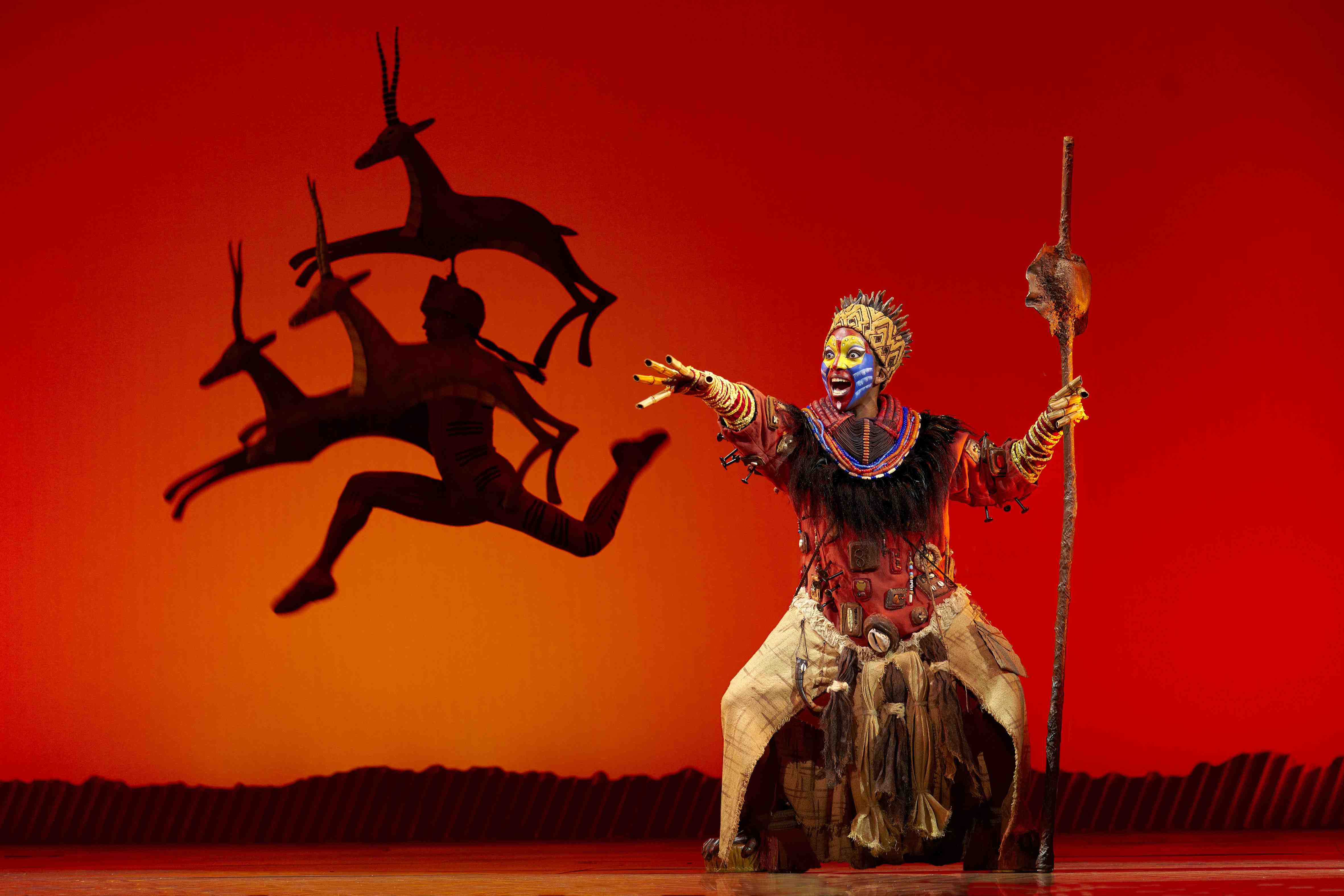
A second dedicated autism-friendly performance of Disney’s The Lion King took place at the Lyceum Theatre, London on 4 May. Picture: Brinkoff and Mogenburg
An autism-friendly matinee performance of The Lion King took place at the Lyceum Theatre, London on Sunday 4 May, 2014.
I saw my first West End musical when I was ten years old (Oklahoma! at the Palace Theatre), and I am fortunate enough to have seen many, many more since. So why, on the morning of Sunday 4 May, when I was going to see The Lion King at the Lyceum Theatre, did I wake up with butterflies in my stomach?
Well, this was a big day, for I wasn’t visiting the musical as a normal punter or as a member of the press, I was going as a parent: with my husband, our 12-year-old daughter and ten-year-old autistic son John.
Autism is a serious, lifelong and disabling condition, affecting children and adults. As a ‘spectrum’ condition it affects each person in a different way, but people with autism tend to experience common social difficulties understanding and relating to other people, and the world around them. Sudden changes in routine or environment can be incredibly frightening and stressful. Sensory issues can also prove problematic: for example a person may dislike bright lights, or may have very sensitive hearing and find noise, including background noise intrusive, distracting or even painful.
A trip to a West End show is, of course, a big deal for most families (not least, because of the price of tickets), but for a large percentage of parents who have an autistic child – or care for an adult on the spectrum – such a venture is virtually impossible and extremely stressful.
However much one plans, the unpredictabilities of everyday life can make the difference between a smooth train journey and one punctuated by an autistic meltdown (often described as a ‘tantrum’ by those onlookers who stare and make comments about your apparently ‘naughty’ child).
Then, if you manage to get to the theatre, there are the perils of queueing (toilets, tickets, drinks/snacks) and the conventions of how to behave in the auditorium – keeping quiet and still (not often an autistic trait). Plus, once again, you are risking the disapproval of others. It’s enough to convince you to stay at home.
On this particular Sunday, though, my visit to The Lion King was an altogether different experience. Described as autism-friendly, and planned in association with Disney Theatrical Productions, the Ambassador Theatre Group and – crucially – the National Autistic Society, the purpose of this very special matinee was to make families/friends who care for children and adults with autism as welcome and relaxed as they could possibly be.
Disney first got involved in presenting autism-friendly performances with The Lion King on Broadway. The organisation then approached the National Autistic Society about creating such events in the UK. There have now been two such performances at the Lyceum and one at the Edinburgh Playhouse.
Even before heading to the theatre, there was a social story to download from The Lion King website which I used to give John a visual idea of what the theatre looked like inside and out, the story and characters in the show, and an idea of the timetable for the afternoon. (It is also worth noting that tickets were sold at a specially discounted price. This encourages families to take a risk on buying tickets, even though there might be a chance they have to leave the theatre early).
Heather Wildsmith, the National Autistic Society’s cultural development manager, had been heavily involved in preparing the cast, backstage crew and front-of-house staff for what to expect from this very different audience, even suggesting subtle changes to the show itself. This ranged from front-of-house volunteers being aware that families may arrive on the back of a stressful journey, to the cast of performers knowing to expect a much noisier and more mobile audience than normal.
While the show remained very much intact, a few adjustments were made, not least the appearance of George Asprey (who plays the villainous Scar) before the performance. Asprey explained to the audience that he was an actor playing a fictional role (a point that would seem obvious to a mainstream audience but not to autistic individuals who can take life quite literally sometimes) and introduced the unusual looking and sounding character of Rafiki (actress Nteliseng Nkhela) as the first performer we would see when the show began.
Asprey made the 2,000-strong crowd feel even more relaxed with his obvious enthusiasm for the event, and brought several people to tears as he emphasised how important it was for those present to have the same opportunities to go to the theatre as anyone else (“every child deserves a day like today”). In addition, he pointed out the oodles of volunteers waiting at the sides of the auditorium who were on hand to help out if anyone had any problems during the performance.
Not only that, situated around the theatre foyer and other areas were several designated quiet and activity areas, staffed by experts in autism throughout the performance, where families could go and take time out if anyone was overwhelmed by the experience or were suffering from sensory overload.
To our surprise and pride, John stayed in his seat and enjoyed the whole of Act I of The Lion King, helped by the visual splendour of Julie Taymor’s vision, Disney story and songs he recognised, and of course the work of a cast (and crew) who never let the incredible noise level within the auditorium bother them.
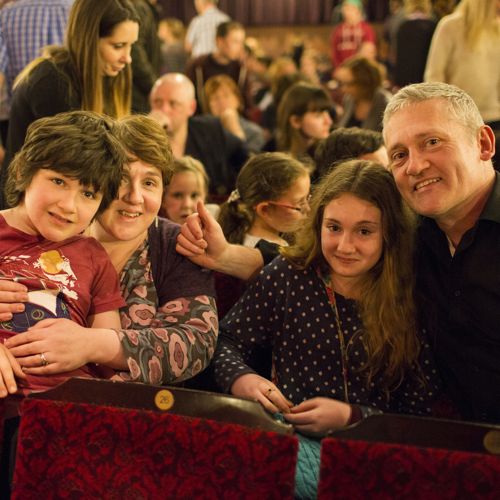
John enjoys his afternoon at The Lion King with myself, sister Eve and dad Brian. Picture: Helen Maybanks
Returning for Act II was not so quite straightforward and much of the rest of the show was seen, intermittently, from the back of the Dress Circle (we had originally been in the stalls!).
The massive difference though was that as I ran up and down stairs chasing John, I only received smiles and offers of help from volunteers and nods of recognition from members of the audience. When John decided to sit alongside another family on a few occasions, and I kept apologising for the intrusion, they simply said it was not a problem. To be around that kind of understanding was incredible.
At the end of the show, a few minutes were squeezed in for a visit to the Lyceum stage and a quick hello to lead members of the cast who were patience personified (despite the fact that John refused to have his photograph taken with them).
Indeed the actors described how excited they had been about the performance and how wonderful the feedback had been from such an enthusiastic audience.
During the journey home, as John gave other members of our train carriage a description of each station we passed through and again received a few looks of disapproval, he was unaware of what he had achieved. But for our family to have the opportunity to go to a West End show means more than words can describe.
For one day, our son’s autism was accepted and understood, and for a few hours he wasn’t judged for being different. These days are pretty rare.
Along with Disney, there have been several small and large venues/organisations who have developed relaxed performances aimed at children or adults with special needs or autism-related learning difficulties. It is vital that this kind of development continues to be financed and supported so theatre is as inclusive as it can be. Then more families across the UK can discover that a theatre trip isn’t as impossible as they think it is. Every time one of these events take place, they are creating special experiences that families like mine will never forget.
Lisa Martland
www.lionkingautismfriendly.co.uk
SHARE THIS POST:


Comments are closed.