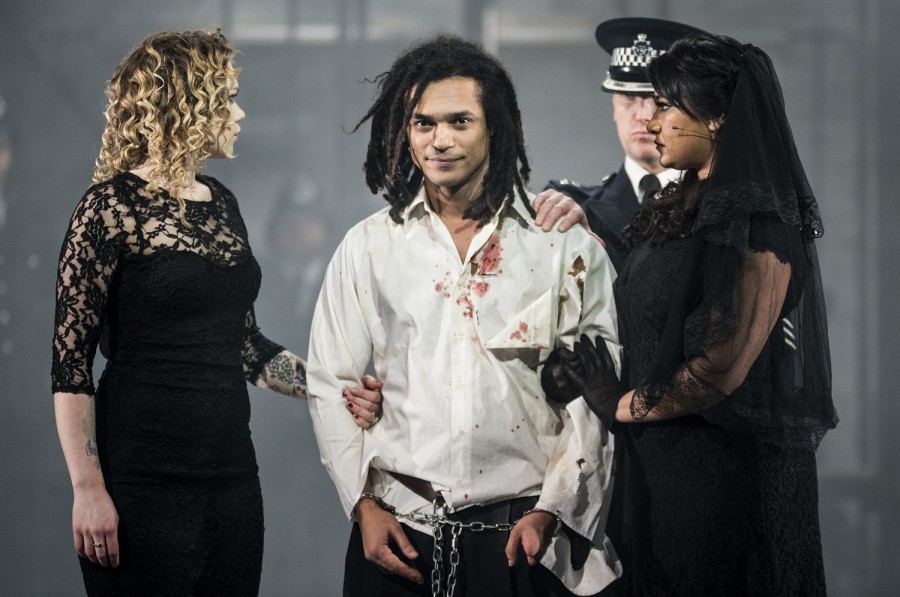
CiCi Howells, Milton Lopes and Natasha Lewis in The Threepenny Opera at the Nottingham Playhouse and touring. Picture: Patrick Baldwin
The Threepenny Opera continues at Nottingham Playhouse until 8 March , then tours until 10 May.
We owe it to Graeae Theatre Company, the pioneering London-based ensemble that classes itself, rightly, as ‘a force for change in the theatre, breaking down barriers, challenging preconceptions, boldly placing disabled artists centrestage’ that this often stunning production of the Brecht/Weill farrago proves such a visual and musical feast.
Expressive actors disadvantaged in every conceivable way – mobility, manual adeptness, sight, height, hearing – make up the bulk of this brilliant cast. But no concessions are needed. This is about as empowered a show as one could imagine. From wheelchair-nifty John Kelly’s opening in-your-face narration to the last scintillatingly played asthmatic wheeze of Kurt Weill’s sneery music, this no-holds-barred event has everything Brecht must have wanted: aggro, cheek, biting irony, vengefulness, hypocrisy – and flair.
Plus poverty. This is a Dickensian crowd: low life, skint, down on its luck, dodging Sweeney Todds, looking in vain for the next crust; ‘these cripples here’, as one character ironically quips. Jonathan Jeremiah Peachum (Garry Robson) solves the problem by controlling all the beggars in crooked East London. Like corrupt cops Tiger Brown (Will Kenning, splendid speaking, witty in duet) and Sergeant Smith (a louche Metropolitan swagger from TJ Holmes), he wants his cut.
It’s Robson’s opening song that gets the show off to a rip-roaring start, from which it scarcely looks back. Victoria Oruwari (his Mrs), feisty and funny, adds a great singing voice – another constant pleasure.
This scintillating show, co-directed by Graeae’s Jenny Sealey and Ipswich New Wolsey Theatre’s Peter Rowe, who – especially with Mark Haig’s spectacularly apt monochrome projections – work wonders in this staging, is also packed with hits. A flaw is that Act I contains too little music, and some dialogue that occasionally droops. In Act II, a dozen plum numbers follow in quick succession, so that the vociferous later stages are an unalloyed joy.
It’s also problematic for Milton Lopes’ central character, the moralising bandit Macheath. His later vocal splashes (‘Who wants to leave his life of crime…?’) work a treat – not because the voice training is that secure, but because he finally finds the right, believable panache.
Lucy Lockit (Natasha Lewis), when she turns up, is easily a vocal match for Mack the Knife’s adoring wife Polly (CiCi Howells). Both sing pretty impressively, but Lucy’s character really shines through. When they bicker, both excel.
The most adorable melody of the evening is reserved for Amelia Cavallo’s Jenny, who brings the show to a magical halt with her exquisite sound and wondrous intonation. Jude Mahon, the actress who interprets with sign, mouths the words with as much rhythmic flair as any of the leads, and looks like a star in her own right. But the second best speaker to my mind (after Kelly), is Ben Goffe’s Jake, also cellist and trumpeter, who has the versatility to bring text as alive as any one of this humdrum melee. Members of the ensemble – wry, sarcastic, empathetic – are mostly knockout.
Roderic Dunnett
* The Threepenny Opera is a co-production between Graeae Theatre Company, West Yorkshire Playhouse, New Wolsey Theatre, Ipswich, Nottingham Playhouse Theatre Company and Birmingham Repertory Theatre Company.
* After Nottingham Playhouse, the production tours to New Wolsey Theatre, Ipswich (12–22 March), Birmingham Repertory Theatre (27 March–12 April) and West Yorkshire Playhouse, Leeds (24 April–10 May).
Readers may also be interested in:
The Threepenny Opera leads New Wolsey season – News
SHARE THIS POST:


Comments are closed.