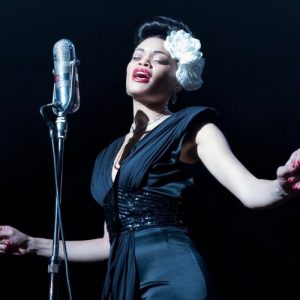
 The United States vs Billie Holiday on Sky Cinema.
Star rating: four stars ★ ★ ★ ★ ✩
As much a movie about a song, ‘Strange Fruit’, and the influence it had on the birth of the Civil Rights movement in the 1950s than about the singer, jazz legend Billie Holiday, The United States vs Billie Holiday tells an ugly story of racism, drugs and alcohol abuse that’s not for the faint-hearted.
And while it’s not easy watching, the upside is the remarkable performance by singer-songwriter Andra Day on what is, to all intents and purposes, her acting debut.
It is so intense, so raw, so brutal that Day has won a Golden Globe for Best Actress in a Motion Picture – Drama, an unexpected triumph that has seen her installed as 2-1 co-favourite for Best Actress gong at the delayed Oscars at the end of April. The nominations are revealed on 15 March. Will Day be named?
If so, she could face the other co-favourite Glenn Close (Hillbilly Elegy), Frances McDormand (Best Picture favourite Nomadland), Viola Davis (Ma Rainey’s Black Bottom) and three Brits Carey Mulligan (Promising Young Woman), Vanessa Kirby (Pieces Of A Woman) and Rosamund Pike (I Care A Lot). But they can’t all be nominated in a short list of five.
The United States Vs Billie Holiday is, of course, not a musical but has plenty of music in it with Day singing the numbers most associated with Holiday plus one she co-wrote called ‘Tigress & Tweed’ which was nominated for Best Original Song at the Globes.
You might only hear a few bars from some of them but ‘All Of Me’ comes in its entirety while ‘God Bless The Child’, ‘Solitude’, ‘Tain’t Nobody’s Business’, ‘Them There Eyes’, ‘Lover Man’, ‘Hallelujah I Love Her So’, ‘Break Your Fall’, ‘I Cried For You’ and ‘Lady Sing The Blues’ are all there in some shape or form.
But it’s ‘Strange Fruit’ with its inflammatory, defiant imagery that’s the show-stopper. No wonder it was banned on some radio stations, no wonder the racist Federal Bureau commissioner Harry Anslinger warned her to stop using it in her cabaret act.
He called it a “starting gun” for the Civil Rights Movement, saying “it gets Black people thinking the wrong thing”, but was frightened to ban it as that would mean acknowledging the lynchings portrayed in the song actually existed when he wanted them brushed under the carpet. So instead of the song, he set about discrediting the singer, busting Holiday even if it meant planting the drugs on her.
Sentenced to a year and a day in prison and barred from getting a licence to perform in nightclubs when she came out, her new “Mr Fixit” manager and lover got her a concert at Carnegie Hall no less and within two weeks she was singing ‘Strange Fruit’ again.
Day, who took her stage name from Lady Day, Holiday’s nickname, is mesmerising as, with blood-red lips in close-up, she wrenches every last drop out of these words, written in 1937 by Jewish-American poet Abel Meeropol, writing under the pseudonym Lewis Allan:
“Southern trees bear a strange fruit/Blood on the leaves and blood at the root/Black bodies swing in’ in the Southern breeze/Strange fruit hanging’ from the poplar trees.
“Pastoral scene of the gallant South/The bulgin’ eyes and the twisted mouth/Scent of magnolias sweet and fresh/Then the sudden smell of burnin’ flesh.”
There’s more but how much more can you take? We are 85 minutes into the film before we’re allowed to hear that performance which echoed Holiday’s nightclub act, keeping it for the last song of the night when table service was halted. She wanted her spellbound, silent audience to hear every last, cruel, bitter word.
Born Eleanora Fagan, raped at 10 by a neighbour, raped again at 14 and encouraged by her mother to try prostitution as a means of survival in a world where Black people were forced to use the servants’ elevator, were segregated, and beaten or lynched almost at the drop of a hat, Holiday blazed a trail with an unforgettable voice and an unforgettably controversial song.
Day, who took up smoking and drinking to help towards capturing that uniquely gravelly voice and character of a showbusiness legend, gives a five-star performance in a three-star movie.
At 132 minutes it is too long, too much on one note, and ducks and dives from one decade to another and back again. But Day does director Lee Daniels more than proud.
Jeremy Chapman
SHARE THIS POST:


Comments are closed.