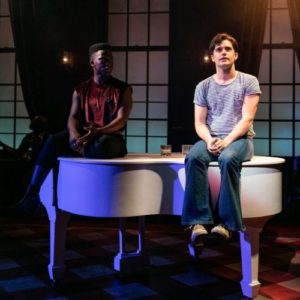
Tyrone Huntley and Andy Mientus in The View UpStairs at the Soho Theatre, London. Picture: Darren Bell
The View UpStairs continues at the Soho Theatre, London – until 24 August 2019.
Star rating: three stars ★ ★ ★ ✩ ✩
In this, the 50th anniversary year of the 1969 Stonewall Riots, that act of uprising has come to symbolise the entirety of the struggle for LGBT civil rights. But there are other, just as monumental, events along the way. Netflix’s recent revival of Tales of the City highlighted the 1966 Compton’s Café riots in San Francisco, for example, an event which has otherwise become lost to time, overshadowed by events on the East Coast of America.
The arson attack on the UpStairs Lounge in New Orleans in 1973 is another milestone event in LGBT history, and similarly has faded from collective memory. Thirty-two people died when the bar went up in flames, but the attack was never fully investigated, as would surely have happened if the victims were not LGBT.
There is something about theatre’s ability to place its audience within an environment that makes it the perfect medium to look at the events immediately preceding the tragedy, to explore the real lives of the people who lost their lives, to try and piece together what really happened.
Max Vernon’s The View UpStairs does not take that approach. Instead, it places at the heart of the story a 2019 Instagram influencer, Wes (Tyrone Huntley), who for some reason never satisfactorily explained has purchased the building that once housed the UpStairs Lounge. After taking a line of cocaine, Wes finds himself transported back to 1973 and the Lounge’s final night, where the stereotypical millennial finds himself immersed in a realm of similarly one-dimensional caricatures.
The time travel aspect to Vernon’s book is explicit in comparing the varying attitudes to LGBT civil rights across the decades. Vernon brooks no subtlety in his writing, forgoing subtext in favour of declamatory speeches and expository dialogue.
Placing the modern Wes in a world where being out and proud would get you killed has potential: the ability to compare the life of 1970s New Orleans to modern-day metropolitan Manhattan could illustrate how, just because some gay people can feel safe and accepted these days, there are many others whose life is still at daily risk.
But to do that, Wes needs to be a proxy for us, the audience of his contemporaries. Instead, Vernon is more concerned with taking tired sideswipes at social media culture, at some people’s obsession with follower counts and likes, that it is only due to Huntley’s innate charisma that Wes contains any redeeming qualities at all.
The habitués of the UpStairs Lounge often fare little better. Vernon creates a fictional clientele for the bar, nominally an amalgam of the real victims but really just a collection of stereotypes.
Director Jonathan O’Boyle has at least been able to assemble an impressive cast, including John Partridge as louche bar singer Buddy, Cedric Neal as camp barfly Willie and Victoria Hamilton-Barritt as the mother of a Puerto Rican drag queen who has come to act as a maternal proxy for all the Lounge’s regulars.
More interesting are Broadway import Andy Mientus as Patrick, the sweet boy who Wes finds himself falling for, and Declan Bennett’s Dale, the messed-up homeless guy who resents being pushed aside by the rest of the bar.
The duality presented by those characters – both of whom suffered at the hands of abusive families, who find themselves on the streets and who hustle sex for money – is Vernon’s most interesting subplot. It is also the plot point that makes the most palpable hits about gay culture then and now: youth and beauty become discriminating factors, with older, more messed-up LGBT people often left behind.
Part of the reason why The View UpStairs has managed to attract such talent is possibly Vernon’s songs, which are a substantial improvement on his book. While his structure is very dependent on giving each character at least one solo number, Vernon does at least explore a number of musical styles, from 1970s disco to much more modern sounds, the time-travelling aspect of the story papering over many anachronisms.
Musical highlights include Hamilton-Barritt’s plaintive ‘The Most Important Thing’ and the opening number, ‘Some Kind of Paradise’, led by Partridge, while the anthemic ‘Theme Song’, a call to arms for community solidarity, pushes every button it is quite blatantly aiming for, and is all the better for that.
As Wes returns to the present, Huntley is saddled with yet more clunky dialogue expressing how, while LGBT people in some countries have many more rights than they did 45 years ago, there is still much more to do in the fight for equality. Had Vernon sold this character better, made the cracks in his facade more believable (instead of yet more clichéd therapy speak), that call to arms may feel more inspiring.
Instead, it feels like a lecture that, despite some inspirational numbers and fine performance, The View Upstairs has not earned.
Scott Matthewman
SHARE THIS POST:


Comments are closed.