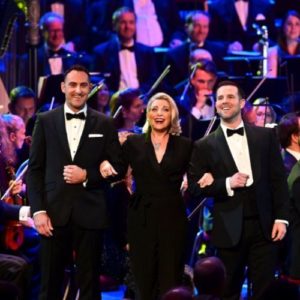
Picture: BBC Mark Allan
The Warner Brothers Story at the BBC Proms was performed at the Royal Albert Hall, London.
Star rating: five stars ★ ★ ★ ★ ★
John Wilson celebrated The Warner Brothers Story by giving us a matinee and an evening performance of the studio’s musical attainments to a packed Royal Albert Hall.
It can have been no easy job for him to select the programme, which was the same for both concerts, given that it was divided between the likes of Erich Wolfgang Korngold and Max Steiner, masters of the grand Hollywood tradition, and that wonderful array of songwriters who gave the studio’s stars like Doris Day, that fine singer-actress with the golden voice, who passed away earlier this year.
Although much has been said about Wilson’s extraordinary ability in returning these classic scores to life and the dedication and purpose behind such a monumental task, less mention has been made of his orchestra, its different sections, the singers and the chorus, who re-create in period performance, the sound peculiar to the studio in hand.
The sopranos and altos in the Maida Vale Singers, caught that sweet sound of the young chorus line so characteristic of the early Warner Bros musicals. Harry Warren and Al Dubin’s ‘We’re in the Money from Gold Diggers of 1933 was brought off by them and soloist Louise Dearman to a tee.
The big orchestra’s musicians focused and actively engaged, know exactly how this music goes, yet manifestly are having the time of their lives under a conductor who shares with us his belief that this music is second to none.
That fine baritone Matt Ford was the charismatic Professor Harold Hill in The Music Man, dustman extraordinaire Alfred P. Doolittle in My Fair Lady, then cut a lonely figure in Arlen and Johnny Mercer’s ‘Blues in the Night’, where his whistling and scene painting took us to that very spot where that lonesome whistle blows across the trestle.
His more intimate way with ‘If Ever I Would Leave You’ from Camelot was in keeping with the arrangement of the song where Alfred Newman’s scoring offered the strings of the orchestra and the conductor an opportunity to pour out their heart and soul, heralding the forthcoming tragedy of Lancelot and Guinevere’s forbidden love.
The one incongruous note of the evening, the big band arrangement of Henry Mancini’s ‘Days of Wine and Roses’, rather glossed over the reflective lyric by Mercer.
Ford duetted in perfect harmony with Mikaela Bennett in ‘The Desert Song’, an overdue reminder of Sigmund Romberg’s lush operatic style, and in close harmony with Dearman and Maida Vale singer Patrick Smyth in ‘Gotta Have Me Go With You’ from Cukor’s A Star Is Born (1954).
The film’s great solo, ‘The Man That Got Away’ (music by Arlen, lyrics by Ira Gershwin), not Johnny Mercer as the programme stated, was a heartrending affair from Dearman, who made this song her own. A special mention for the band too, lit in blue shadow, as in the film, where saxophone, muted trumpet and trombone improvised the warm up to this blues in Ray Heindorf’s laidback arrangement.
Dearman and Bennett shared the contrasting songs in a tribute to the unique talents of Doris Day, who made her cinematic debut in Warner Bros’ Romance On the High Seas in 1948. Bennett sang the soaring ballad ‘It’s Magic’, by Jule Styne and Sammy Cahn, with a touching sincerity. It was preceded by the fun-and-games of ‘The Deadwood Stage’, Sammy Fain and Paul Francis Webster’s rousing paean to Dearman’s Calamity Jane.
It was Korngold’s music that so aptly opened and closed this Prom. ‘The Overture’ to The Sea Hawk, shared the vistas of Vaughan Williams’ ‘A Sea Symphony’ and ‘Bax: Tintagel’ in its opening paragraph, the violins revelling in the big string tune, wind glistening ever upward like a spiral of sea spray.
Korngold gave The Constant Nymph an opus number, signifying a film score that he was proud to own. If the film has been forgotten, this performance urges us to seek it out, as mezzo soprano Kate Lindsey, the MV Singers, organist Richard Hills and the ensemble powered it to a shattering climax.
From composer Max Steiner, we heard the ‘Suite’ from The Treasure of the Sierra Madre, a dramatic score he wrote for John Huston’s thriller of the same name, with entertaining episodes colouring in character and locale with two banjos, nearly walking off with their turn.
An unexpected but welcome inclusion was Dimiri Tiomkin’s ‘The Old Man and the Sea’, where the glistening orchestration lit up the to and fro of the main theme. Bronislau Kaper’s ‘Auntie Mame’, the precursor of the stage/film musical, was a lavishly dressed waltz, in keeping with the expensive wardrobe worn by its star Rosalind Russell.
Lavish too was the well upholstered arrangement by Frank Perkins to Jule Styne’s Gypsy, where trumpeter Michael Lovatt earned himself a well-deserved burst of applause, blasting out the show’s strip music.
This celebrated Overture made a stunning opener to the concert’s second-half and was followed by Wilson’s own arrangement of Steiner’s ’Now Voyager’, an intricate drama, starring Bette Davis, that touches on episodes of the narrative twixt drama and reflection, in a deeply felt manner. In this performance it came across as as Steiner’s cinematic masterpiece, a miniature symphonic poem.
Although A Streetcar Named Desire was billed as a ‘main title’, we were treated to so much more of Alex North’s sultry jazz-inflected score where many individual players shone in this powerful piece of writing.
Bennett’s ‘I Could Have Danced All Night’ thrilled us all and was greeted with a huge round of applause. The counterpoint of the three ladies from the Higgins household urging her in vain to go to bed was deftly brought off.
Then came a Harry Potter sequence of John Williams’ memorable music, a lovely touch to a living composer of extraordinary range and depth, through whom the Warner Bros story lives on in countless Harry Potter worlds.
Adrian Edwards
SHARE THIS POST:


Comments are closed.