
Ian Hallard and Sara Crowe in Shadow Play, as part of Bedroom Farces for Tonight at 8.30 at the Jermyn Street Theatre, London. Pictures: Robert Workman
Tonight at 8:30 continues at the Jermyn Street Theatre, London until 20 May 2018.
Star rating: four stars ★★★★☆
Nothing embodies the breadth and depth of Noël Coward’s writing abilities quite like Tonight at 8:30, his cycle of ten one-act plays designed to be performed in repertory by the same company over three evenings. From the steamy heat of the South Pacific to the repressed emotion of a railway tearoom, Coward’s pieces embody romance, comedy and tragedy amongst the upper classes.
It is unusual these days for any theatre to attempt the full collection of plays; for a Fringe theatre to attempt to do so is unheard of. And yet Jermyn Street Theatre feels like a natural home, its limited space allowing us to focus in on the lives played out in microcosm before us.
Dropping one of the original ten pieces (‘Fumed Oak’), director Tom Littler arranges the remaining nine into three themed triple bills, to be experienced individually, or as a complete collection – and, at weekends, in a single day if the mood so takes.
The trio of pieces given the umbrella title Bedroom Farces initially seem like they may all belong at the breezier end of Coward’s comedic output. ‘We Were Dancing’ sees Sara Crowe’s Louise Charteris abruptly announce to her husband that she has fallen in love with another man (Ian Hallard), whose name she has yet to learn. The consternation felt by her husband Hubert, played with harrumphing bewilderment by Nick Waring, has the twinge of tragedy underlying so much of Coward’s writing; but the insistence on politeness and good manners allows for much comedy.
The biggest drawback to ‘We Were Dancing’ as an introduction to all nine pieces is the spartan staging. The only set, apart from a colour-washed backdrop, comprises four verandah chairs. Littler’s direction follows suit, often requiring the principal four characters (including Rosemary Ashe as Hubert’s sceptical sister) to stand, or sit, in a line. While it allows room for Crowe and Hallard to dance together, and the ensemble to break out into song and dance for a rendition of Coward number ’We Were Dancing’, the arrangement feels unusually and uncomfortably forced and static.
Much better is the staging for ‘Ways and Means’, a deliciously frothy comedy in which a sponging, gambling-prone couple scheme to extricate themselves from their hostess without repaying the money they owe her. Waring and Miranda Foster have a breezy honesty with each other as Toby and Stella.
But the highlight of the Bedroom Farces is ‘Shadow Play’, a brooding masterpiece in which a woman’s sleeping pill-fuelled fantasies cause her to ruminate on her marriage and its eventual breakdown. Crowe and Hallard are sublime as Victoria and Simon, encircling one another in Victoria’s lucid dreams in which they re-enact and discuss fragments of their lives together. Containing three Coward songs – ‘Then’, ‘Play, Orchestra, Play’ and ‘You Were There’ – each number appears both in full and as fragments spilling out into Victoria’s dreams.
The jumbled, woozy, nature of the piece helps make ‘Shadow Play’ still seem modern and relevant, a treatise on depression and on memory as much as it is on love. The staging in the small Jermyn Street Theatre also allows Crowe, in possession of a smaller voice than many of her cast mates, to nevertheless fill the auditorium.
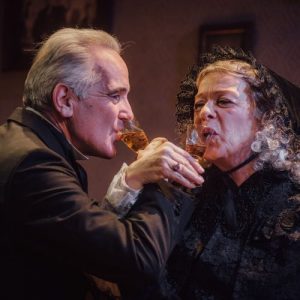
Jeremy Rose and Rosemary Ashe in Family Album, as part of Nuclear Families
In Nuclear Families, Littler presents three of Coward’s tales all set in drawing rooms. The first, ‘Family Album’, is the most ornately decorated of Louie Whitmore’s designs, re-creating a Victorian parlour as the Featherway family convenes after their father’s funeral. The most musical of all the pieces, including four numbers, the cast switch effortlessly from restrained, and slightly fond, memories of their paterfamilias to a much more convivial mood when the over-emotional Lavinia (Crowe) admits out loud the truths about their father which nobody had previously dared utter.
It is a shame, perhaps, that the intricate setting of ‘Family Album’ requires it to be placed first in the triple bill. For while ‘Hands Across the Sea’ is a delightful farce, all cross purposes and mistaken identities, the melancholic ‘The Astonished Heart’ – a tale of the impact a psychiatrist has on both his wife and his mistress, and the tragic end that ensues – makes for a terrifically downbeat end to the trio. A dark, brooding piece, one almost senses that this is Coward showing Rattigan how it really ought to be done.
For the final triple bill, Secret Hearts, the thematic resonance between the three pieces is weakest. The first piece, ‘Star Chamber’, sees a collection of actors unite for a committee meeting, ostensibly to discuss an extension to the home for retired actresses of which they are all trustees. Coward milks many of the stereotypical portrayals of activities divas for all they are worth, but despite the sparkling dialogue this is a piece which feels overtaken by more recent pieces ploughing the same furrow of thespian caricature.
The following piece, ‘Red Peppers’, remains within the entertainment world but is hugely more satisfying. Ashe and Jeremy Rose play bickering music hall couple Lily and George Pepper, whose musical double act gives the play its title. Featuring the songs ‘Has Anybody Seen Our Ship?’ and ‘Men About Town’, it is Coward’s love letter to the palaces of varieties which, by the time Tonight at 8:30 was written in the 1930s, were well on their way to near extinction.

Nick Waring and Miranda Foster in Still Life, as part of Secret Hearts
And while the final piece of Secret Hearts is not set within the theatrical world, it maybe deserves its association with ‘Star Chamber’ and ‘Red Peppers’ by virtue of its future adaptations. ‘Still Life’ is better known by the title it acquired when Coward expanded the one-act play into his screenplay for Brief Encounter. Right now, of course, Emma Rice’s joyful adaptation of that screenplay into a stage musical, including many Coward songs which also feature in Tonight at 8:30, is currently in revival at the Empire Haymarket cinema around the corner from the Jermyn Street Theatre.
But the latter venue offers a rare chance to see the original one-act version. Waring and Foster team up as Alec and Laura, whose chance meeting in a railway cafe turns into a passionate affair. But by keeping all the action within the cafe itself, it is the romantic lives of the station staff that comes to the fore.
When seeing the trio of triple bills in this order, it ensures that all nine finish with the piece that has most endured over the ensuing decades. But in Littler’s thrilling revival, the versatility of Coward’s writing shines through. Musical director Stefan Bednardczyk ensures that the musical numbers are infused with the mixture of levity and pathos for which the playwright and songwriter is justly remembered.
And, as the cast gathers to take their bows after all nine plays, they bring on some other stars of the show: stage manager Sarah Rhodes-Canning and her team. Implementing nine very different sets within the constraints of the Jermyn Street theatre is an act approaching the miraculous, and to acknowledge the backstage staff who make it possible is a worthy end to a day of great theatre.
Scott Matthewman
SHARE THIS POST:


Comments are closed.