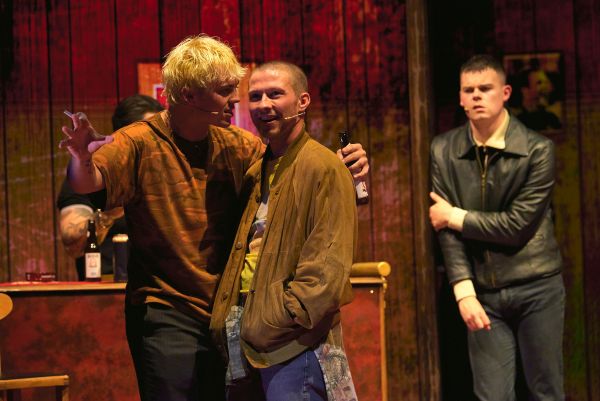
(L-R) Sheridan Townsley, Lewis Kidd and Kieran Andrew in Trainspotting: The Musical at the Theatre Royal Haymarket, London. Picture: Matt Crockett
Trainspotting: The Musical continues at the Theatre Royal Haymarket, London until 5 September 2026.
Star rating: two stars ★ ★ ✩ ✩ ✩
In the mid-1990s, the film adaptation of Irvine Welsh’s novel Trainspotting was everywhere. Barely a student room existed that didn’t have a copy of the poster on its wall, and some scenes filmed by director Danny Boyle became instant classics.
Perhaps the most famous of these was the film’s opening scene, a chase around the streets of Leith as Ewan McGregor’s Mark Renton intoned the famous “Choose Life” monologue over the strains of Iggy Pop’s ‘Lust for Life’.
That number also opens the stage musical adaptation, with Renton (Lewis Kidd, stepping in after Robbie Scott retired after sustaining an injury during rehearsals) joining the ensemble in a performance of the song, breaking off to introduce the musical’s key characters. It’s a loud, raucous, not always comprehensible start – and one which in so many ways reflects the show as a whole.
The musical, developed by director Caroline Jay Ranger, mixes songs familiar from the movie soundtrack with new songs written by Stephen McGuinness and Welsh. The result is a show that in some places feels like an imperfect jukebox musical, where the tone of the song fits, but the lyrics do not (the use of ‘Perfect Day’ being a perfect example). Elsewhere, the musical numbers fit more closely but never really attain any sort of memorability even seconds after they have finished.
The original novel used a nonlinear narrative to explore the world of Renton and his friends, as they are all affected to differing degrees by heroin addiction and other issues. John Hodge’s film screenplay re-wove some of the novel’s tales into a more comprehensible narrative. Welsh’s book for the musical follows the film’s lead, but there’s still a lot of jumping around between incidents in the play’s first act before the work founds its core: Renton’s capitulation to his addiction, and his disassociation from everything else around.
There are distractions along the way. A trip to Blackpool for a Northern Soul night provides an excuse for some great choreography by Christina Andrea, but little else. Other scenes feel included because they have become famous from the film, such as Kieran Andrew’s Spud trying to hide some heavily soiled bedsheets.
The closer the story is to the central plot about the drug addiction of Renton and his friends, though, the more affecting it is. Rosie Dignan is particularly impactful as young mother Alison, whose infant daughter dies while she is shooting up, even though some odd blocking and lighting decisions work against the actor. Sheridan Townsley’s Sick Boy, one of Renton’s best friends and the father of Alison’s baby, is curiously underserved by both book and songs, though.
It thus falls upon Kidd, a fantastically charismatic Renton, to shoulder the majority of the show’s good moments. In this, he’s joined by Andrew, whose physicality as Spud turns the character into a lovable mass of ungainly limbs, threatening to shoplift every scene he’s in.
Act II feels much more linear than the initial mess of Act I and is all the better for it. The anomaly here is a performance by the show’s three female leads (Dignan, Ashley J Russell and Yana Harris) of Republica’s ‘Drop Dead Gorgeous’, a song which doesn’t feel particularly associated with the film nor in keeping with the stage adaptation. If anything, it feels inserted for the sake of allowing the women in the cast the chance to perform without their male counterparts, rather than for plot purposes.
And that points to something that niggles throughout. Trainspotting doesn’t feel like it is a musical that has been constructed around a coherent vision at all. Tonally and thematically, it’s all over the place. There’s even a scene in which a character (Andrew’s Spud) expresses surprise that people are bursting into song, even though he himself did the same thing in the previous scene. That cliché can work when deployed carefully, but there is none of the meticulous thought it would need on display here.
It’s all just a bit too much of a mess to really work. Renton’s story comes to an end rather than a climax, as he absconds from his group of friends with a holdall full of the proceeds of a drug deal. Like that final act of theft, Trainspotting feels like an unsatisfying cash grab that leaves everyone feeling robbed.
Scott Matthewman
SHARE THIS POST:


Comments are closed.