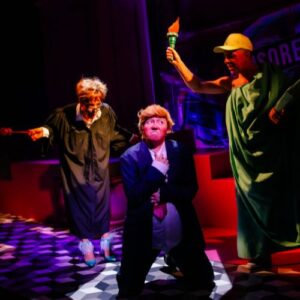
Picture: Danny Kaan
Trompe L’Oeil continues at The Other Palace Studio, London until 15 October 2023.Star rating: one star ★ ✩ ✩ ✩ ✩In art terms, trompe-l’oeil is an artistic illusion, giving solidity and three dimensions to a two-dimensional picture. Henry Parkman Biggs’ new musical Tromp L’Oeil (for which he has written the book, music and lyrics, with an additional music credit to Preston Jones) could take this as a cue to take a scenario which we think we know, and use art to give us a greater sense of depth than we imagined. Instead, it achieves the opposite: it takes a two dimensional scenario and reduces it to one.Biggs has been working on this musical for nearly eight years, and it is already showing its age. His attempts to create a political satire focus on Donald Trump’s transition from a flim-flam filled businessman and TV celebrity to becoming US president. A story which at the time threatened to turn the news into self-parody, and which has already been satirised in the intervening years, needs something new to bring to the table in order to answer the question, “Why now?” When Trump is once again gearing up to run for president – this time, while also facing 91 criminal indictments, on charges ranging from paying hush money to Stormy Daniels to election interference and the 6 January insurrection – any satire around the man’s political career needs to have more bite than revisiting events of eight years ago and inviting us to laugh at them.And there are occasionally flashes of something interesting. Vladimir Putin, with whom Emer Dineen’s Trump signs a Faustian pact to secure his presidency, is presented as a gymnastic cirque-style acrobat. But for every off-the-wall interpretation that could work come swathes of desperately unfunny attempts at humour. As payment, Putin demands Trump wears a remote-controlled vice around his genitals, meaning the Russian leader literally has his opposite number’s nuts in a vice. Redneck, MAGA-hat wearing Americans and floral-shirt wearing gay men clash. Trump’s daughter Ivanka is presented as a PVC dress-wearing sex doll.Alongside these attempts at satire is a mess of a romantic subplot, with Republican Rip (Alex Wadham) falling for Dominic Booth’s female-presenting Demi. Whether Demi is supposed to be a drag queen, trans, genderfluid or anything else is never explored in any depth, beyond a couple of lame jokes about Rip not knowing that Demi possesses a penis. If the borderline offensiveness was tempered by characterisation or an involving plot, it might be more palatable.
As with the entire piece, the talented cast work their hardest to elevate the material. Occasional flashes of something greater – often led by Sarah Louise Hughes in a variety of roles, or by Dineen’s impressive Trump caricature – give slivers of hope, only to be dashed away moments later. Biggs’s songs do not exactly help. Most are delivered in a half-spoken patter style, rarely illuminating the plot. Act II does contain a couple of improved numbers. Booth gets one of the show’s rare opportunities to actually sing rather than talk in time, with the fun Hey Diddle Aye, and shows that as a performer he deserves a better vehicle. Before that, the show’s biggest and best musical number is the satirical ‘Putin On the Ritz’ – and if you think that sounds like a play on Irving Berlin’s ‘Puttin’ On the Ritz’, you would be correct; this new musical’s strongest moment was written in 1927.The programme devotes six pages to explaining how clever the song lyrics are – whether it’s ‘Magical Me’, written in anapestic tetrameter to mimic the cadence of a Dr Seuss poem; ‘They’ll Never Get Me’, using no vowels other than E or Y; or ‘Pity Party’, in which some portions of the lyrics are tortuous anagrams. Worst of all is the explanation that the lyrics of ‘Château Lafitte’ include a picture of a penis if you capitalise some of the letters D, I, C and K within (but not all the occurrences of those letters, just the ones the writer wants you to notice).If such literary diversions contributed to onstage comedy, they would be excusable. Here, though, it feels as if so much effort has been made to the form of the lyrics that musicality and sheer audience enjoyments are, at best, afterthoughts. And while director/choreographer Blair Anderson gives his able cast some opportunities to show off their dance moves, there is no level at which the production can be played that can compensate for its compositional shortcomings.
Scott Matthewman
SHARE THIS POST:


Comments are closed.