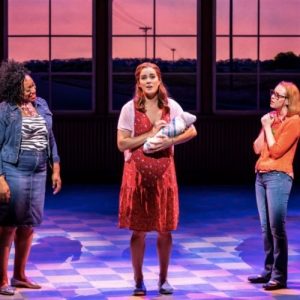
 Waitress continues at the Opera House, Manchester until 20 November 2021 and then tours until 20 August 2022.
Star rating: four stars ★ ★ ★ ★ ✩
Waitress’ West End run was cut short by Covid in March 2020, so this tour feels like an opportunity for UK audiences to enjoy a welcome extra slice of its home-baked charms.
But while the public have embraced Sara Bareilles and Jessie Nelson’s sweet and mildly empowering fable of love, infidelity and pastry in small-town America since it first appeared on Broadway in 2016, the critics haven’t always been universal with their praise.
That’s probably because Nelson’s book – based on Adrienne Shelly’s offbeat 2007 movie – treads an uncertain line between hard-nosed reality and warm-hearted hokum. There is a real, believable sadness and darkness at the heart of the story of unassuming baker Jenna’s misadventures, as she tries to keep her unplanned pregnancy secret from her abusive husband while embarking on a consequences-free fling with her doctor, that is slightly at odds with the homespun wisdom and sunny disposition elsewhere in the show.
It’s a recipe that won’t be to everyone’s tastes, but – as in other productions – if you buy into the premise and give in to the show’s good-natured tone, there is plenty to enjoy.
Chief among its pleasures are Bareilles’ songs. The sharp lyrics aren’t always discernible through the Opera House’s sound system and some of the cast struggle with the more unusual rhythms and higher notes, but, at their best, they are as intoxicating as Jenna’s pies.
The orchestrations – devised by Bareilles, guitarist Rich Hinman and the rest of the original production’s house band – and Nadia DiGiallonardo’s arrangements still give the show a quirkily distinctive sound. Having the six musicians – well marshalled by musical director Ellen Campbell – appearing onstage as patrons of Joe’s Diner or popping up individually to accompany the cast in stripped back, intimate solos, also adds to the idiosyncratic charm.
Scott Pask’s wide-screen staging is a little flat and lacking in depth in the diner-set scenes and Lorin Latarro’s choreography similarly suffers in terms of impact whenever the ensemble is involved. But in the smaller, more imaginatively staged moments, such as during Jenna’s internal quandaries and flights of fancy, Diane Paulus’ direction, Ken Billington’s lighting and the innovative, moving set designs really come into their own.
Of the cast, Lucie Jones and Evelyn Hoskins, both reprising roles they played in the West End as Jenna and her nervy, nerdy co-worker Dawn respectively, have no issues with the demands of the songs. The show’s two biggest showstoppers – the comedic, additively tuneful ‘When He Sees Me’ and the heart-breakingly plaintive ‘She Used to Be Mine’ – are delivered with all the gusto and panache that they deserve.
Jones, in particular, is a revelation as Jenna. A former X Factor finalist with plenty of musical theatre credits on her CV but not as much straight acting experience, she pulls off the tricky task of portraying a character used to going unnoticed – or, as Bareilles’ lyrics put it, never being “attention’s sweet centre” – with a quiet confidence and unshowy assuredness.
She’s helped by a warm, natural rapport with Matt Jay-Willis as the unsure-of-himself Dr Pomatter, and the former Busted star underplays the role to winning effect. The pair’s two big duets, ‘It Only Takes a Taste’ and ‘You Matter to Me’, are touchingly effective.
Elsewhere there are assured comic turns from Christopher D Hunt as the taciturn diner manager Cal and George Crawford as Dawn’s similarly nebbish suitor Ogie – the latter’s energy elevating ‘Never Getting Rid of Me’ into a wildly funny, epic set-piece – while Michael Starke brings an old school, gentlemanly warmth to Jenna’s fairy godfather Joe.
Chris Bartlett
SHARE THIS POST:


Comments are closed.