 Susan Elkin chats to JUSTIN COOKE, CEO of Digital Theatre. Digital Theatre offers access to films of live theatre, ballet, opera and classical concerts to individual subscribers and educational institutions.
“Well of course what we do is different from live theatre but we believe we’re creating a new complementary art form,” says Justin Cooke. “We’d never try to compete with live theatre. We can’t create the buzz, for a start. Rather, we’re providing a new way of watching performed arts.”
Big Clever Learning, Cooke’s company, acquired Digital Theatre two years ago. At that point, as Digital Theatre Plus, it had been going for seven years, mainly as a means of getting filmed live theatre into schools and colleges.
“We inherited a fantastic education platform which was reaching three million students” says Cooke “Although at the very beginning DT was aimed mostly at individual consumers.”
He continues: “With 400 plays and productions on the list, supported by 400 study guides, it was – and is – a must-have resource for secondary schools, colleges and universities.”
Then last summer the company relaunched the consumer side of the business so that anyone, for £9.99 per month, can have unlimited access to a large “library” of plays, shows, operas, ballets and concerts. “And it has gained a lot of interest in just a few months,” says Cooke.
So how does it work? Digital Theatre has partnerships with a growing number of theatres and companies including the Almeida, Young Vic, Tricycle Theatre, Shakespeare’s Globe and the London Symphony Orchestra, among many others.
“We take cameras, often as many as eight, in and record three performances. Then we can edit so t
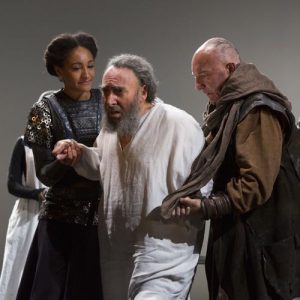
The RSC production of King Lear starring Antony Sher is available to watch via Digital Theatre
hat the end product presents the very best possible performance in high definition with surround sound. Robert Delamere, co-founder of DT, works closely with the director on all this,” explains Cooke.
Subscribers can then access these performances on tablets, phones, computers, TV screens and so on. All you need is an internet connection. “So you can watch something you missed at, say Stratford, wherever you happen to be – perhaps Nepal or Manchester in a hotel room or on a train – and, if you wish you can take it in short bites over several days as you would a book,” enthuses Cooke.
How, I ask him, does it differ from live streaming? “To enjoy a live streamed show you have to be in a cinema on a certain day to catch it,” Cooke says. “The point about DT is that you have total autonomy over what you watch, when and where.”
And he adds: “You’re seeing one specific that-night performance with live streaming too. DT versions are edited so, although you won’t be aware of it, you are seeing a composite of more than one performance. The best of the best, effectively.”
Cooke and I don’t get round to discussing cost but DT is also a cheaper option than seeing a live streamed show. You will probably pay more for the latter for a single performance than you will for a month’s unlimited access with DT.
So DT is certainly making more shows accessible to more people. It is, also, by recording them, preserving fine performances for posterity. “Just think how many shows have been staged and lost in the past,” says Cooke. “We are ensuring that good productions can go on being seen, enjoyed and compared.”
When I was quality testing DT to see if is as good as Cooke claims I watched and compared part of two Lears – one with Antony Sher for RSC (directed by Gregory Doran) and the other with Jonathan Pryce for Almeida Theatre (directed by Michael Attenborough) – neither of which I saw live in the theatre.
It’s fascinating to watch two such fine performances in tandem. The camera work is nifty so that you are seeing close up exactly what your eye would be drawn to in the theatre.
I would certainly have found this an invaluable classroom resource when I was teaching.
The quality of filming is high although sometimes the sound doesn’t seem to be quite synched but that may be something to do with bandwidth and my equipment.
Nonetheless I am thinking of taking out a personal subscription in order to catch the things I miss live – I see a great deal of theatre but I can’t be everywhere at once.
Cooke himself has long roots in drama and theatre. “I did GCSE and A level before doing a drama degree at Manchester University,” he says. “Then I went into technology and advertising and there were several businesses.”
He always wanted, somehow, to come back to theatre. “When I was offered this in 2015 it was a chance to return to my first love, Technology and theatre linked together was the perfect fit for me!”
He isn’t a man to let the grass grow under his feet either and there are further developments afoot. “We have partnerships with a whole raft of organisations worldwide and there will be 50 more productions available in the next month,” he says, adding that in April there will be “a significant partnership with a major broadcaster which will make even more plays available.”
SHARE THIS POST:



Comments are closed.