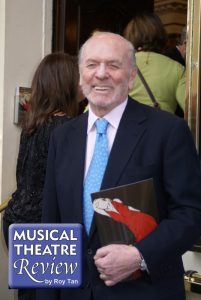
 The name of the journalist and lyricist Herbert Kretzmer, who has died at the age of 95, may not mean much to most people until they realise that it was he who provided the English-language lyrics for the musical of Les Misérables in 1985 which has become the longest-running London stage musical and one that is still with us after 35 years. Michael Darvell looks back at one man’s astonishing career…
The success of Les Misérables in London came about almost by chance. Originally written by French writers Alain Boublil and Jean-Marc Natel (French lyrics) and Claude-Michel Schönberg (music) it had a two-hour production in a three-month run at the Palais des Sports in Paris in 1980. The show was released as a concept album in French and director Peter Farago sent impresario Cameron Mackintosh a copy of the album, hoping he would stage the show in Britain.
The Royal Shakespeare Company was interested in staging the show in London and initially fielded the poet James Fenton to write the libretto. Cameron Mackintosh found Fenton’s lyrics not strong enough for the show and replaced him with Herbert Kretzmer. So, by default, Kretzmer got to write the lyrics for one of the most successful musicals of all time. It took two years to re-create the piece in an English language version which Kretzmer had expanded to three hours and which the RSC then staged at the Barbican Centre in the City of London in 1985.
It opened to almost complete indifference on the part of the London theatre critics, one of whom dubbed it ‘The Glums’. However, it didn’t put off either Cameron Mackintosh or the Barbican audience and he decided to transfer the show to the West End where it proceeded to put down its roots at the Palace Theatre for several decades. Only in recent years has it moved down Shaftesbury Avenue to the Queen’s Theatre, now renamed the Sondheim Theatre. Closed during the Covid-19 pandemic, Les Mis is due to have a Christmas and New Year season in its concert format from 5 December 2020 to 31 January 2021.
When I interviewed Cameron Mackintosh at the time of the West End transfer I had to admit I couldn’t see why it had become so popular with the theatre-going audience who were obviously not fazed by its critical mauling. It wasn’t a standard musical comedy but conversely even some of its grandiose music would never place it in the opera bracket, so what has kept the show running for so long? Through word-of-mouth it was initially successful in London, then on Broadway where it also had two revival productions. It has played Canada, Austria, Germany, Spain, Argentina, Japan, Hungary, Iceland, Australia and, in fact, in 42 countries around the world in either new stagings or in visiting touring productions. And, of course, it has become an equally successful film.
The answer for its success is manifold. The original 1862 novel by Victor Hugo has elements of a thriller with its tale of Jean Valjean, a petty thief, being pursued by the authorities against a background of political and social unrest, looking at the lives of the poorest wretches in a poverty-stricken class. Then there’s the elaborate staging which at times reaches epic proportions with a touching music score that pulls its audience along with it as the plot unfolds, and finally the lyrics that have gone to the heart of its audience and touched them in a truly emotional way, thanks indeed to the work of Kretzmer.
Much has been written about the contributions of the French composer Alain Boublil and his lyricist Claude-Michel Schönberg, but in fact the English language lyrics by Kretzmer are really part and parcel of the show’s popularity and enormous success. Just think of the power behind the lyrics of Jean Valjean’s solos ‘What Have I Done?’ and ‘Who Am I?’, Fantine’s memories in ‘I Dreamed a Dream’, the Ensemble chorusing ‘Do You Hear the People Sing?’ and ‘One Day More’, Cosette, Valjean, Marius and Eponine singing ‘In My Life’, Marius and his ‘Empty Chairs at Empty Tables’ solo and, perhaps most moving of all, Valjean telling the crowd to ‘Bring Him Home’. Although the music carries the plot on, it is, however, the words of Kretzmer that the actors sing to which the audience really responds.
Herbert Kretzmer was born in South Africa in 1925. His career as a journalist started in 1946 with him writing scripts for a weekly cinema newsreel. From 1951 he worked for the Sunday Express in Johannesburg, as a reporter and entertainment columnist. He came to London in 1954 to work as a feature writer and columnist on the Daily Sketch and subsequently the Sunday Dispatch. He joined the Daily Express in 1962 as a feature writer, interviewer and theatre critic. Then in 1979 he became the television critic of the Daily Mail until 1987.
He always reckoned that he was basically a journalist, but during his time with the British press he also wrote song lyrics mainly with music by Dave Lee and they often contributed to the BBC’s controversial topical Saturday night satirical programmes That Was The Week That Was, Not So Much a Programme… More a Way of Life and BBC-3. He and Lee also wrote a song for Peter Sellers and Sophia Loren, ‘Goodness Gracious Me’, to promote their film of Shaw’s The Millionairess, but it was cut from the final print. It did, however, win an Ivor Novello Award. With Lee he also wrote another comedy number, ‘Kinky Boots’, for Honor Blackman and Patrick Macnee, the stars of the TV series The Avengers.
With music by Lee, Kretzmer wrote the book and lyrics for Our Man Crichton, a musical based on the James Barrie play The Admirable Crichton which had a season at the Shaftesbury Theatre with Kenneth More and Millicent Martin. Then came The Four Musketeers, written with composer Laurie Johnson for Harry Secombe at the Theatre Royal Drury Lane. With music by Anthony Newley, Kretzmer wrote lyrics for the film Can Heironymus Merkin Ever Forget Mercy Humppe and Find True Happiness? And he penned some very successful songs for Charles Aznavour, namely ‘Yesterday When I Was Young’ and ‘She’. He also contributed to the screenplay of Every Home Should Have One, a satire on advertising with Marty Feldman.
When Les Misérables came along in 1985 it towered over and above anything Kretzmer had written until then. And nothing that followed it has ever had such an impact on the theatre itself. More recently he provided lyrics for Michel Legrand’s musical Marguerite, an updating of La Dame aux Camélias, and Kristina, written with Björn Ulvaeus and Benny Andersson of ABBA fame. Finally there was a new song, ‘Suddenly’, written for the film of Les Misḗrables in 2012, which was nominated for an Oscar.
In his time Kretzmer won countless awards for his songwriting, including a Gold Record for ‘She’, a Grammy Award for Les Misérables and many other music industry awards, an Honorary Doctorate from Rhodes University in South Africa, nominations from BAFTA, the Golden Globes and the Academy Awards, plus he was made Chevalier de l’Ordre des Arts et des Lettres in France and the Order of the British Empire for his services to music. Not bad for one who considered himself to be just a journo!
In 1961 Herbert Kretzmer married Elizabeth Margaret Wilson with whom he had a son Matthew and a daughter Danielle. They divorced in 1973. In 1988 he married Sybil Sever. He was born on 5 October 1925 and died on 14 October 2020, nine days after his 95th birthday. R.I.P.
SHARE THIS POST:


Comments are closed.